
How to Specify Water Fill and Level Alarms for a Lab PEM Hydrogen Generator
State how the offered proton exchange membrane (PEM) hydrogen generator will be filled, where its water requirement applies and which water level indications the lab must see.
Table of Contents
State how the offered proton exchange membrane (PEM) hydrogen generator will be filled, where its water requirement applies and which water level indications the lab must see. Then put those conditions into the acceptance plan for the model and options actually supplied. This makes it possible to distinguish a generator function from a utility or monitoring item the lab needs to provide.
Define the water supply boundary on the order
Ask for the water specification and verification point for the quoted model and revision. Identify the water source and any treatment, reservoir or delivery equipment outside the generator. If the buyer provides the water, agree who verifies it at the point the generator receives it and who retains the record.
State whether the order calls for manual filling or an external replenishment arrangement. Ask the bidder to list the hardware, connections and monitoring included in the proposed configuration. Parker's 20H, 40H and 60H guide, for example, documents manual filling, an optional automatic fill arrangement and separate monitoring functions through an accessory. Confirm the offered equipment against its own manual and option list. Parker 20H/40H/60H user guide, §§2.6.4 and 3.2–3.3
Agree what the laboratory must be able to observe
Ask for the list of water-related indications for the fitted model. Identify which are visible on the unit, which can be sent to an external monitoring system and whether event history is available. Ask for the alert meaning and the documented operator response. A local display may satisfy an attended lab while an unattended facility may need a separate alarm handoff in its acceptance plan.
Record who will receive and act on each required indication. If an alarm must reach a building or lab monitoring system, name the party who owns the receiving interface and the end-to-end witness check. Clarify who provides authorized service and how a report is raised if a water-related indication recurs.
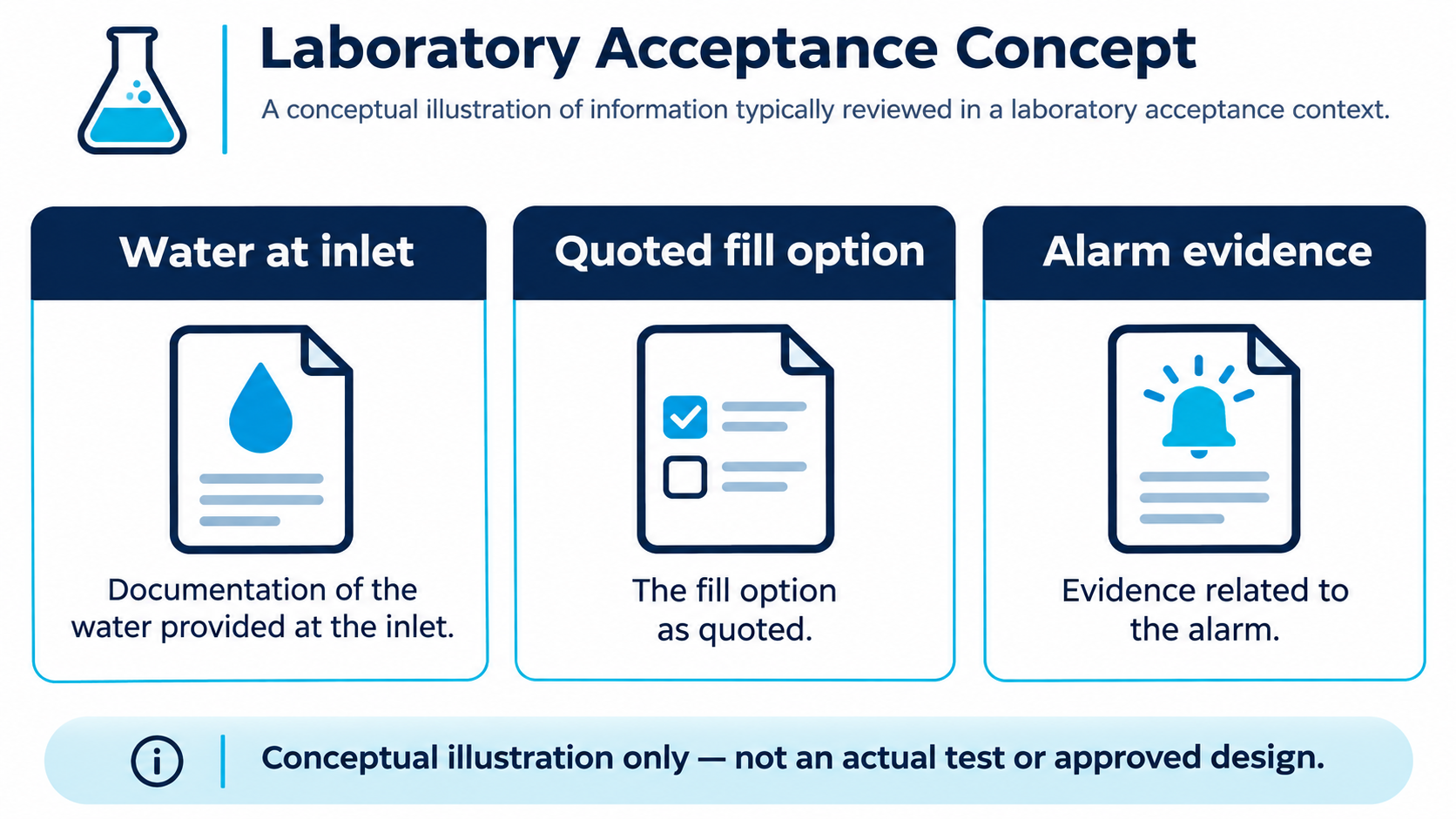
Laboratory acceptance cards distinguish water at the inlet, the quoted fill option and alarm evidence. Conceptual illustration only. Shapes and document icons do not represent actual equipment, measured results or an approved design.
Write acceptance around the installed configuration
The handover record should identify the unit and options, the verified water requirement and supplied connection, and the results of the agreed fill and indication checks. Have the manufacturer or authorized commissioning team define how to demonstrate any alarm safely. Record which checks were simulated under the approved procedure and which were witnessed at the site.
For a quotation, give the lab's available water source, expected fill arrangement, monitoring expectations and planned verification responsibilities. Ask for a model-specific response that lists included options and remaining site work. HELE laboratory hydrogen generator enquiries
Frequently asked questions
Does a water certificate at the treatment unit cover the generator inlet?
Agree where acceptance applies. If storage or distribution separates those points, ask whether the commissioning team needs evidence at the generator inlet.
How should we name an automatic fill option in the order?
Use the offered option identifier and state which external supply or reservoir it requires. Ask the supplier to mark each connection and accessory as included or provided separately.
Does a low-level indication identify a failed part?
It identifies the reported condition according to the fitted model's documentation. Use the approved service process to determine the cause and confirm any replacement part.
What if the generator has no event history?
Agree how the lab will retain the required indication and time record. This may be a witnessed test record or a site monitoring record within the specified scope.
Should a factory check cover the lab's remote display?
Check which portion of the interface can be demonstrated at the factory. Agree on a site check for any receiving equipment or functions that are absent from the factory setup.
Which instructions should the lab keep?
Keep the manual and option documentation that applies to the model, serial number or revision as appropriate. Include the service route and the signed record of the agreed checks.
Prepare a technical enquiry
Share the hydrogen or test duty, operating conditions, interfaces and the equipment scope you need reviewed.
Ask a technical question →References

Project contact