
Replacing a PEM Hydrogen Generator: Repair, Module or Complete System?
Compare repair, a replacement module and a new PEM hydrogen generator before committing to a purchase.
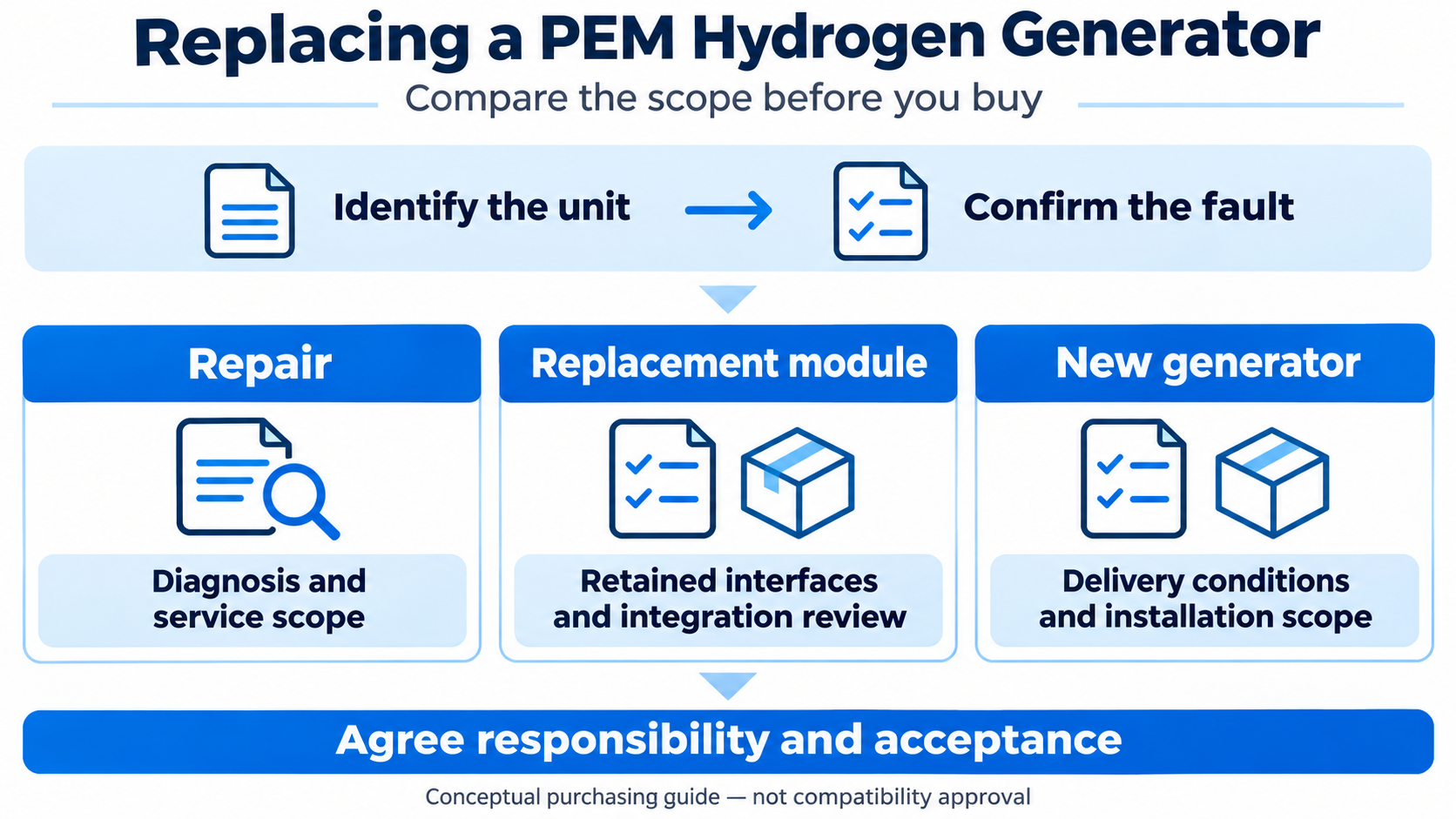
Read the illustration as text
Identify the unit; confirm the fault; compare repair diagnosis and service scope, replacement-module interfaces and integration review, or new-generator delivery and installation scope; agree responsibility and acceptance.
Table of Contents
Before buying a replacement for a proton exchange membrane (PEM) hydrogen generator, identify the installed unit, establish what has failed and ask who will accept responsibility for returning it to service. A matching hydrogen flow rate is not a compatibility decision. Compare an OEM repair, a replacement module and a new generator only after each proposal explains what will be retained, changed and verified.
For a laboratory or industrial maintenance buyer, the first purchase may need to be a documented assessment rather than a component. This guide helps prepare that enquiry; it does not identify a drop-in replacement for any manufacturer's equipment.
What evidence identifies the equipment and the fault?
Start with the generator's nameplate, serial number, model suffix and available service history. Add the part number of the suspected failed assembly if it is already recorded in approved service documents. Keep the generator identity separate from labels on its power supply or other components: the supplier needs to know which assembled product is being assessed.
A public equipment-replacement discussion illustrates the information gap. An owner seeking an alternative PEM module provided a generator model, a reported gas flow and power-supply details. The discussion does not establish a verified compatible replacement or a successful repair. Those details are useful starting points for a service enquiry, not a specification for ordering an alternative.
Describe the symptom separately from the proposed diagnosis. Record the displayed fault, when it appeared, relevant maintenance and any assessment already performed by a qualified service provider. If the only conclusion is “the cell must be bad,” ask what evidence supports it before requesting that cell. A component quote cannot resolve uncertainty about which assembly needs attention.
Check the current support route for the exact product family. For example, Nel's official support page provides a separate information link for discontinued Proton Onsite laboratory products. This confirms a place to start checking support; it does not establish stock, a repair price or eligibility for a particular unit.
What would each proposal actually replace?
Ask each bidder to identify the assembly offered, its part or configuration reference and the equipment left in service. “Cell,” “module” and “stack” are insufficient purchasing descriptions when their included parts have not been listed. A quotation should show whether the proposed work restores an identified original configuration or creates a modified assembly requiring further assessment.
| Proposal | Clarification to request | Decision it enables |
|---|---|---|
| OEM or established service repair | Diagnosis, work included, parts replaced, test record and service terms | Whether the documented repair addresses the fault and the intended return to service |
| Alternative module or stack | Exact offered assembly, retained equipment, required changes and named integration reviewer | Whether there is a supported route to evaluate the proposed substitution |
| Complete replacement generator | Delivered gas requirement, site connections, installation scope and acceptance responsibilities | Whether replacing the generator offers a workable alternative to repairing the existing asset |
Do not rank these options using the hardware price alone. Ask for separately identified assessment, adaptation, installation and verification costs, plus exclusions. Request an achievable schedule and the assumptions behind it. An inexpensive module with unresolved engineering work is not yet a comparable repair offer.
Retain the service option while investigating an alternative. If the original configuration can be restored with documented support, that evidence may favour repair. If the necessary records or support cannot be obtained, ask for a complete-generator proposal as a separate option; missing information alone does not prove that the old equipment is beyond repair.
Which retained interfaces need a change assessment?
Use the available OEM documents and the proposed assembly's documentation to prepare a retained-versus-changed interface list. Ask the responsible engineering team to assess electrical connections and control behaviour, water and cooling arrangements, gas connections, physical installation and any affected protective functions. Mark unavailable documents as unresolved rather than assuming the old arrangement is suitable.
A power-supply label belongs in the identification pack, but it does not document the generator's complete operating requirements or the proposed module's compatibility. Ask for a written compatibility assessment tied to the particular equipment revision. Do not use a photograph, connector resemblance or nominal power as approval to connect an alternative assembly.
Define the required hydrogen at the receiving application. Record flow, pressure, gas-quality requirements and where those conditions must be achieved. Then ask whether retained drying or other gas-handling equipment is included in the assessment. HELE's PEM project enquiry information similarly separates project requirements and supply scope; it does not establish compatibility with an existing third-party generator.
For every proposed change, identify who will review its effect on the rest of the equipment. Where controls or protective functions are affected, obtain an assessment from the party responsible for the modified system before deciding to proceed. This procurement review is not an instruction to alter settings or bypass a shutdown.
What must be agreed before placing the order?
Ask for a return-to-service plan with named responsibilities. It should identify the proposed configuration, the installation work, the documents supplied and the acceptance evidence required by the owner. Have the responsible technical parties define the relevant checks and acceptance conditions for this unit and application; a generic supplier test sheet may describe a different assembly.
Clarify how a failed acceptance check will be handled: who investigates, which work is included and which further work needs a new quotation. Obtain written terms for the repaired or replacement assembly and ask how retained equipment is treated. Do not infer coverage for the whole generator from a component warranty.
For an initial HELE PEM enquiry, prepare the equipment identification, fault assessment, available interface documents and required hydrogen delivery conditions. State whether you are asking about a new system or requesting evaluation of a component scope. HELE suitability and any third-party equipment compatibility require specific confirmation; sending an enquiry does not establish either.
Frequently asked questions
What if the original manual is missing?
Ask the original manufacturer or current support contact for documents matched to the serial number and revision. Record what remains unavailable. A manual for a visually similar model should not silently become the basis for approving a substitution.
Can I use the generator's old brochure as the acceptance specification?
Use it to identify advertised characteristics, then ask which requirements apply to your delivered configuration and present application. Attach the agreed requirements to the enquiry. A brochure may not describe later modifications, accessories or the owner's current gas-quality needs.
Should I send confidential drawings with the first enquiry?
Start with information you are authorised to disclose and a list of the documents available. Agree a suitable confidential exchange before sending restricted drawings or customer information. Removing a customer name alone may not remove all sensitive information from a drawing.
Can a spare from another machine be treated as interchangeable?
Ask for confirmation against both machines' part references and revisions, including any relevant differences in installation or controls. A shared product-family name is a search clue. It is not an interchangeability statement from the responsible supplier or reviewer.
How should procurement compare a repair quote with a new-generator quote?
Ask both suppliers to state what is delivered at the agreed handover point, what work the owner must arrange and how acceptance will be recorded. Keep unresolved costs visible. A headline repair price and a delivered-equipment price can describe substantially different obligations.
What if no supplier will take responsibility for the proposed modification?
Keep the alternative-module option unresolved. Request a supported service assessment or a separately defined replacement-generator proposal. Buying the component first does not appoint an integration reviewer or settle responsibility for the altered equipment.
Prepare a PEM replacement enquiry
Share the equipment model and serial number, the fault record, interfaces you plan to retain and the hydrogen delivery conditions. Tell us whether you need a replacement module assessed or want to compare complete systems.
Request a PEM replacement review →References

Written by
Bobby Fu
Bobby works with industrial buyers and production teams to turn equipment requirements into a defined supply scope, with clear interfaces, inspection records and handover responsibilities.