How to Specify a Hydrogen Generator for Several Gas Chromatographs
Build a demand schedule from the exact instruments, their hydrogen uses and the operating modes that can overlap.
Table of Contents
Build a demand schedule from the exact instruments, their hydrogen uses and the operating modes that can overlap. Ask vendors to demonstrate how their proposed hydrogen generator and supply scope will meet that combined demand at the points of use. The number of gas chromatographs (GCs) is the start of the inventory. Each instrument's configuration and operating schedule determine what goes into the specification.
Identify each instrument and its hydrogen use
Record the instrument model, inlet and detector configuration, and the method that uses hydrogen. In some applications hydrogen is the carrier gas moving the sample through the column. It can also serve as fuel for a flame ionization detector (FID). Confirm each use in the applicable instrument documentation and method. An instrument using hydrogen for its detector may have a different carrier gas.
Agilent's site preparation guide, for example, distinguishes carrier gas applications from detector supply and gives model-specific instrument requirements. The guide also notes that hydrogen carrier gas is unsuitable for some systems. Use the documentation applicable to each installed instrument and obtain the lab's approval before assuming a change in gas or method. Agilent GC site preparation guide
Write down the operating scenarios that can overlap
Give each hydrogen use its own row in a schedule with the required flow basis, instrument connection, inlet pressure and gas quality. Include the instrument's normal method or cycle, plus startup, purge or other demand conditions the lab confirms are relevant. Record both the duration of each condition and which uses can occur at the same time. Two benches that usually run separately may overlap during a restart or a busy shift.
Make the calculation basis explicit before adding flows. Keep the stated units and reference conditions with each value and resolve incompatible bases with the vendors. An unspecified volume cannot be added as a flow. An instrument count or a single daily average can also hide a short period of higher demand. Put the simultaneous schedule in the request for quotation so bidders explain what the offered configuration can sustain and where their assumptions differ.
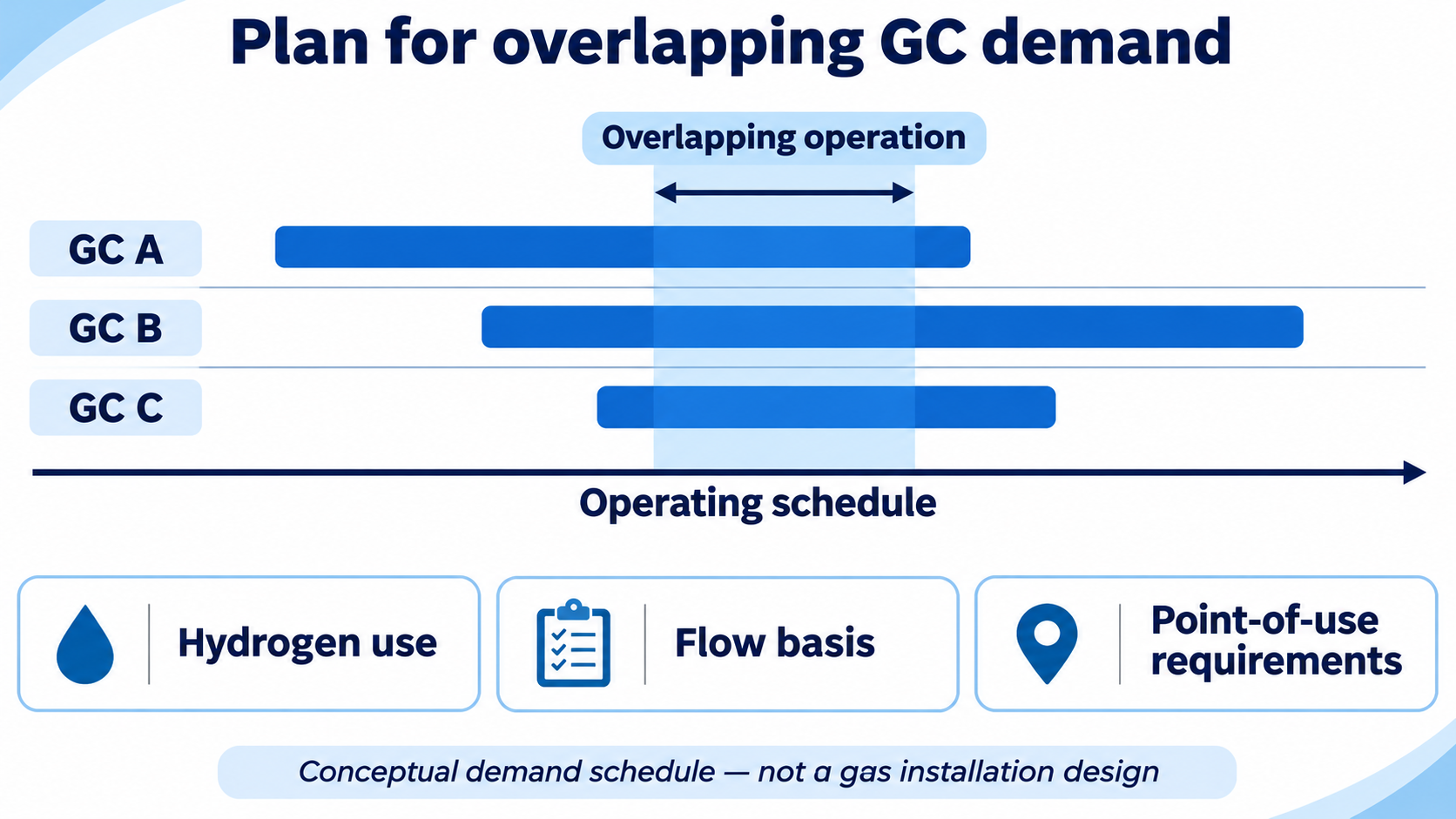
Conceptual schedule for three gas chromatographs highlights overlapping operation and demand-planning inputs. Illustrative operating windows show a shared period of operation. Bar lengths are not gas-flow values, and this is not an installation design.
Ask for evidence at the points of use
Separate the supplier's generator outlet specification from the lab's requirements at the instrument connections. Ask who owns the intervening distribution and any gas conditioning, and how the complete arrangement will be verified at the agreed combined load. Where gas-quality requirements include specific constituents, record those limits and the verification point as part of acceptance. Ask the instrument manufacturer or integrator to review any unresolved requirement.
Make downtime a purchase criterion if losing one supply interrupts multiple instruments. Define how long each activity can pause, which instruments have priority and who owns the facility's approved outage response. Ask for service scope and any inputs needed to return the equipment to use. Route the facility and instrument safety review to the responsible teams before selecting a supply arrangement.
For a quotation, send the instrument schedule, concurrent operating cases and point-of-use requirements. Ask the supplier to identify the offered generator configuration and the project conditions it has reviewed. HELE hydrogen generator enquiries
Frequently asked questions
Should a GC with two hydrogen uses have one line or two in the demand schedule?
Track each use separately, then show when both run. That makes it easier to trace a method or detector change to the part of the demand it affects.
Can we use column flow as the complete carrier demand?
Check the configured inlet and method with the instrument team. Ask for the full supply demand for that mode, including any relevant flows that do not go through the column.
What if two vendor flow ratings use different reference conditions?
Request a common reporting basis before comparing them. Have vendors state the reference conditions, delivery pressure and whether the figure represents a continuous or another specified operating condition.
What if one instrument requires a tighter gas-quality limit?
Record the requirement for that instrument and ask the responsible supplier or integrator to show how it is met at that use point. Keep any additional conditioning and its acceptance test visible in the scope.
Should a spare instrument be counted in normal demand?
Show the likely use separately from an operating case in which the spare is running. If it replaces an active unit, record that assumption. If the lab expects both to run, include the overlap case.
Can a proposal rely on the lab never starting two instruments together?
Treat the assumption as an operating constraint. Ask the lab to confirm that it is practical, record who owns it and request an alternative proposal if future operating schedules may require overlap.
Prepare a technical enquiry
Share the hydrogen or test duty, operating conditions, interfaces and the equipment scope you need reviewed.
Ask a technical question →References

About the publisher
HELE Titanium
HELE Titanium supports industrial buyers with titanium materials, electrochemical anodes and PEM system project review.