
What to Verify at a Cased Crossing Before Ordering Replacement ICCP Anodes
Check the carrier pipe and casing isolation records before ordering replacement ICCP anodes for a cased crossing.
Table of Contents
Before requesting replacement impressed current cathodic protection (ICCP) anodes, have the corrosion engineer confirm what the current isolation record says about the carrier pipe and its casing. If the record cannot identify both assets or the engineer cannot rely on it for the proposed work, commission a verification scope before releasing the replacement specification.
Can the reviewer identify both assets?
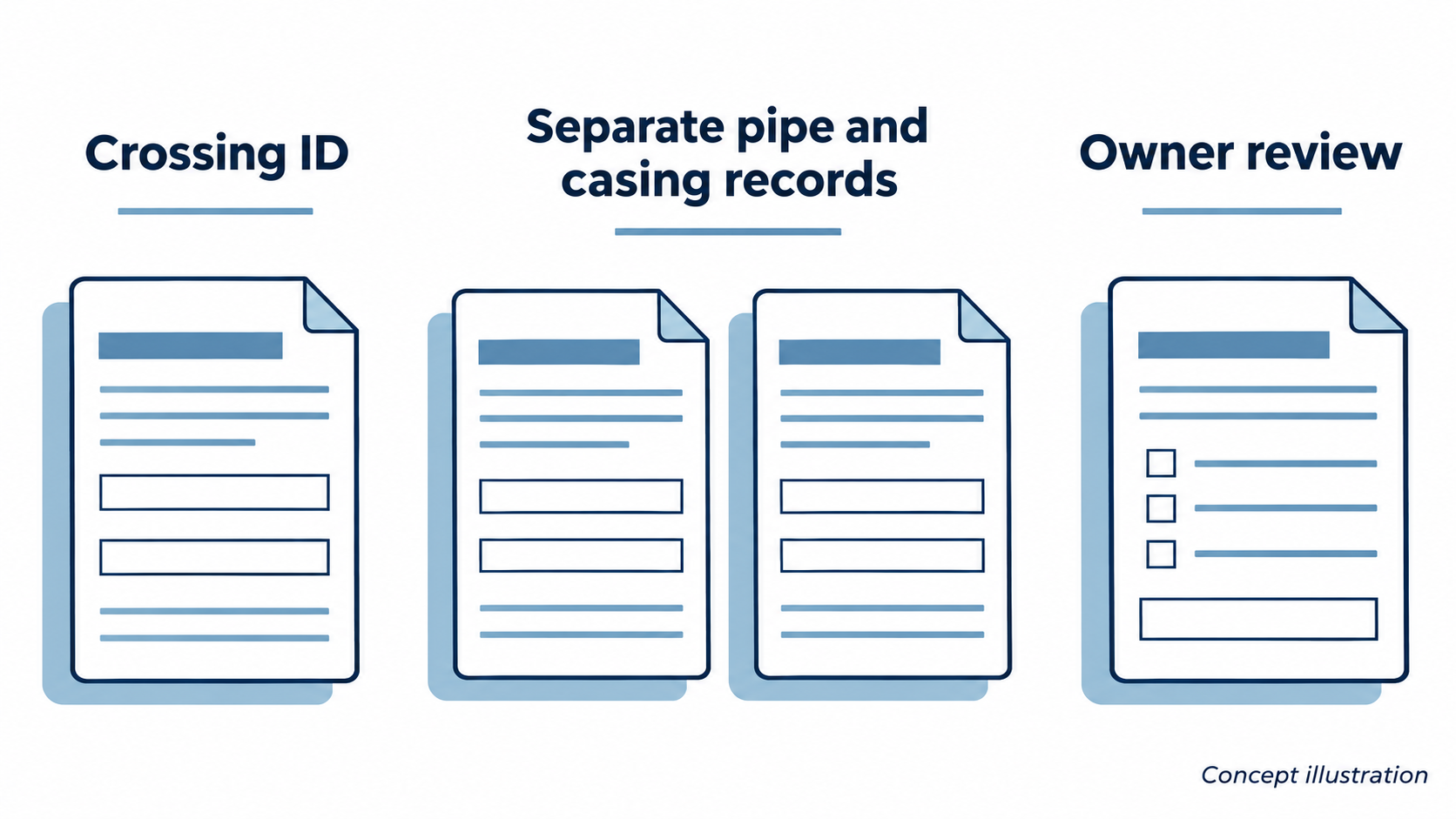
Use the crossing ID and current as-built drawing to tie the inspection record to the casing and the pipe it surrounds. Maintain separate identifiers for the two assets in the record and in any associated test-station schedules. Seattle Public Utilities illustrates this distinction in its pipe-and-casing test-station design guidance. The project's approved drawings govern identification at the actual crossing. Seattle Public Utilities design guidance, DG10
What keeps a replacement specification on hold?
| Review item | Evidence to look for | Decision if the evidence is missing |
|---|---|---|
| Crossing identity | Asset ID, drawing revision and dated record | Ask the asset owner to reconcile the record with the crossing |
| Pipe and casing references | Distinct asset and lead identifiers tied to the approved record | Have the corrosion engineer specify which identities need verification |
| Stage and changes | Date, stage of work and modifications since the recorded check | Ask the engineer whether that evidence applies to the current configuration |
| Engineering disposition | Accepted record, unresolved findings and the approved anode scope | Keep the replacement specification on hold until the authorized reviewer resolves the gap |
Consider a file containing a signed construction record and a later sheet labelled only “crossing.” The signed record establishes what was recorded during installation. The later sheet needs enough identification and context to show what it covers. Ask the owner to reconcile the records and the corrosion engineer to say whether a new verification is required. Purchasing can assemble drawings and stock records while that decision is open.
What belongs in the anode enquiry after clearance?
Send the engineer's approved replacement scope, the anode schedule and the applicable drawing revision. Identify any dimensions or supply interfaces that still need a vendor response. Keep the assurance of the crossing condition with the asset owner and corrosion engineer. For the remaining RFQ inputs, use the buried water main anode replacement guide.
Frequently asked questions
Which two assets need distinct identifiers?
Identify the carrier pipe and its casing separately, then tie the records to the same crossing ID.
What if two lead entries use the same label?
Ask the owner to reconcile the entries against the approved drawings and field record before using them to support scope approval.
Can a pre-backfill inspection establish the present condition?
Ask the engineer whether later works, changes or missing records affect how it can be used.
Is a station photo enough to identify the casing?
Use it alongside a traceable drawing or verified asset record. A photo alone may leave the association unresolved.
Who decides whether another check is needed?
The asset owner assigns a qualified corrosion reviewer to determine the verification and approval required.
Can I ask for a budget estimate before clearance?
If the owner permits it, label the estimate and its assumptions as preliminary. Record the verification required before releasing an order.
Request a replacement anode scope review
Send HELE TITANIUM the crossing drawing reference, the reviewed record or open verification item, and the approved supply scope when available. Review pipeline ICCP anode supply · Send the enquiry
Prepare a technical enquiry
Share the process or protected asset, operating conditions, geometry or drawing, and the scope you need reviewed.
Ask a technical question →References

Project contact