
What to Verify Before Requesting Replacement ICCP Anodes for a Buried Water Main
Before requesting replacement anodes for a buried water main, obtain a qualified cathodic protection professional's assessment of the affected circuit and an approved replacement scope.
Table of Contents
Before requesting replacement anodes for a buried water main, obtain a qualified cathodic protection professional's assessment of the affected circuit and an approved replacement scope. An unexpected reading from an impressed current cathodic protection (ICCP) system should trigger a review. The purchase decision depends on what the team has verified, which remedy it recommends and which equipment the asset owner has authorized for replacement.
Establish what the abnormal reading represents
Ask for the inspection sheet and the asset drawing or map that identifies the affected pipeline segment, protection zone, test station and associated rectifier or circuit. Record whether the reported value is a pipe-to-electrolyte potential or a rectifier output reading. Keep their identities separate when assembling the assessment record.
For a potential reading, request the measurement date and location, the signed value and units, the reference electrode type and the measurement condition. Ask the reviewer to identify the criterion applied to that pipeline and whether the reading can be compared with earlier results. If the method, reference or circuit condition differs, keep that comparison open until the reviewer explains the difference. Preserve the original records instead of copying a single value into the purchasing request.
The U.S. Bureau of Reclamation's FIST 4-5 manual covers inspection records, reference electrodes and professional review in the context of its corrosion protection program. Use the manual as an example of evidence organization and let the asset owner identify the criteria and procedures for the project. USBR FIST 4-5, §§5.4.1 and 5.4.5.2
Request a finding that separates the measurement, the circuit and the groundbed
Ask the responsible professional to show which parts of the ICCP system were assessed. The report should identify the condition and records of relevant test stations and junction boxes, wiring and connections, rectifier output and protection readings. Ask how those findings compare with the prior survey or commissioning baseline and which areas remain unverified. One circuit may cover multiple locations, so record which zone and component the recommendation actually concerns.
Separate what was observed from the finding that supports the proposed work. For example, a reviewer may recommend checking an uncertain reading, repairing a connection, assessing a change in site conditions or replacing an anode assembly. Each recommendation leads to a different request. Where the evidence supports only further investigation, send the service inquiry with its open questions. Where the assessment recommends anode replacement, request the specific basis for that recommendation and an approval reference before releasing an equipment RFQ.
USBR's ICCP maintenance section groups test station and junction box checks, rectifier checks, protection readings and review of current and earlier records. Its structure provides a useful model for asking whether the assessment covers the affected circuit. USBR FIST 4-5, §5.4.7
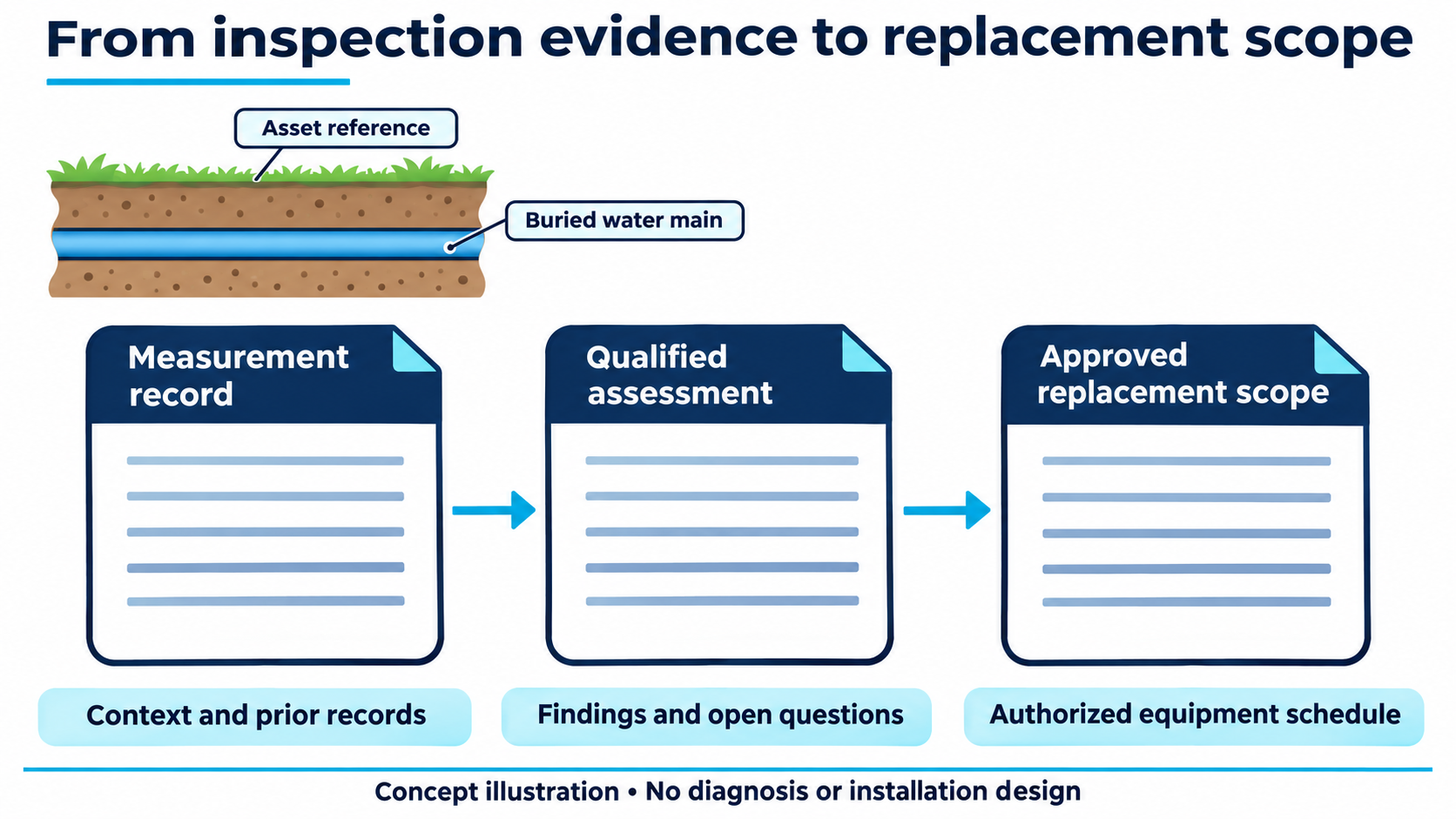
A generic buried water main accompanies measurement records, a qualified assessment and an approved replacement scope. Conceptual evidence sequence for replacement review. It depicts no actual asset, fault diagnosis, electrical circuit or installation design.
Turn the approved remedy into a quote that can be compared
Use the design authority's approved equipment schedule. Attach the drawing revision, groundbed location and arrangement, any relevant installation media and backfill requirements, anode assembly to be quoted and the specified design duty. Identify which cable lengths, junction or termination details, seals, identification and supporting records belong in the supply. State any interfaces the installation contractor handles separately.
Keep the acceptance responsibilities with the quote. Define the records the component supplier provides, which installed details the contractor records and who signs the follow-up protection survey or other agreed system check. That division matters in rehabilitation work. WSSC Water's early vendor engagement notice, for example, described prospective work across several corrosion-control functions on existing metallic water and sewer mains. It discussed system work, testing and troubleshooting as part of a broader service scope. WSSC Water vendor engagement notice
For an anode supply enquiry, share the approved schedule and drawing, the affected circuit, the design duty and the interface and inspection requirements. Ask the supplier to identify its offered items and exclusions against that scope. HELE pipeline ICCP anode enquiries
Frequently asked questions
Can a single reading start a replacement anode RFQ?
It can prompt service review and preparation of records. To request a defined replacement quote, obtain the responsible professional's finding and the authorized equipment scope for the affected circuit.
What if a recent survey and a rectifier log are both available?
Provide both with dates, equipment identifiers and the method or operating condition recorded for each. Ask the reviewer to explain which entries can be compared with the relevant prior records and how they support the assessment.
What if the original commissioning documents are missing?
List the missing records and provide the latest controlled drawings, maintenance history and site evidence available to the asset team. Ask the responsible reviewer which information must be reconstructed before the design or replacement can be approved.
Can an anode with the same physical dimensions be ordered as a replacement?
Verify it against the approved requirements. The dimensions identify geometry, while duty, installation environment, connection and assembly details determine which specification the quote must address.
Who can approve changes to the anode configuration?
Use the authority designated by the utility or project. The qualified cathodic protection professional assesses implications for protection and the affected circuit, and the asset owner authorizes the scope through its approval process. Document any resulting change on the controlled schedule.
Which records should be retained after installation?
Keep the delivered item identification, installed locations and cable records, approved deviations and the signed follow-up assessment required by the project. Link those records to the affected zone so they can serve as the basis for a future survey comparison.
Prepare a technical enquiry
Share the process or protected asset, operating conditions, geometry or drawing, and the scope you need reviewed.
Ask a technical question →References

Project contact