
What to Put in a Water-Main RFQ When AC Interference May Be Present
Define investigation, design, utility coordination, equipment and site acceptance in an RFQ for suspected AC interference on a metallic water main.
Table of Contents
When alternating-current (AC) interference is suspected on an existing metallic water main, ask bidders to price the investigation and any later equipment work on identifiable scopes. The owner should name who determines whether an assessment is needed, who approves the engineering scope, and which records release equipment purchase and site acceptance. A single contractor can cover several parts of the work if the quote identifies each responsibility and deliverable.
WSSC Water's early-engagement notice for prospective corrosion construction services illustrates the breadth of the work a utility may consider. It describes a proposed scope for existing metallic water and sewer mains that includes cathodic protection, insulating joints, test stations, monitoring, AC mitigation and testing. The notice describes possible services for procurement planning. It leaves equipment selections and award details open. WSSC Water early-engagement notice
Set the investigation scope before requesting equipment prices
Give the qualified corrosion or electrical professional the relevant asset records available to the owner. Identify the affected corridor or segment, the available route and crossing drawings, existing test-station and isolation records, and known changes to nearby facilities. Keep information at the level the responsible parties are authorized to share. Mark which drawings or observations need verification and which owner or utility is expected to provide them.
Tucson Water's design standard addresses surveys of crossings and parallel utilities separately from evaluation of possible induced AC near AC power lines. Phoenix's 2026 manual reproduces a design example for large-diameter ductile-iron water transmission lines that identifies major pipe crossings as test-station locations. Those examples help a buyer ask about route evidence and coordination. The responsible professional and owner establish which conditions and requirements apply to the particular asset. Tucson Water §8-11.5 C–D · Phoenix 2026 manual, Appendix D
Name who delivers and accepts each part of the work
| Work to request | What the quote should deliver | Who closes the item |
|---|---|---|
| Asset and corridor records | A list of records supplied by the owner, drawing revisions, access assumptions and outstanding information | Asset owner and the designated survey lead |
| Investigation and assessment | The agreed investigation scope and a signed finding stating what the evidence supports, what is still open and whether design work is recommended | Qualified corrosion or electrical professional, reviewed by the owner |
| Neighboring facilities | A responsibility list for coordination, third-party approvals, access and work that depends on another operator | Designated owner or authorized coordination lead |
| Design and supply | Separately priced design and installation responsibilities, plus the approved drawings and item schedule required before component manufacture | Design authority approves the technical scope. Procurement approves the order. |
| Site acceptance | Agreed witness responsibilities, test report, approved deviations, as-built record and unresolved items carried to handover | Owner's designated acceptance authority with the relevant engineer and contractor |
List what bidders should price as firm, what may be quoted provisionally and which approvals release the optional work. If a neighboring operator needs to provide records or approve an interface, identify the owner of that follow-up and its effect on schedule. Keep unresolved items visible in the comparison so low equipment prices do not conceal missing engineering, coordination or acceptance work.
Ask the project engineer to identify the applicable standard edition and the owner requirements in the contract. AMPP's June 2026 update lists NACE SP0177-2026 as a revision covering mitigation of AC and lightning effects on metallic structures and corrosion control systems. That announcement identifies the edition and subject. Use the approved project documents to determine applicability and any contract obligations. AMPP June 2026 standards update
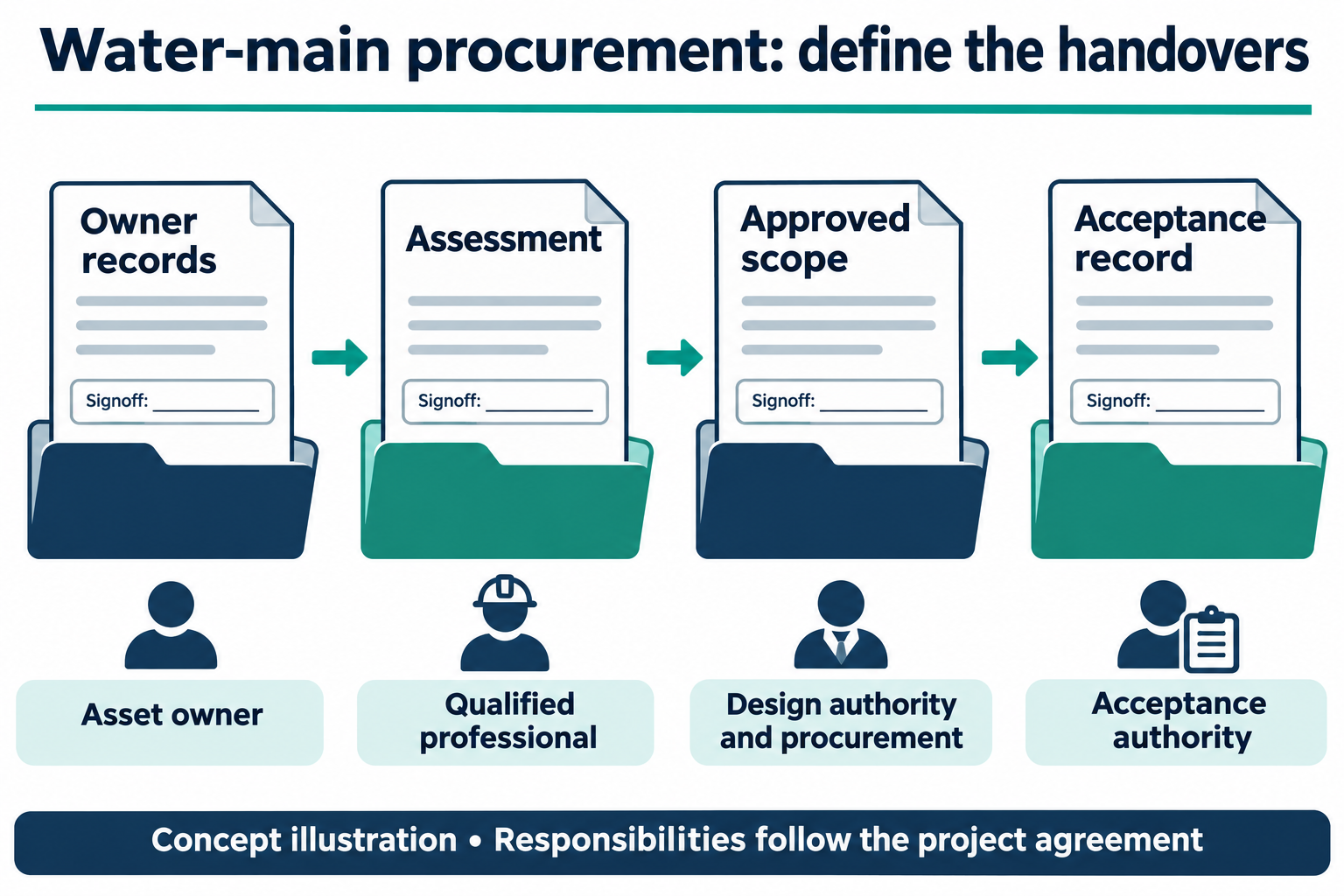
Four procurement documents link owner records, assessment, approved scope and acceptance records to their responsible roles. Conceptual procurement handovers only, not a facility design, assessment method or completed approval. Responsibilities and release requirements follow the approved project agreement.
Release a component enquiry when the scope has been approved
A report recommending further investigation supports a request for professional services. When the owner and design authority approve a scope and identify supplied components, use the approved drawing and item schedule to request a component quote. Confirm the included accessories, inspection documents, responsibilities and any bidder exceptions. If the separate engineering finding recommends replacing an impressed-current cathodic protection anode, use the confirmed circuit and approved replacement requirements to prepare that enquiry. Buried water-main anode replacement RFQ
For component supply review, send the approved drawing, item schedule and inspection requirements. Put any open design or field decision with the responsible project engineer before authorizing manufacture. HELE component supply enquiries
Frequently asked questions
Can I issue a preliminary RFQ with incomplete route drawings?
Yes, for investigation or conditional pricing. State what has been supplied, who must verify or obtain missing information, and the approval that will release subsequent work.
Who decides if AC interference needs a formal assessment?
The asset owner appoints the qualified professional who reviews the available records and determines what assessment is appropriate under the project requirements.
Does a test-station supply quote include field verification?
Ask the bidder to identify what it supplies, any installation work it includes and which party provides field verification and records. Put the responsibility in the contract.
Who coordinates with the neighboring facility operator?
Name the authorized coordination lead. Document which records, permissions or approvals that party must obtain and which work remains subject to them.
Which documents should come with site acceptance?
Agree the assessment and design references, as-built and inspection records, approved deviations, witness or acceptance report and the disposition of open items as applicable to the ordered work.
When do I send the enquiry to an anode supplier?
Send it once the engineering finding and owner's scope identify anodes as approved supply items. Define the drawing revision, item schedule and evidence required of the component supplier.
Prepare a technical enquiry
Share the process or protected asset, operating conditions, geometry or drawing, and the scope you need reviewed.
Ask a technical question →References

Project contact