
What to Verify Before Qualifying a Second Source for Titanium Parts
Give both suppliers the same released package before comparing prices for a custom titanium part.
Table of Contents
Give both suppliers the same released package before comparing prices for a custom titanium part. Then ask the second source to show how it would obtain the material, make and inspect an initial part or trial lot, and reserve capacity for repeat orders. Each step needs its own evidence and date if the buyer is relying on the second supplier to cover a production interruption.
Give both suppliers a comparable package
Identify the controlling drawing and model revisions, material grade and form, finishing requirements and delivery condition. Include inspection and packaging requirements and any approval needed for externally processed work. Require each quote to list its assumptions and deviations. If a supplier proposes a different starting shape or process route, ask engineering to review the effect on qualification before treating the offer as equivalent.
NIST's Manufacturing Extension Partnership asks buyers using its U.S. supplier scouting service for technical details such as process, dimensions, tolerances and materials, alongside business information such as volume and delivery. Those inputs are also useful when asking a second source to quote a defined part. The service identifies potential suppliers within its programme scope. Your qualification decision depends on the proposed supply and its evidence. NIST MEP Supplier Scouting NIST MEP supplier scouting request fields
Establish the first available production date
Ask for an initial schedule with dates for material availability, workholding and gauge readiness, trial parts, inspection and buyer approval. Where a supplier says material is stocked, confirm the grade, form and dimensions, whether the quantity is allocated, and what traceability it carries. A supplier can then identify which activities can start and which depend on a buyer decision or an outside processor.
Clarify who owns existing fixtures, gauges and inspection programmes and which items may be shared with the new supplier. If the supplier plans to make substitutes, request the cost and resulting readiness date. Confirm the proposed inspection arrangements and the evidence required to approve any differences.
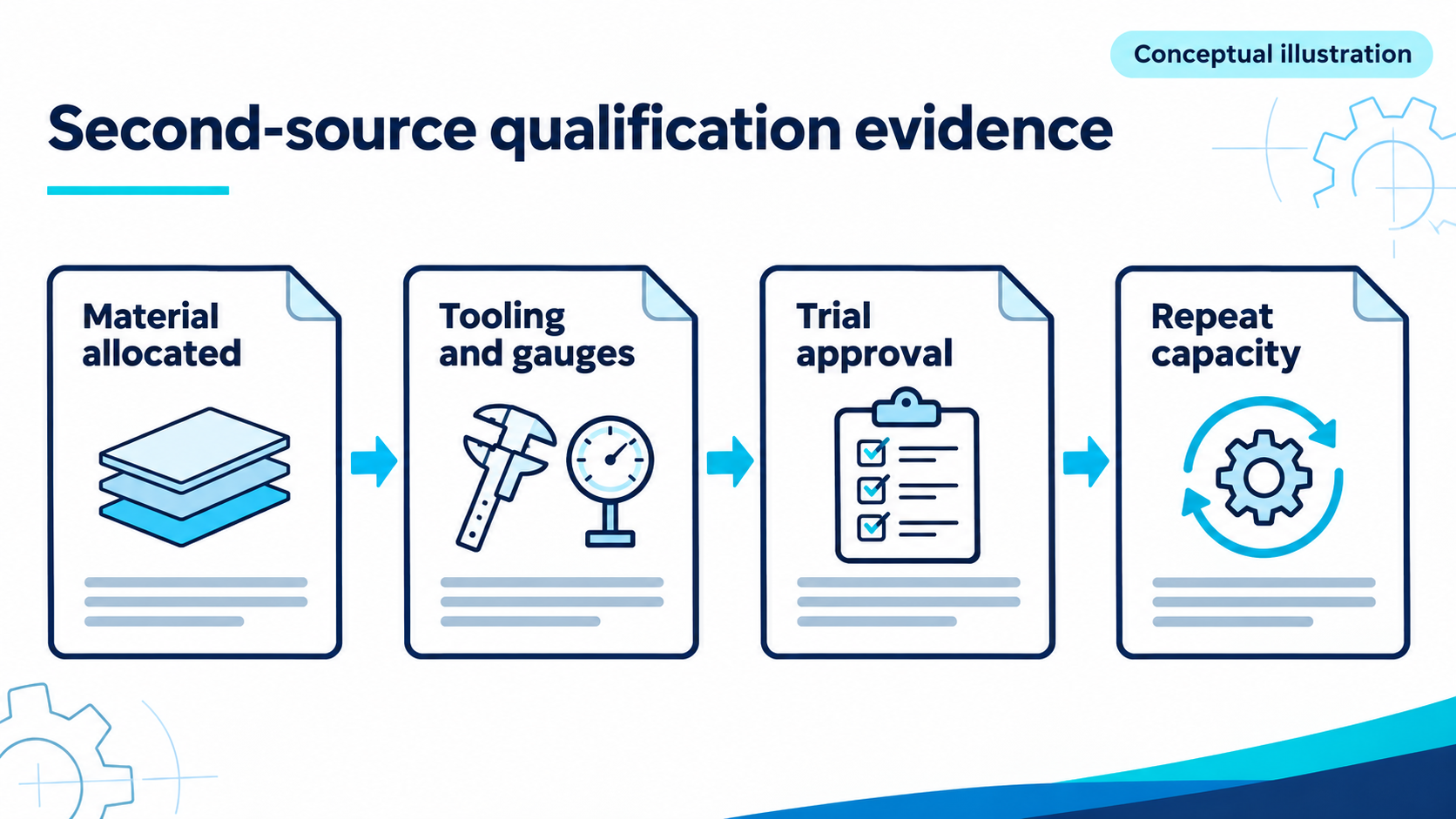
Four evidence categories cover allocated material, tooling and gauges, trial approval and repeat capacity. Conceptual illustration only; symbols do not represent actual products, measurements, certificates or completed approvals.
Qualify the proposed route and confirm repeat-order capacity
Agree what the trial must represent. If it uses different material, a temporary fixture or an alternate finishing site, record the difference and identify what needs to be reverified when the production route changes. Document which measures, material records and functional checks support the buyer's approval of the trial.
Ask what volume the supplier can allocate in the period you need and what constrains it. Separate the time to deliver the first qualified order from the expected repeat-order lead time. If the second source is intended as a backup, agree how often its readiness is checked and what would trigger a new qualification review.
For a second-source machining enquiry, provide the controlled technical package, the intended trial quantity, the repeat demand and the date your production plan needs qualified parts. HELE titanium machined parts
Frequently asked questions
Which drawing revision should the suppliers quote?
Issue the same controlled revision to both with any referenced files they need. Have each supplier identify the quoted revision and call out assumptions or deviations.
What lead times should be quoted separately?
Ask for material allocation, tooling and gauge readiness, trial submission, buyer review and the first production shipment. Confirm which date or event starts each interval.
What should a supplier confirm when it says material is in stock?
Ask whether the material is suitable for the approved order and available in the quantity needed. Confirm its stock form, dimensions and the traceability records that will accompany the parts.
Can the existing tooling be transferred?
Confirm ownership, permission, condition and availability with the parties that control it. Ask the second supplier to confirm compatibility and any validation needed before use.
When does the second source need a first article or trial lot?
Use the buyer's qualification rule and assess changes in process, tooling, inspection or material route. Agree which differences require evidence before orders can move to the second source.
How can repeat-order readiness be checked?
Ask for the volume and lead time the supplier can support against its material plan, critical operations and external processing capacity. Agree when that capacity will be reconfirmed.
Prepare a technical enquiry
Share the product form, grade or standard, dimensions, quantity and inspection requirements.
Ask a technical question →References

Project contact