What Should Buyers Verify Before Releasing a Small Batch of Threaded Titanium Parts?
Agree on two decisions before ordering a small batch of mating threaded titanium parts.
Table of Contents
Agree on two decisions before ordering a small batch of mating threaded titanium parts. First, define the evidence that lets you approve a representative sample. Then define what must be checked on the production lot before it ships. A sample that assembles smoothly is useful evidence about that pair. The production lot still needs its own release decision.
Define what the two threaded parts must do
On the request for quotation, identify the internal and external threads separately. Give the governing drawing revisions and specify the thread designation, class or tolerance and required engagement as defined by the order. If a seal face, shoulder or stop also controls assembly, identify how that feature will be checked. A correctly gauged thread and an acceptable finished assembly are separate checks when the drawing calls for both.
Name the condition for inspection. If parts are supplied after finishing or another secondary process, state whether thread acceptance applies at final delivery and how any earlier measurements will be used. Ask who will verify each member of the pair if the supplier makes only one of them. Provide an approved counterpart or its controlled requirements when an assembly check is part of the order.
Use the sample to agree what the production lot must show
Write the sample approval form before the supplier makes the sample. Identify the sample parts, drawing revisions and supply condition. Record the results of the agreed thread checks and any separate assembly test. If the parts are preproduction samples, document how their material or process differs from the planned batch and which checks must be repeated.
Ask how the supplier will establish thread conformance. ASME B1.3, where invoked and applicable to the thread form, describes gaging systems by the characteristics to inspect and the gages used. Agree on the applicable specification and edition for each thread. A supplier's demonstration with a chosen gauge is easier to review when the buyer can tie that gauge and result to a defined characteristic. ASME B1.3 scope
For paired production, decide whether the components will be shipped as matched sets or must be interchangeable across the lot. If interchangeability matters, testing one preferred pair leaves a gap. Agree how the lot checks will address the intended pairing and how the parts will be identified in the report or shipment.
Set the shipment release rule in the order
Define the lot, who selects the units, which features are checked and what happens after a failure. For a small first order, the buyer may ask for all units to be checked on a critical characteristic or approve an agreed sample. Choose the approach with the supplier based on the consequence of a failure and the practicality of the check. State what evidence the buyer must receive before shipment and who can approve any departure.
Remote evidence can help when it identifies the inspected part, the gauge and the result. Agree which records need a physical sample, an inspection report or an independent witness. Ask a third party to witness specific checks on identified parts or lots. Give the inspector the approved drawing and methods so their report can support the release decision.
For a quotation, provide the two part drawings, the intended pairing, quantity, supplied finish and sample and lot release requirements. Ask which checks the supplier can document for each stage. HELE titanium machining enquiries
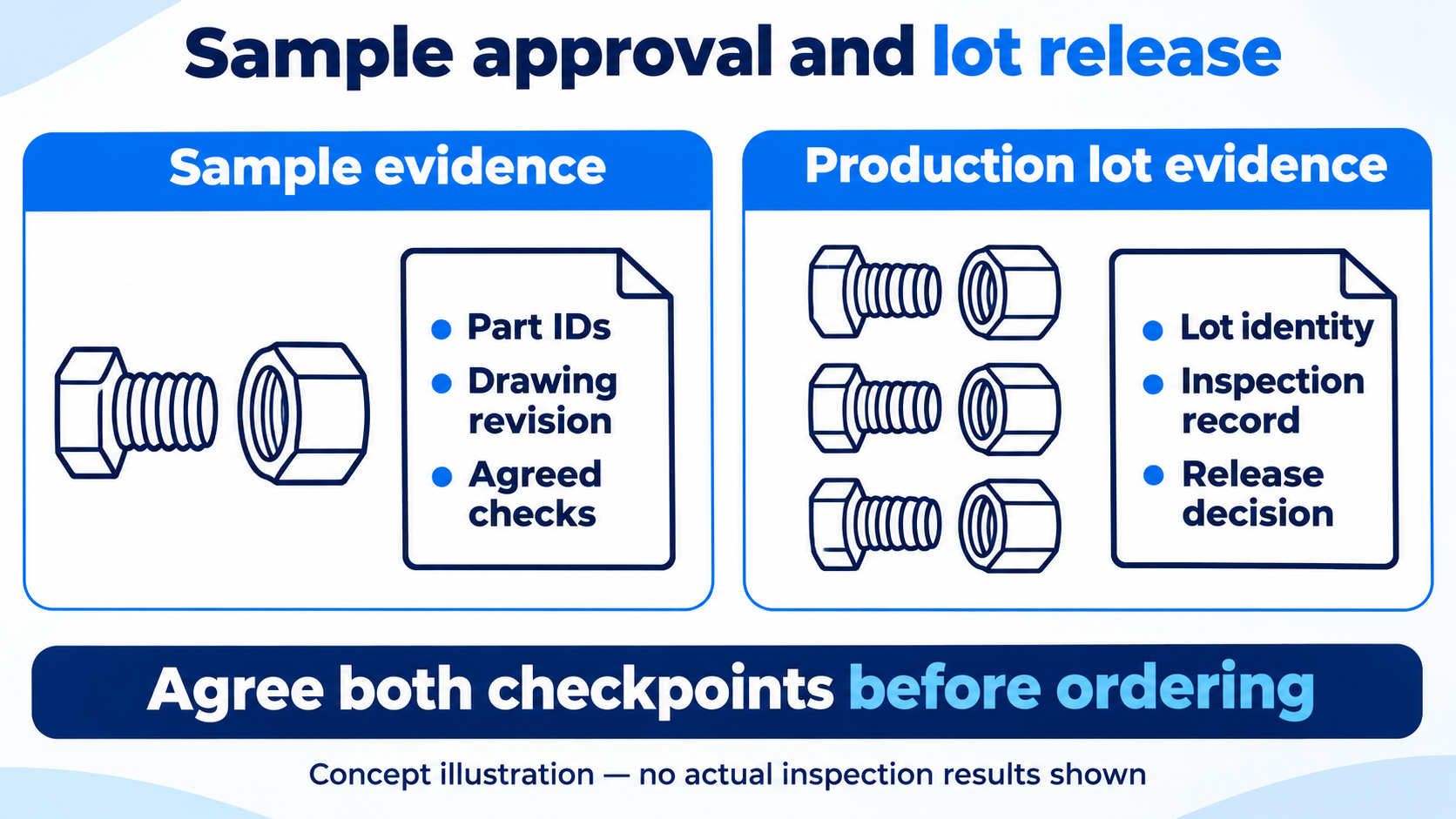
Concept graphic separating sample-part evidence from production-lot inspection records and release decisions. Sample approval and lot release require their own agreed evidence. The generic part icons do not represent inspected stock.
Frequently asked questions
Do we need samples of both mating parts?
For a fit check, use both intended members or a controlled reference for the one that already exists. Identify the counterpart in the result so a change to that counterpart can trigger a review.
What does a thread gauge result tell the buyer?
It reports the outcome of the characteristic or check covered by that gauge and method. A result can support dimensional acceptance when it matches the specified gauging plan. Separately verify any specified seal, torque or assembly requirement.
Is a video useful for a remote sample review?
Yes, if it makes the part identification, gauge and check visible. Ask for the corresponding record, especially when the camera cannot show which unit was selected or whether the result relates to the production lot.
What if a supplier proposes a different gauge?
Ask which characteristic it verifies and for the basis for equivalence under the order's specification. Resolve the alternative before the supplier uses it for final acceptance.
What if the sample comes from a different material lot?
Record the difference and separate the sample's geometry or fit results from production material evidence. Agree which records must trace to the actual shipment and whether the lot change triggers any further checks.
Who can approve a departure before shipment?
Use the approval authority stated in the order. Have the supplier identify the requirement, affected quantity and proposed disposition. Retain written approval linked to the lot if the buyer authorizes release.
Prepare a technical enquiry
Share the product form, grade or standard, dimensions, quantity and inspection requirements.
Ask a technical question →References

About the publisher
HELE Titanium
HELE Titanium supports industrial buyers with titanium materials, electrochemical anodes and PEM system project review.