
What to Verify When One Module Is Out of Service in a PEM Electrolyzer System
Define flow, gas quality, delivery point and the test record for a PEM system with one planned module unavailable.
Table of Contents
Define the required hydrogen delivery with one module unavailable before accepting a modular system proposal. Put the project’s delivery point, minimum acceptable flow, gas conditions and required duration on the same acceptance sheet. Then identify which shared equipment and storage contribute to meeting that duty.
Describe the planned state the bids must address
Identify which module the agreed scenario removes from production and when the owner expects that state to apply. Record the required hydrogen delivery profile, allowable interruption, test duration and gas conditions at the contract delivery point. Mark which limits apply during the planned maintenance window and which belong to a separately approved fault-response scenario.
Obtain a written statement about the offered configuration and the module boundary. A module can share equipment and utilities with other modules. Have the integration owner identify the assumptions about the rest of the system for this verification. Testing a named planned state should address the configuration, measurement and safety conditions approved by the plant’s responsible team.
Map equipment that can limit delivery
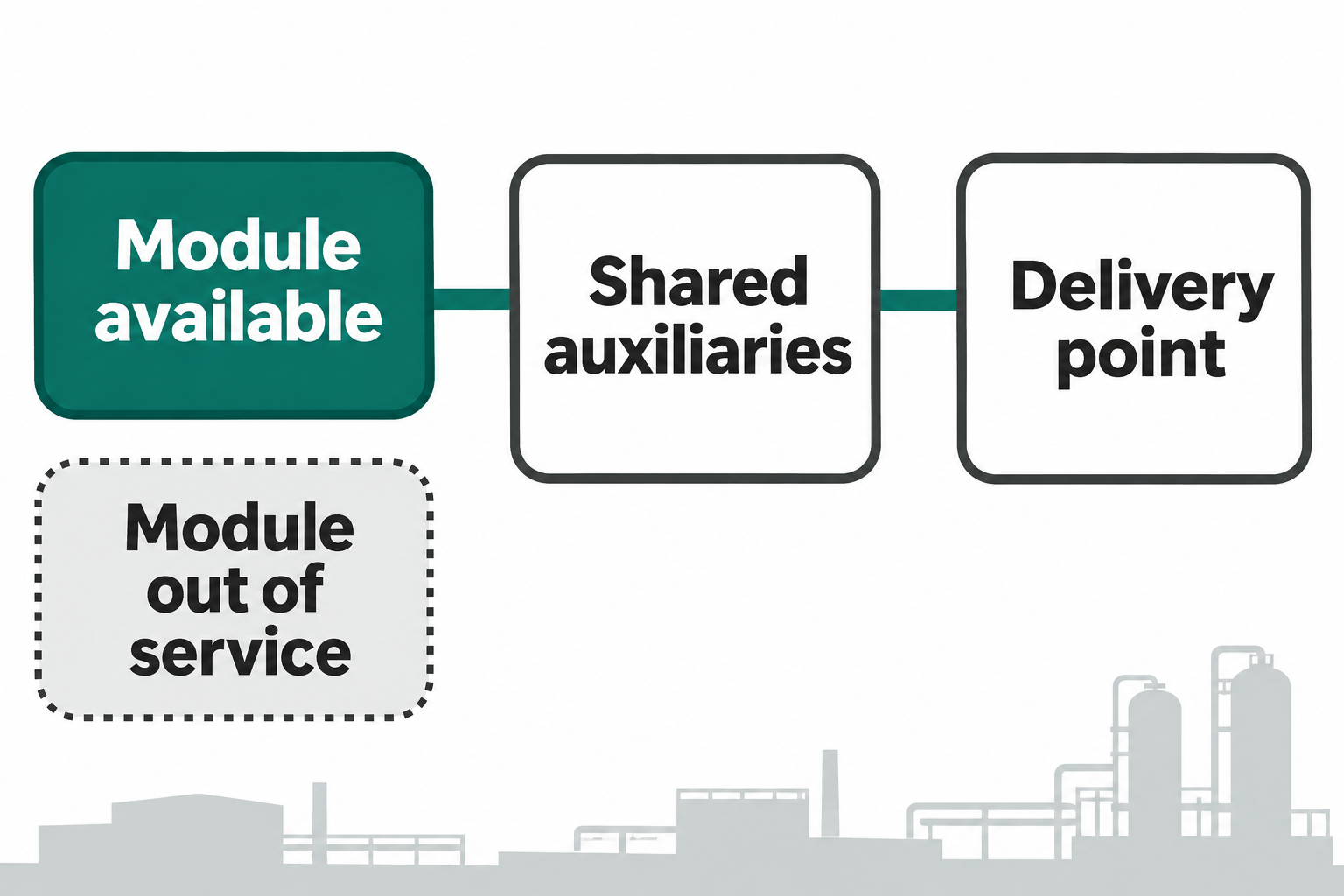
Record where the system depends on common power conversion, water treatment, cooling, drying, gas handling, compression or other services relevant to the offer. State the parties responsible for those services and which agreed output characteristics they can affect. The U.S. Department of Energy's integrated system research considers subsystem contributions such as power conversion, drying and pumps. Use the installed configuration and its delivery interface for this project’s scope. DOE integrated electrolysis testing report
If stored hydrogen contributes during the test, agree how to record its contribution alongside ongoing production. Define which source is included in the acceptance criterion, the agreed initial storage condition, and the measurement records needed to interpret the observed supply. Ask the project team to identify any operating limitation that prevents the declared duration from being demonstrated.
Put the promised state and the evidence in the same matrix
| Acceptance item | Fill in for the project | Evidence or responsible party |
|---|---|---|
| State to be demonstrated | Named module unavailable, test configuration and date window | Project-approved scenario and suppliers’ configuration records |
| Required delivery | Flow and reference conditions, pressure and quality, measurement point | Owner defines the requirement and assigns measurement responsibility |
| Duration and interruption | Required observation period and acceptable change in delivery | Time-aligned observations from the agreed data source |
| Common functions | Included equipment, limits and any services outside the supplied package | Integration owner confirms dependencies and any exclusions |
| Storage contribution | Starting condition, whether buffer supply counts and evidence for the separate contribution | Storage and measurement scope owners |
| Acceptance location | What evidence is available at FAT and what requires site conditions | Named approvers and a due date for open items |
Ask procurement to include this sheet in the quotation return. A proposal can then set out the supported conditions, exclusions and who verifies them. If a requirement depends on equipment from another package, show that dependency in both the interface schedule and the acceptance record.
Agree which checks require site conditions
Factory acceptance testing can establish observations supported by the offered test arrangement and its documented conditions. Review which conditions require the final shared utilities, installed delivery measurement, storage or upstream and downstream interfaces. Assign those checks to site acceptance testing where appropriate, with a named owner and review date. Ask how the parties will resolve a deviation before treating a conditional result as system acceptance. See HELE TITANIUM PEM balance-of-plant scope for an interface schedule.
Frequently asked questions
Can we subtract one module’s rating from the total nameplate capacity?
Use the supported delivery for the agreed configuration, shared systems, gas conditions and measurement point. Nameplate arithmetic omits those dependencies.
Do several stacks establish independent redundancy?
Ask which equipment and utilities are shared and which states the offered configuration supports. Independence and available delivery require project-specific evidence.
Can stored hydrogen count toward the test?
The owner may specify that it counts for the stated window. Agree how storage and production will be identified in the record and what initial conditions apply.
Which gas result should the test capture?
Record the agreed flow basis, pressure, gas quality and duration at the designated measurement point. Use the requirements and data source approved for that project.
Can the same acceptance record cover unexpected faults?
Define a separate scope for any fault scenario the project needs to evaluate. The planned-state test supports the conditions described in its approved matrix.
Who closes checks that cannot be run at the factory?
Name the party responsible for the installed conditions and the authority that approves the result. Assign a due date and acceptance location for each open item.
Request a modular PEM scope review
Send HELE TITANIUM the delivery requirements, demand profile, allowable interruption, proposed maintenance scenario and current interface schedule. View PEM electrolyzer systems · Submit a project enquiry
Prepare a technical enquiry
Share the hydrogen or test duty, operating conditions, interfaces and the equipment scope you need reviewed.
Ask a technical question →References

Project contact