How to Verify PEM Electrolyzer Cold Start and Low-Load Operation Before Acceptance
Ask the supplier to demonstrate two outcomes on the quoted proton exchange membrane (PEM) electrolyzer system.
Table of Contents
Ask the supplier to demonstrate two outcomes on the quoted proton exchange membrane (PEM) electrolyzer system. First, measure the time from an agreed cold condition to hydrogen that meets the delivery specification. Then show that the system can sustain the agreed low load for the required duration while maintaining the specified gas conditions. Include both acceptance scenarios in the request for quotation if the project depends on intermittent power or variable hydrogen demand.
Define the start and the point at which hydrogen counts as delivered
Describe the shutdown or standby period the project expects, the initial thermal state and the utilities available at the start of the test. Agree on the event that starts the clock. A start after heated standby can represent a useful operating case. Record it separately from a start after the system has cooled, with the starting conditions and availability of any preheating documented for each.
Distinguish the first indication of hydrogen production from the time the delivery point meets the buyer's requirements. Specify the gas flow, pressure and composition needed at that point, with any moisture or other constituent limits that matter to the receiving process. Define how long those conditions must be held before the demonstration counts as a pass. If the downstream equipment supplies stored gas during the start, record when the electrolyzer itself meets the agreed condition and how the source of delivered gas is distinguished.
The ASPIRE demonstration report illustrates why these times can differ. It describes a specific PEM installation with downstream conditioning and reports that its purification and drying equipment took time after a cold start to produce gas suitable for ammonia synthesis. The observed behavior belongs to the equipment and operating conditions reported for that project. ASPIRE final report, printed pp. 19 and 23
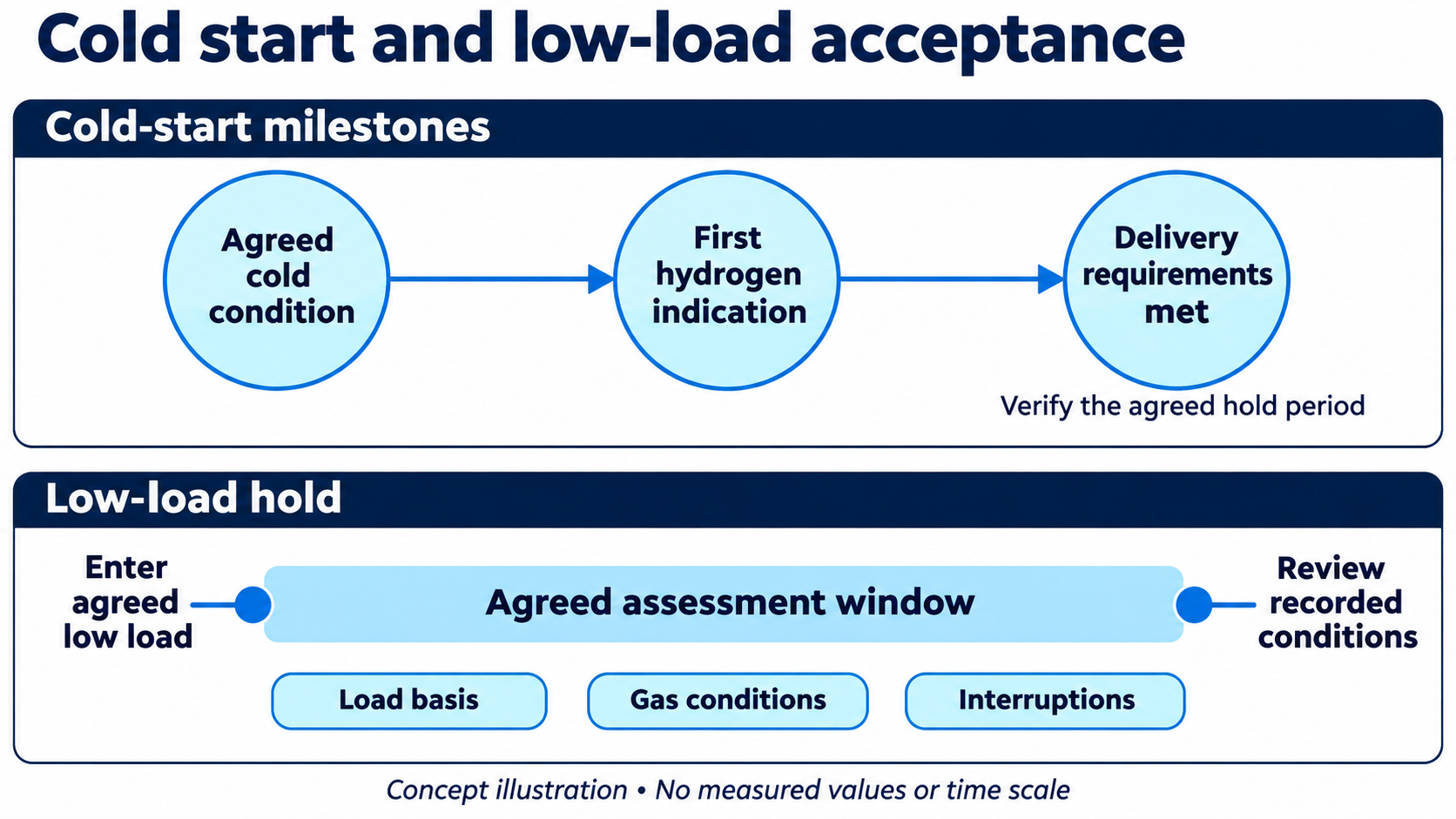
Concept diagram distinguishes the agreed cold condition, first hydrogen indication and delivery requirements, with a separate low-load assessment window. Conceptual acceptance sequence and low-load assessment window. Spacing does not represent elapsed time, and the graphic contains no measured performance values.
Give minimum stable load a measurement basis and a duration
Ask what the quoted percentage refers to. It might describe stack current, system electrical input or hydrogen output. Record the denominator and the measurement point. Define a hold period representative of the intended duty, what counts as an interruption and whether gas outside the agreed limits can be excluded from the delivery result. A short visit to the setpoint during a ramp provides different evidence from sustained operation.
Request a time record showing the commanded and measured load, the relevant temperature readings, hydrogen delivery conditions and any interruptions or periods of gas outside specification. Agree on how missing readings and unstable conditions will be handled before the test. If the project commonly returns to a higher demand after a low-load period, specify that transition as a separate part of the duty to verify.
In ASPIRE, the team attributed part of the PEM system's cold-start behavior to the thermal mass of its circulating water tank. The report also says heat loss from that tank limited low-load operation in the tested installation. The load-point power and production measurements reported elsewhere in the document serve a different purpose from showing how long the system can maintain an acceptable delivery condition. ASPIRE final report, printed pp. 24 and 52
Check which version was tested and what the site must verify
Request a configuration reference for each test record. Ask the supplier to identify differences in the stack, water circuit, conditioning equipment, controls and utility inputs that could affect either acceptance scenario. Record which equipment the supplier provides and which site systems must be available for the test.
The Gigatest project report separates variable-load field testing on Mk1 equipment from extended testing of Mk2 stacks in a factory test bay. Use that distinction when reviewing a reference: ask which configuration and location produced each result and which operating condition it covers. Field experience and a factory trial may answer different questions about an offered system. Gigatest final report, printed pp. 32–37
Ask the project team to allocate each check to a factory acceptance test, a site acceptance test or both. For example, the controls sequence might be witnessed at the factory while the site team verifies delivery with the installed conditioning equipment and actual utilities. Agree on who captures the records, who witnesses and signs, and how to document any conditions the factory cannot reproduce.
What to include with the enquiry
Send the anticipated operating schedule, cold and standby conditions, low-load duration and the hydrogen requirements at the receiving point. Ask the supplier to return its proposed equipment boundary and indicate for each acceptance case whether the evidence is already available, planned or conditional on site facilities. Keep any unresolved performance commitment open for project review. HELE PEM electrolyzer enquiries
Frequently asked questions
Can a test after an overnight stop be called a cold start?
Only if the observed starting state meets the definition agreed for the order. Record the relevant temperatures, time out of operation and availability of any standby heat. The length of the stop alone leaves the thermal state open.
What if the gas analyser is still stabilizing when production begins?
Record when the analyser provides a valid result and follow the agreed treatment of missing or invalid data. The review needs usable evidence at the defined measurement point before assigning a time to acceptable delivery.
Can intermittent production satisfy a low-load requirement?
It depends on the buyer's duty. If continuous output is required, evaluate that condition directly. If intermittent operation with storage is acceptable, specify that as its own scenario and check the agreed delivery conditions across the complete period.
What if a supplier gives a minimum load for one stack in a multi-stack system?
Ask how that figure maps to the total plant and its proposed control strategy. Record which stacks are in service, which auxiliaries remain active and the resulting delivery at the agreed measurement point.
When should a factory result be repeated on site?
Agree which installation differences could change the outcome. Relevant differences might include the utilities, conditioning train or operating conditions. Assign a site check to each material gap and identify who accepts the result.
Can a successful low-load hold support a lifetime commitment?
It documents the behavior observed over that test and under the recorded conditions. A lifetime or cycling commitment needs its own evidence, configuration and contractual basis.
Prepare a technical enquiry
Share the hydrogen or test duty, operating conditions, interfaces and the equipment scope you need reviewed.
Ask a technical question →References

About the publisher
HELE Titanium
HELE Titanium supports industrial buyers with titanium materials, electrochemical anodes and PEM system project review.