
How to Clarify Deep Titanium Threads on a Drawing Before Quotation
Before quoting a deep internal thread in a titanium part, agree on the usable threaded region, the reference face from which it is measured and the mating part's required engagement.
Table of Contents
Before quoting a deep internal thread in a titanium part, agree on the usable threaded region, the reference face from which it is measured and the mating part's required engagement. For a long through hole, ask the design owner whether engagement is required along the entire bore or in specified regions from the ends. The released drawing should make that decision visible to the machinist and inspector.
Identify the threaded length that serves the assembly
Show the mating part and its insertion direction. For a long coupling that accepts different parts at opposite ends, mark the required thread region from each reference face. Ask the designer to say whether the middle needs thread continuity, clearance for a mating member or another function. Keep the approved interpretation with the drawing.
Distinguish usable thread depth from the depth of the hole. Where entrance chamfers, thread runout or a blind end affect available engagement, identify the length that must meet the agreed requirement. Confirm the reference face after any finishing or end machining that changes the dimension basis.
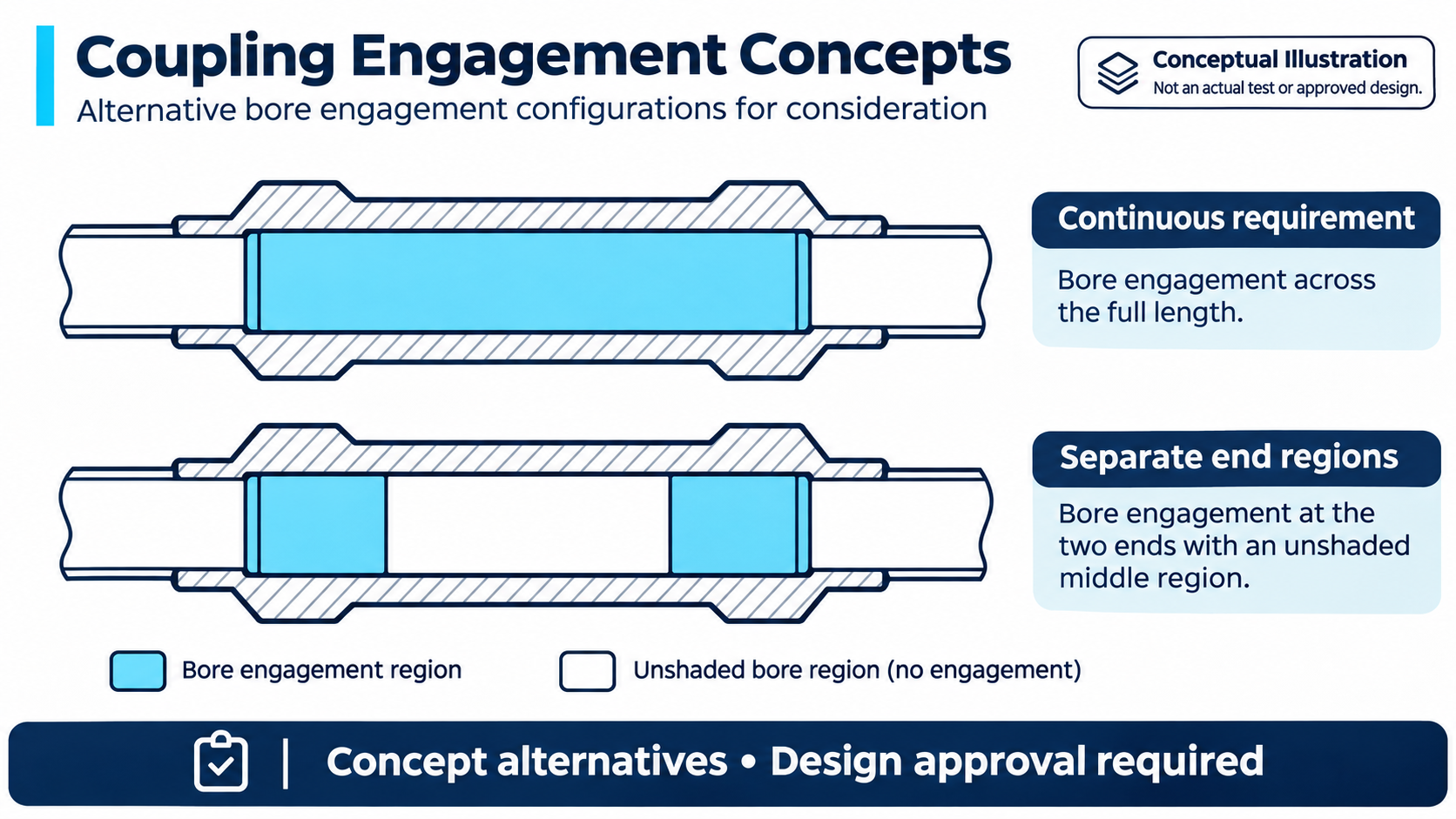
Concept coupling diagrams contrast continuous bore engagement with separate end engagement regions requiring design approval. Conceptual illustration only. Shapes and document icons do not represent actual equipment, measured results or an approved design.
Review what the supplier can manufacture and verify
Ask suppliers to flag any constraints on reaching the specified region and inspecting it. For a blind feature, ask which end clearance or transition details require confirmation. For a through feature, clarify whether the supplier can verify the required region from one end or needs access from both ends. Ask what inspection record will establish the depth as well as thread acceptance.
The NASA Fastener Design Manual treats tapped-hole pullout as a design consideration. That is useful context for why a supplier's proposal to change engagement should return to the design owner. The required engagement depends on the assembly and its approved design basis. NASA Fastener Design Manual, NASA-RP-1228
Approve any change before comparing quotes
If one bidder quotes full-length threads and another proposes separate threaded regions, record the difference as a proposed drawing change. Ask the responsible designer whether it preserves the assembly requirements. Treat an insert proposal in the same way. Specify who approves changes to geometry, material or interfaces and which checks must be repeated on the first part.
For a machining enquiry, provide the drawing revision, mating interfaces, required usable thread regions and the inspection access or records expected. Identify unclear dimensions before accepting a price or delivery date based on them. HELE CNC machined titanium parts
Frequently asked questions
What is usable thread depth?
It is the region that must meet the agreed engagement and thread requirements for that application. Have the drawing distinguish it from the hole depth and any transition region.
Which face sets the depth?
Use the reference defined by the released product definition. If a chamfer or later operation changes the relevant face, ask the design owner to clarify where the dimension begins.
Does a through hole require a continuous thread?
Follow the authorized drawing and assembly requirement. If separate engagement regions may satisfy the design, obtain an approved revision before quoting on that basis.
Can a gauge result alone document usable depth?
Check what the agreed gauge and method establish. Where the order separately specifies a usable length, request evidence that covers that length.
When does a thread insert need approval?
Route the proposal through design approval when it changes the specified part, material or interface. Define verification and release requirements for the approved configuration.
What should the first-part record establish after a change?
Link the results to the revised drawing and the intended mating interfaces. Retain the observed thread condition, depth verification and any other checks required by the change approval.
Prepare a technical enquiry
Share the product form, grade or standard, dimensions, quantity and inspection requirements.
Ask a technical question →References

Project contact