
Titanium Fastener Buying Guide
Buy a titanium fastener against the joint it serves.
Table of Contents
Buy a titanium fastener against the joint it serves. The order should identify the finished bolt, screw, stud or nut, the material and condition, the full thread designation and the evidence supporting the specified geometry and mechanical properties.
Define the joint and finished fastener
Describe the mating parts, engagement, loads, environment and assembly constraints relevant to the design. Put the head style, bearing face, drive, shank, length and thread extent on the controlling drawing or reference. Confirm whether mating nuts, washers and installation supplies are in the order.
Record the titanium grade and required condition and identify the specification that controls the finished fastener. A specification for starting stock answers a separate material question. If the assembly design depends on mechanical properties, identify what tests and lot links the buyer requires from the finished parts.
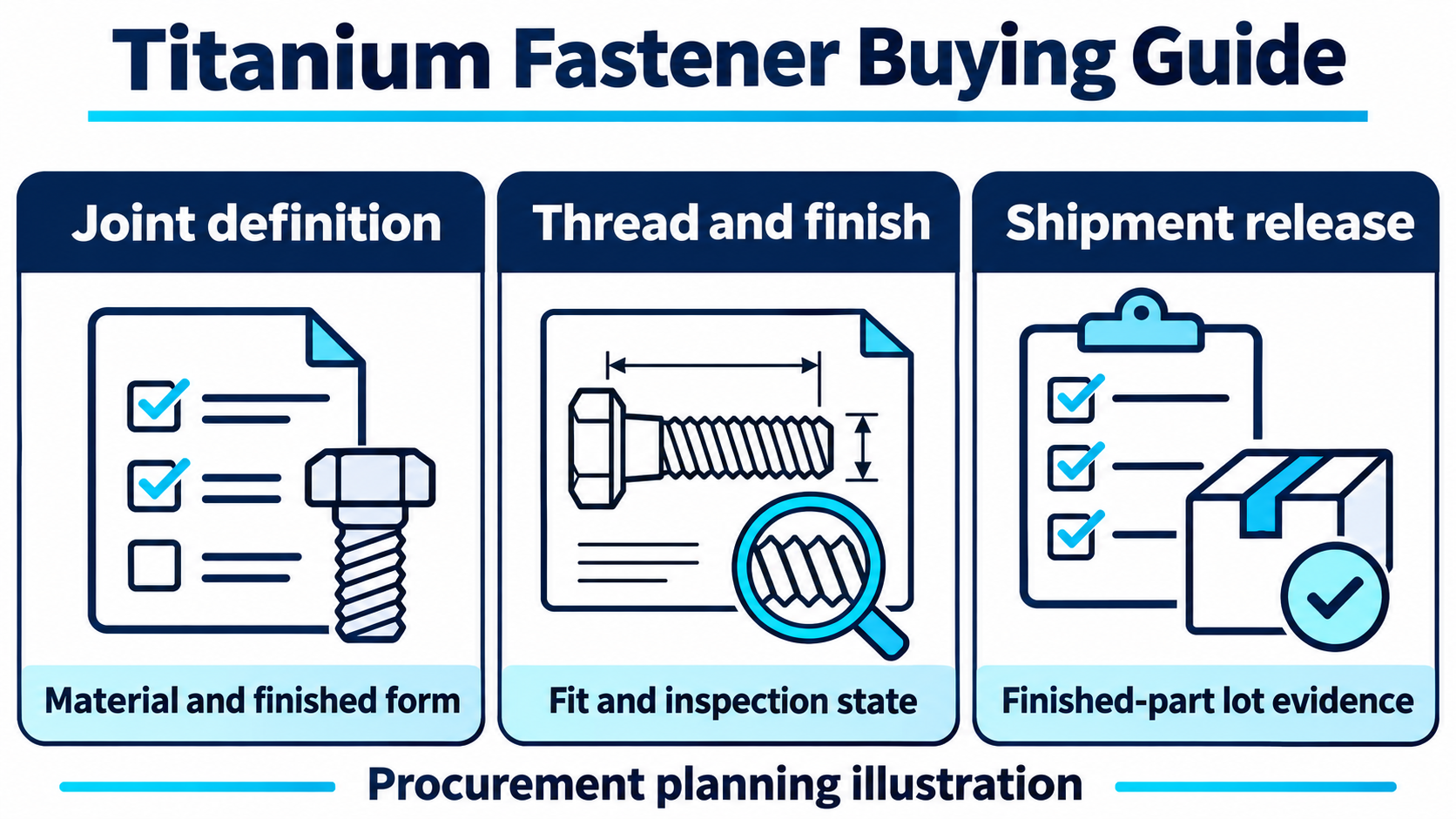
Titanium Fastener procurement illustration: joint definition, thread and finish, shipment release. Concept illustration of the article's procurement checks: material and finished form; fit and inspection state; finished-part lot evidence.
Compare manufacturing and thread evidence
Give suppliers the complete thread designation, fit or tolerance class where applicable, and any lead-in, runout and end requirements controlling assembly. Ask how external and internal threads will be inspected. If the method of forming threads or the condition after heat treatment matters, state the accepted route and who can approve changes.
Agree whether fits and coatings are evaluated before or after the specified finish. If the joint is sensitive to galling or preload variation, let the design owner specify and validate the mating materials, surface condition and installation procedure. Keep any accepted component or process changes with the released drawing.
Link inspection and documents to the shipment
Use the purchase order to define material evidence, finished properties, geometric checks, lot sampling, markings and any first-article or witness requirement. A satisfactory trial fit with one pair supports a decision about the sample. Set the evidence required for the actual shipment as a separate step. Threaded titanium parts sample and lot release
Before requesting a quote, share the joint drawing, material and condition, thread callout, quantity and required property and inspection evidence. HELE titanium fasteners
Frequently asked questions
Does specifying a titanium grade fully define the fastener?
Include the finished dimensions, thread, condition and required performance or tests. Establish which specification controls each characteristic.
What length should the RFQ state?
Use the drawing's reference points. Identify total length, thread extent and usable engagement where those values govern the joint.
Can a bar certificate establish finished-fastener strength?
It documents the material under its own specification. Ask which finished-product tests and lot records the purchase requires.
Should cut and formed threads be treated as interchangeable?
Check the governing requirements and design. If the route is controlled, have any proposed change approved with the relevant evidence.
What should be verified after finishing?
Check the characteristics sensitive to finish, including fit or available engagement where specified. Use the approved measurement plan.
Can a catalogued tightening value be applied to the joint?
Use the procedure validated by the responsible designer for the specified joint, surface condition and assembly method.
Prepare a technical enquiry
Share the product form, grade or standard, dimensions, quantity and inspection requirements.
Ask a technical question →
Project contact