
Reference Electrodes for Cathodic Protection: Selection and Buying Guide
Select and specify reference electrodes for cathodic protection by measurement scale, environment, installation, and verification.
Table of Contents
Specify a cathodic protection (CP) reference electrode by the measurement it must support. Start with the protected asset, the electrolyte, the intended reference scale and the location of the measurement. Then define the electrode assembly, cable, installation method and acceptance checks. That sequence lets engineers compare bids and gives the owner a reading it can interpret after installation.
A reference electrode provides a potential against which the structure’s potential can be measured. The electrode chemistry and environment matter, and the number also depends on where and how the measurement was taken. State the reference scale with every recorded value. The purchase is complete when the delivered device can be identified, checked and connected at the intended point, with an agreed baseline for future comparison. HELE cathodic protection reference electrodes · UFC cathodic protection operation and maintenance guidance
Define the measurement before selecting the electrode
Write a measurement brief for each group of monitoring locations. Identify the structure and whether the electrode is for a permanent monitoring point, commissioning, periodic portable surveys or corroboration of a fixed cell. Describe whether it will sit in soil, seawater, brackish water, concrete or another defined medium. For sites where the environment varies, describe the expected range and flag periods when electrolyte contact could change.
Name the reference scale required by the project criterion. Specify whether the team will record an on-potential, an instant-off potential when the approved method calls for it, or another defined measurement. Include the role of any test station, logger or controller. The CP engineer determines how measurement location, timing and voltage drop affect interpretation. Procurement should carry those requirements through to the electrode and instrument schedules.
| Design input | What to record | Why it affects the purchase |
|---|---|---|
| Structure and zone | Asset, protection zone, access and monitoring purpose | Determines the location to represent and which parties need the result |
| Electrolyte | Soil or backfill, chloride environment, concrete or immersion conditions, as applicable | Affects which cell construction and exposure conditions the project can accept |
| Reporting scale | Electrode system, relevant filling solution or chloride basis, reference used for verification | Allows the engineer to compare readings against the correct criterion |
| Measurement method | Portable or permanent measurement, instrument input requirements, sampling or interruption method | Establishes the signal path and commissioning checks |
| Service conditions | Physical access, routing length, repairs expected during asset life and installation restrictions | Changes the assembly, cable and baseline records that should be ordered |
Use the standard edition and specification named by the project. For example, ISO 12696:2022 applies to steel in concrete within its defined scope. Reference electrodes for a seawater asset should be assessed against the applicable marine or asset-specific requirements. A title that names a standard does not establish that a product meets the project’s specification. ISO 12696:2022 scope · UFC cathodic protection operation and maintenance guidance
Compare the four electrode families
| Electrode family | Where to consider it | Specify before ordering | How to verify the match |
|---|---|---|---|
| Ag/AgCl | Seawater, other chloride environments and certain explicitly qualified concrete monitoring applications | Confirm the chloride basis, body, junction, immersion or embedment and cable details | Ask for the cell construction, stated reference scale, acceptable environment and verification procedure |
| Cu/CuSO₄ | Soil CP and similar buried-asset monitoring applications where the design calls for a copper–copper sulfate reference | Specify permanent or portable construction, required backfill or contact arrangement, cable route and soil conditions | Confirm the cell’s intended electrolyte, verification basis and whether a contact or prepackaged assembly is included |
| MnO₂ | Permanent monitoring in concrete when the project specifies a compatible cell and measurement basis | Define embedment position, concrete exposure, separation from reinforcement as designed, lead routing and recording method | Confirm the exact cell system, inspection method and sequence before concrete placement |
| Zinc reference | Marine or subsea monitoring when the owner or CP design accepts the specific reference system | Document the zinc electrode construction, service environment, the reference basis and how it will be checked | Ask for the technical basis for interpreting the zinc scale under the agreed conditions and for identification of the assembled reference electrode |
For chloride environments, identify the actual Ag/AgCl construction. A seawater-exposed electrode and a device with a defined filling solution can use the same shorthand while requiring different interpretation. Verify the construction and conditions before applying a conversion. The procurement schedule can include a field for the full reported reference scale. Ag/AgCl reference electrodes
For a permanently installed Cu/CuSO₄ cell, clarify soil contact, any prepackaged backfill, cable exit and what can be verified after burial. Specify a portable verification arrangement if the monitoring plan requires one. The ability to use a portable reference for a field comparison depends on access and the approved method. Permanent copper–copper sulfate reference electrodes
Concrete projects need an early handover between the person choosing the cell, the installer and the team placing concrete. For MnO₂, request the construction and the comparison procedure for that exact product. Agree how reference ID, lead continuity and location will be recorded before the installed assembly becomes inaccessible. Highway guidance illustrates that particular Mn/MnO₂ and Ag/AgCl constructions can be specified for concrete monitoring. Apply the project’s own requirements to the final choice. MnO₂ reference electrodes · National Highways guidance on cathodic protection of concrete highway structures
A zinc reference serves as part of the measurement system. Keep it separate in the schedule from a zinc sacrificial anode, whose job is to deliver protective current. Where the design calls for zinc reference monitoring, confirm the environment, assembly, agreed stability check and how readings will be correlated with the designated comparison reference. Zinc reference electrodes · UFC reference cell guidance
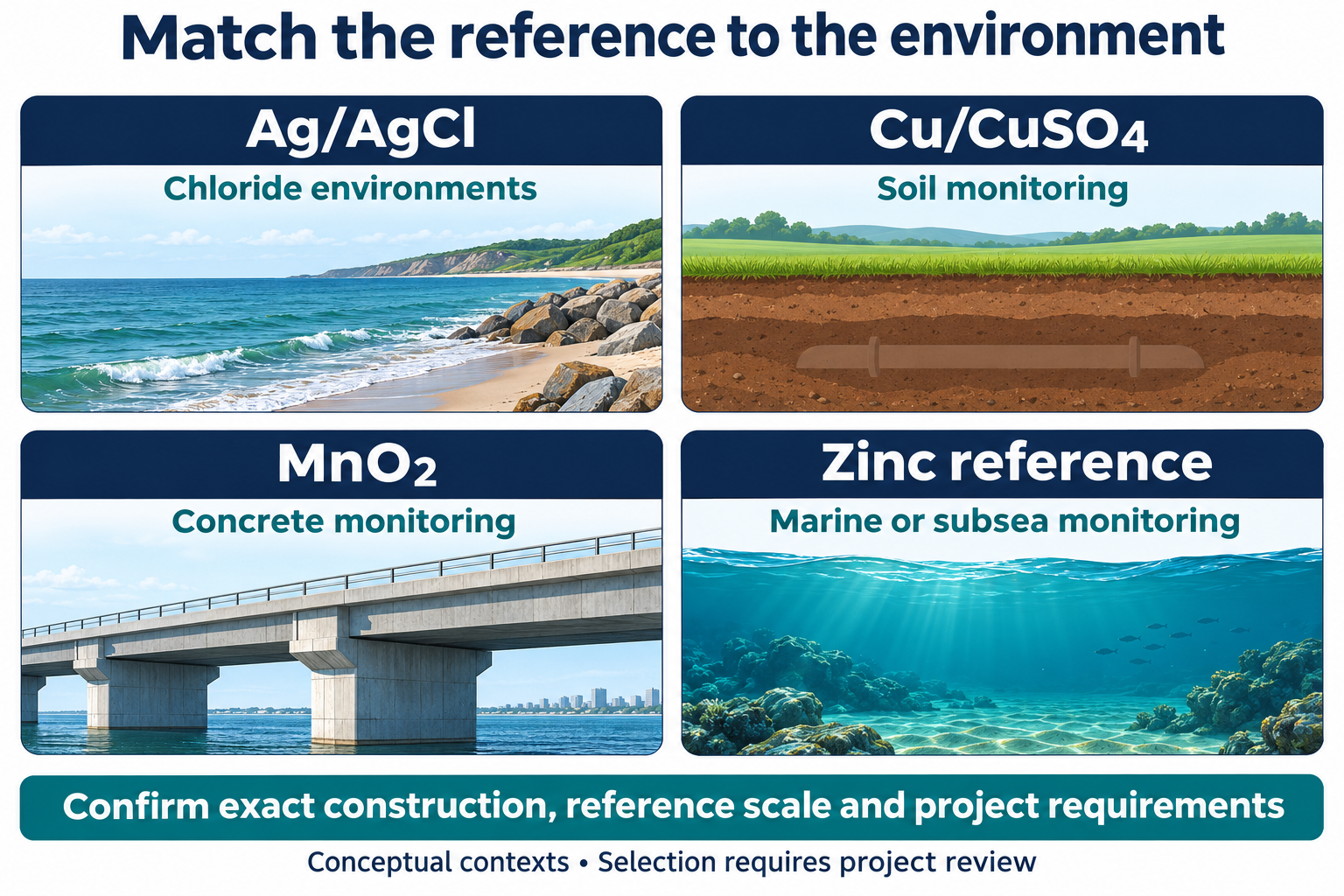
Conceptual application contexts for Ag/AgCl, Cu/CuSO4, MnO2 and zinc reference electrodes in chloride, soil, concrete and marine environments. Illustrative application contexts, not universal suitability claims or installation guidance. Confirm the exact cell construction, reference scale, environment and project requirements.
Put the measurement chain on the drawing
Start the layout with the structure connection, electrode sensing location and anticipated route to the measurement or control equipment. Show the electrode orientation, the distance or location relative to the structure as specified by the designer, the entry into the junction box and the cable identifiers. A representative measurement depends on the as-installed position. A drawing is also useful when later troubleshooting needs to distinguish the monitoring electrode from a different test point.
The cable is part of the assembly review. Specify length including routing allowance, conductor and jacket requirements, termination, protection at transitions, and any restrictions on splices. Ask the system integrator to confirm the instrument input and wiring scheme. Keep the reference lead separate in the documentation from any current-carrying circuit so that the correct connections can be checked using the approved method.
Plan accessibility for verification even when the electrode itself will be inaccessible. Set out the comparison point, the portable reference and instrument that the procedure calls for, the acceptable location and conditions, and how a discrepancy will be recorded. Wet or dry contact, movement in the measurement position and electrical conditions can influence the comparison. The assigned CP engineer should resolve a difference against the approved procedure. FHWA field protocol for half-cell potential measurements
Compare complete quotations
| Bid item | Ask bidders to state | Look for |
|---|---|---|
| Cell and assembly | Exact cell family and construction, drawing revision, body, junction and included mounting or packaging | A quoted assembly that matches the environment and fits the drawing |
| Cable and tag | Included length, termination, gland or connector, delivery label and mapped location | A traceable path from the purchase order to the future monitoring station |
| Verification | Comparison reference, medium, temperature where relevant, method, agreed acceptance band and record format | Evidence you can interpret on the project’s reference basis |
| Site activities | Handling instructions, installation responsibility and required pre-installation and commissioning records | Named parties and timing, especially for buried or embedded cells |
| Exceptions | Substitutions, omitted items, availability of spare assemblies and changes to lead time | A deviation list the engineer can close before release |
A lower unit price may exclude a cable assembly, verification report, mount or prepackaged item. Compare delivered assemblies at the same scope. If a supplier proposes another cell chemistry or a different reference scale, record it as a technical substitution for review. A conversion may be part of the review, but the conditions and its basis must be documented.
Agree what passes at receipt, installation and commissioning
Receipt. Inspect the packaging and physical condition, then match the quantity, drawing revision, IDs, cable and accessories to the order. Compare the supplied verification record with the agreement. Retain the certificate or test report with the corresponding electrode tag. If only a batch record is available and the project calls for individual traceability, resolve that gap before installation.
Before burial, submersion or embedment. Record the planned and actual location and protect the installation interface during adjacent work. Carry out the specified checks using a method approved for the assembly. Photograph or plot the location where useful and permitted. Confirm the lead reaches the designated termination and is identified there. Make discrepancies visible before access closes.
Commissioning. Record the indicated potential with its reference scale, monitoring location, measurement method, operating conditions, time and instrument. If the design includes a nearby field comparison, record both sets of readings with their conditions. Include the signed record in the turnover file and assign responsibility for reviewing trends or resolving questionable measurements.
If the reference reading changes unexpectedly later, review the installed conditions, lead and termination, instrument and any change in the CP system before diagnosing cell drift. Compare results using the design’s procedure and reference. The baseline and installation record make this investigation considerably easier. UFC CP operation, maintenance and troubleshooting guidance
Prepare the RFQ and release the order
For each tag, give bidders the asset and environment, monitoring method, reference scale, approved or marked-up drawing, cable route and termination, required evidence and acceptance sequence. List which parts of the scope the supplier should price, including spare cells and accessories where required. Show the milestone the package must meet, especially when it must arrive before concrete placement, backfill or marine work.
Before approving manufacture, close the cell and cable configuration, the verification method, the treatment of deviations and the party responsible for the installation record. HELE can review the stated measurement duty and assembly against the specifications you provide. Request a reference electrode configuration review
Frequently asked questions
Why do I need to record the reference scale with a potential?
The structure potential is reported against the reference used for the measurement. Retain the cell type and the applicable electrolyte or filling solution basis. Those details determine what the value can be compared with.
Can a marine Ag/AgCl electrode be substituted for a concrete monitoring device?
Have the CP engineer confirm the exact construction, service conditions and project acceptance criteria. A matching chemistry abbreviation does not establish that the housing, junction, electrolyte or verification method suits the proposed installation.
When should I order permanent rather than portable Cu/CuSO₄?
Use the measurement plan. A permanent unit supports a designated monitoring location. A portable unit can support surveys or field checks when access and the procedure allow. The permanent assembly also needs a documented route, termination and as-installed location.
What should the crew record before an MnO₂ assembly is embedded?
Record the electrode ID, intended and actual location, specified checks, lead condition and routing, and who released the installation. Tie the records to the structure or concrete zone on the drawing.
Can a zinc sacrificial anode be ordered as a zinc reference electrode?
Specify the dedicated reference assembly and the measurement basis approved by the CP engineer. The sacrificial component and the reference serve different jobs and should have separate part and location records.
How do we compare results taken with two reference systems?
Use the project’s approved comparison or conversion procedure. Retain the original readings, exact reference types, relevant conditions and uncertainty. Keep the converted result traceable to the originals.
What should we do if the supplied verification report omits the comparison medium?
Request the missing test conditions and comparison reference. The project engineer can then decide whether the record meets the specified acceptance basis or needs a repeat check.
Prepare a technical enquiry
Share the process or protected asset, operating conditions, geometry or drawing, and the scope you need reviewed.
Ask a technical question →References

Project contact