
Powered vs. Magnesium Anode Rods for Water Heaters: What Changes in a Retrofit?
Compare powered and magnesium water heater anode replacements by tank approval, fit, power, inspection and service responsibilities.
Table of Contents
Start with the tank manufacturer’s approved replacement information and the owner’s service plan. A magnesium rod provides galvanic protection through consumption of its alloy. A powered anode assembly uses an external controller and electrical supply. A retrofit decision therefore depends on whether the manufacturer or responsible owner accepts the change, whether the assembly fits, and whether the electrical and monitoring arrangements can be supported. Powered titanium anode rods · Sacrificial anode selection
This review is for tank OEMs, service organizations and equipment owners specifying replacement parts. It starts with one known tank configuration and produces a replacement specification that service teams can follow for that configuration.
Identify the tank and how it is currently protected
Collect the equipment tag, model, serial range or revision, parts manual and drawings. Confirm whether the rod is a dedicated service part or shares an assembly with another tank connection. Record which openings are available and which are required for other functions. Keep a photo of the accessible connection and the clearance above it.
Check the previous service record. Note the date and condition of the removed rod, water source changes and any other recent work. If the project is a fleet change, identify which models and revisions actually share a replacement arrangement. A single successful retrofit on one unit does not qualify every tank in a fleet.
Compare both options against the same installation drawing
| Decision | Magnesium rod | Powered assembly |
|---|---|---|
| Protection arrangement | Match the approved alloy and anode assembly for the galvanic design | Verify the approved system arrangement, rod, controller and compatible tank connection |
| Fit and access | Check thread, insertion envelope, sealing and access for future replacement | Check those same items plus the route and space for the lead and controller |
| Site support | Agree periodic inspection and replacement under the tank service plan | Agree power availability, indicator checks and who responds if the unit loses power or reports a fault |
| Evidence to request | Part revision, dimensional record and material documentation if specified | Assembly drawing, control documentation, inspection record and a list of included accessories |
| Release decision | Confirm that the part fits and is approved for the model and service | Obtain any required retrofit approval and define how the responsible service party confirms the installed configuration |
Water chemistry is a design input. Give bidders the tank’s service conditions and the water information available to the OEM or equipment owner. Ask them to identify assumptions and exceptions in their offers. Keep measured data and service observations tied to a tank model and date.
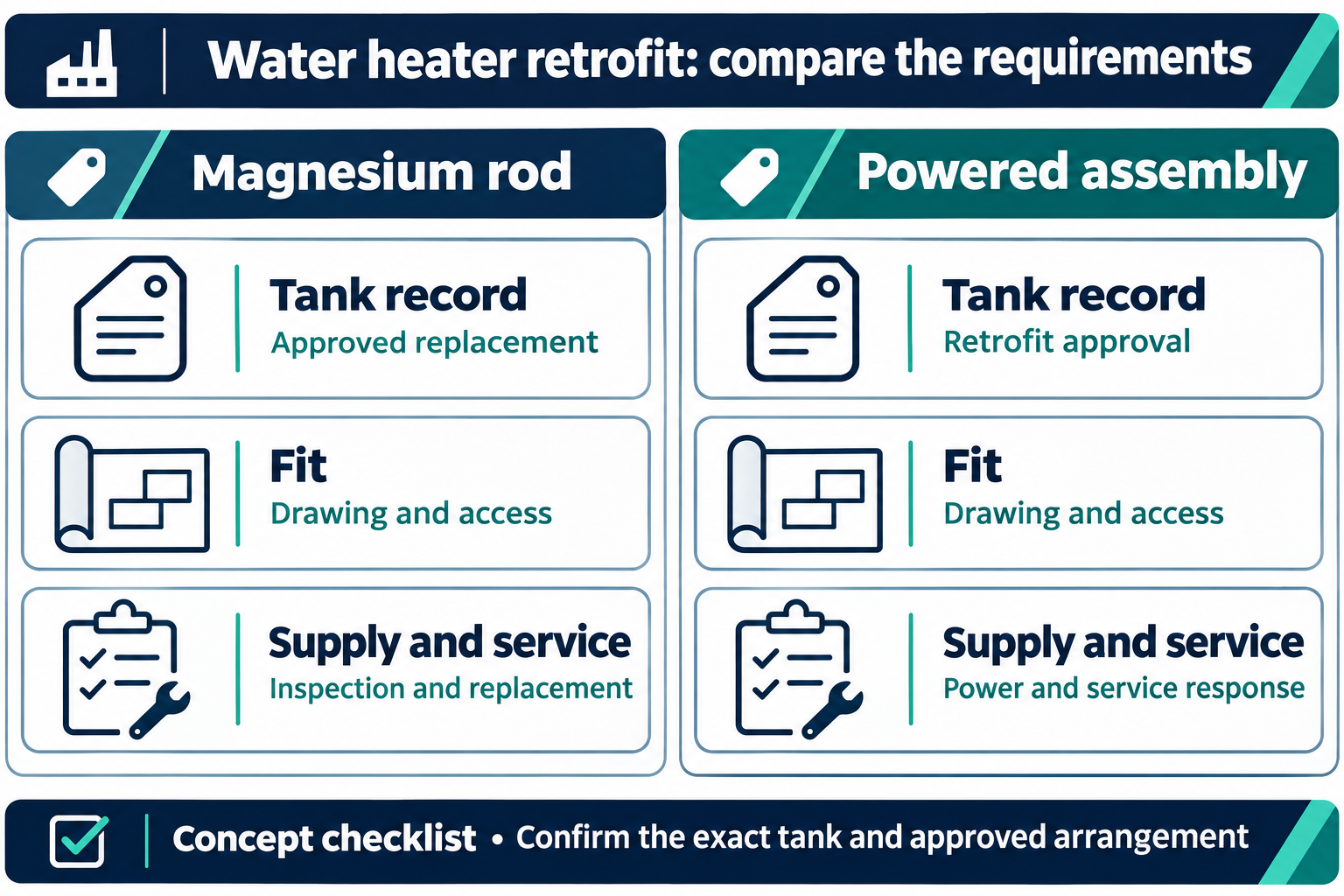
Concept checklist comparing tank records, fit, supply and service requirements for magnesium rods and powered water-heater anode assemblies. Conceptual procurement comparison only, not an installation design or compatibility approval. Confirm the exact tank configuration and the approved replacement or retrofit requirements.
Close responsibility before purchasing a retrofit
Ask the manufacturer or responsible engineering party to document whether the retrofit is permitted for that exact asset. Confirm the original warranty or service terms separately for the tank and the replacement assembly. Avoid treating a supplier’s dimensional match as evidence of approval for the entire water heater.
A useful quote states the items included, any wiring or mounting components supplied separately, the controlled assembly drawing, and the inspections included in the price. Have the owner confirm that site power and service access match the proposed unit. Agree what will be checked on receipt and at installation under the manufacturer’s instructions. If a site condition is unresolved, record it in the order with an owner and a release milestone.
Send a quote request the supplier can verify
Send the tank model and revision, existing rod ID, mounting and clearance drawings, actual operating conditions, and the service scope. For a powered option, identify the electrical interface and any approved controller or signal requirement. Ask for one compatibility statement per tank family, supported by drawings and listed deviations. Request a powered anode fit review
Frequently asked questions
Is a matching thread enough to approve a replacement?
Check insertion clearance, sealing, access, the approved protection arrangement and the tank manufacturer’s documentation. For a powered rod, also review the controller and electrical requirements.
Does a powered rod require external power?
Yes. Confirm the power supply and service response for the exact assembly. Include those responsibilities in the operating plan.
What if the existing magnesium rod is no longer identifiable?
Use the tank model and service drawing first. Record the removed assembly and the measurements that need confirmation before ordering.
Can I apply the same approval to another tank model?
Confirm the revision and interface match. Extend the approved release only to the tank models and conditions covered by the owner’s or OEM’s written decision.
Do either of these replacements establish an odor performance guarantee?
Odor needs a separate investigation. Document the water and service observations and ask the responsible party to identify the cause before relying on a procurement claim.
Who should confirm the retrofit’s effect on equipment warranty?
Ask the tank manufacturer or its authorized service organization for the terms applying to the identified equipment and change. Obtain replacement assembly terms from its own supplier.
Prepare a technical enquiry
Share the process or protected asset, operating conditions, geometry or drawing, and the scope you need reviewed.
Ask a technical question →References

Project contact