
What Evidence Should Buyers Require Before Accepting a PFAS Electrochemical Oxidation Pilot?
Before accepting a pilot for per- and polyfluoroalkyl substances (PFAS), name the claim the pilot must support and the streams it must account for.
Table of Contents
Before accepting a pilot for per- and polyfluoroalkyl substances (PFAS), name the claim the pilot must support and the streams it must account for. A lower concentration of selected compounds in the treated water can support a water-quality result for that sample. A claim that electrochemical oxidation destroyed those compounds requires additional evidence about their fate, potential transformation products, and the limits of the analysis.
Specify which result the buyer is purchasing
Separate the treatment train into the work that each party performs. A separation stage can move PFAS from the water into a concentrate or another residual stream. Collection and transport establish custody and destination. A destruction claim concerns what happens to specified compounds during the subsequent treatment. Give each stage its own deliverable and record which party is responsible for producing it.
Agree on the feed and the output to which the pilot result will apply. Identify whether the oxidation stage receives the original water or a concentrated stream. When a supplier reports a result on concentrate, keep that basis attached to the reported result. In an integrated pilot, reconcile the water-quality result with the amount and destination of the separated material before interpreting the full treatment train.
Agree on sampling and reporting before the pilot
Ask the project team to map the feed, treated water and other outputs relevant to the proposed system, including any concentrate, residual solids or collected emissions where applicable. The sampling plan should state which streams are measured, when they are sampled, and what information is available on volumes or flows. Name the target compounds, analytical methods, reporting limits and quality checks for each relevant sample type. Ask the laboratory how it will document results below the reporting limit, reporting-limit changes and any data qualifiers.
A concentration result below the reporting limit should retain that limit and method context. If the limit is too high to support the acceptance decision, flag the gap before testing. Ask how the team will account for material outside sampled streams or analytical coverage. Where it is feasible and applicable, a fluorine mass balance can help account for fluorine across measured inputs and outputs. Have the team state its scope and any unaccounted fraction. U.S. EPA 2026 interim guidance, Emerging Technologies chapter
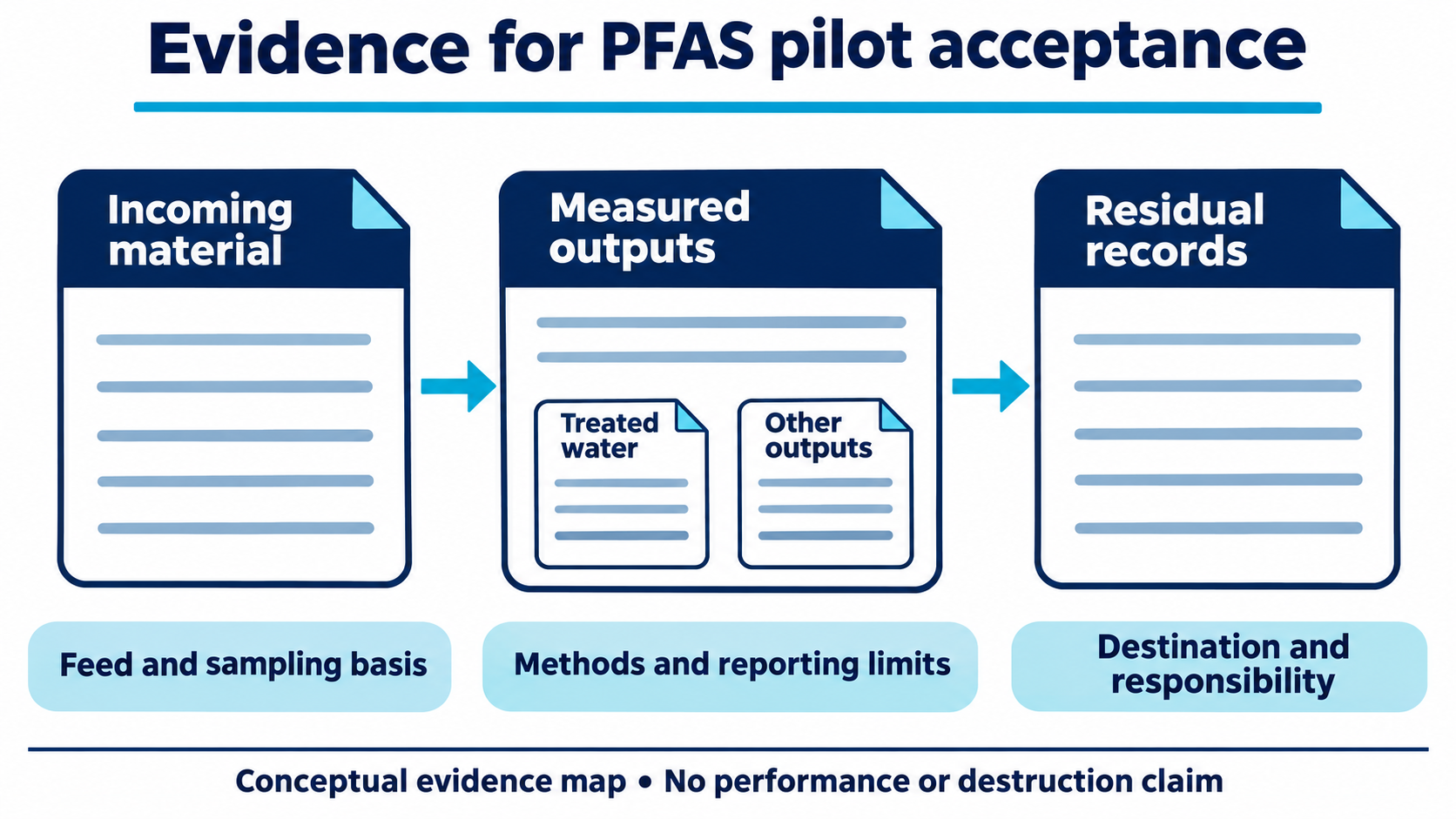
Evidence cards connect incoming material, measured treated water and other outputs, and residual destination records. Conceptual evidence map for pilot review, not a treatment process diagram or a claim of PFAS destruction or compliance.
Review transformation products and assign responsibility for residuals
The pilot plan should specify which transformation products or other constituents the team will evaluate, the scope of the methods and how uncertain findings will be handled. In a 2024 study, Rehnstam and colleagues reported transformation products in electrochemical oxidation tests involving groundwater and landfill leachate. The authors called for further study of their concentrations and toxicity. Use this study to frame questions about your own water and system. The pilot needs evidence from its actual feed and test configuration. Rehnstam et al., 2024, original study, §§3.4 and 4
Ask for a destination and responsible party for each residual stream. If the supplier plans to send concentrate to a second facility, define the handover record, what receiving evidence will be available and whether any further treatment result is included in the acceptance criteria. Agree who reviews environmental questions and who authorizes the next phase. A pilot acceptance decision should identify which claims the evidence supports, which results remain conditional and what must be resolved before a larger trial.
For an electrode scope enquiry, share the water matrix, intended process role, equipment boundary and planned acceptance tests. Ask the component supplier to state its proposed scope and evidence for that scope. Process performance and the treatment train's acceptance remain project decisions. HELE titanium anode enquiries
Frequently asked questions
Can a lower concentration in treated water establish destruction?
It supports the change observed for the specified compounds and samples. To evaluate a destruction claim, ask for the evidence on remaining material, transformation products and the applicable process boundary.
What if an analyte is reported below the reporting limit?
Keep the qualifier, method and reporting limit with the result. Ask the laboratory how the qualified value can be used in the agreed comparison. A limit on what could be reported leaves a range of possible concentrations.
Can a pilot on concentrate establish the same outcome for untreated water?
Treat them as distinct test feeds. Compare the matrix and tested treatment train with the proposed duty. Ask the project team what additional evidence it needs for any feed outside the pilot scope.
What if a fluorine mass balance is impractical?
Document which inputs and outputs could be characterized, what was excluded and why. Ask the reviewer to state how those gaps limit the claim and what other evidence is appropriate.
Does a tentative transformation-product identification settle its concentration or toxicity?
Ask the laboratory to report its confidence and the scope of the method. Concentration and toxicity require their own supporting evidence. Document whether further identification, quantification or evaluation is needed for the decision.
Who signs off the pilot before scale-up?
Use the project approval plan. Assign analysis and data review, environmental and residual management decisions, system performance acceptance, and purchase authorization to the designated people. Record any open conditions with the approval.
Prepare a technical enquiry
Share the process or protected asset, operating conditions, geometry or drawing, and the scope you need reviewed.
Ask a technical question →References

Project contact