Electrochemical Salt Splitting: What Process Data Should Buyers Define Before an Electrode Review?
Define the process route and electrode-contact environment before discussing an electrode specification. Use a compartment-based worksheet to identify missing data, validation tasks and supply responsibilities.
Table of Contents
Prepare a process description, a representative feed analysis and a compartment-by-compartment description of the proposed cell before requesting an electrode recommendation. Identify the intended reactions, the liquids that will contact each electrode, the operating conditions and the evidence needed to assess suitability. A salt name alone leaves too much of the application undefined.
This guide is for process engineers, electrochemical equipment manufacturers and technical buyers assessing lithium refining, recycling or other industrial salt streams. It provides a suggested review worksheet. The process designer must determine the actual chemistry and cell configuration; an electrode enquiry does not establish that a complete process is ready for procurement.
Why does the feed name leave the electrode duty unresolved?
Public supplier information illustrates the need to identify the route. De Nora’s lithium-refining explainer describes lithium chloride and lithium sulphate applications, different compartment configurations and validation with real process streams. Its report for the first nine months of 2026, page 52, also lists Enso industrial salt splitting. These are statements from one supplier, rather than independent validation of another company’s equipment.
For an electrode review, ask the process designer to translate the overall production objective into a specific duty at the proposed electrode location. What reaction is intended there? Which liquid will actually reach that surface? Which other liquids could contact it during a planned operating or maintenance sequence? Do not fill those answers from a generic diagram of salt splitting.
Keep the incoming plant stream separate from the electrode-contact description. If the proposed process includes pretreatment, circulation or separate compartments, request the relevant stream identifiers and their relationship to the electrode. An analysis labelled only “lithium feed” does not tell the reviewer which location was sampled.
A useful first document is a marked process sketch. It need not contain a final design, but it should identify the proposed electrode position, adjacent compartments, stream references and unresolved design decisions. Leave an unknown arrangement marked as unknown. Specifying an electrode to fit an assumed arrangement can send the review down the wrong path.
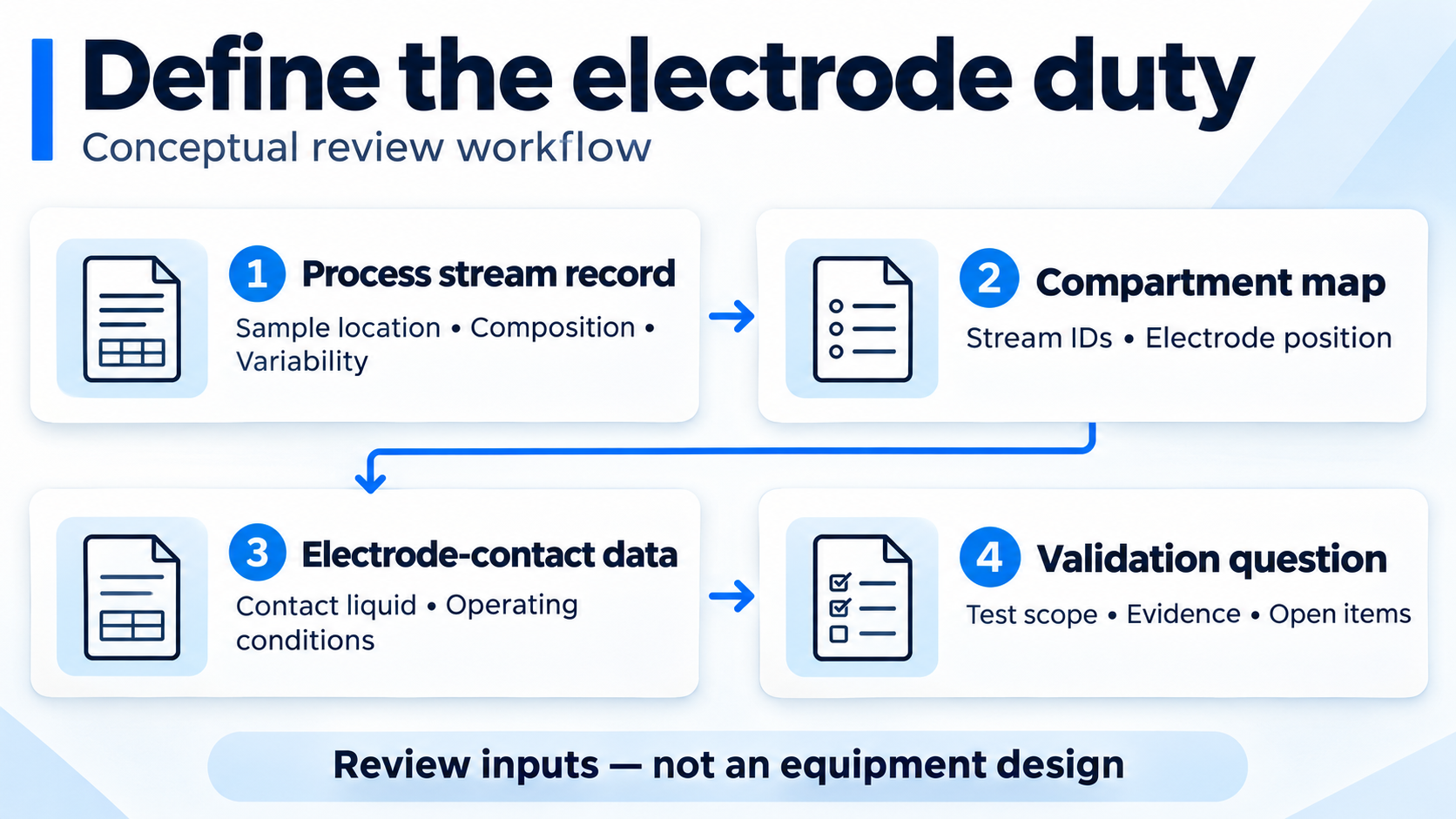
Process stream record: sample location, composition, variability. Compartment map: stream IDs, electrode position. Electrode-contact data: contact liquid, operating conditions. Validation question: test scope, evidence, open items. Review inputs, not an equipment design.
What should the initial review package contain?
Use the following fields to organise a preliminary discussion. They are suggested inputs, not universal operating limits or a mandatory standard. Attach existing records where available and distinguish measured information from design targets.
| Review input | What to provide | Question it helps the reviewer resolve |
|---|---|---|
| Stream identity | Source process, sampling location, sample date and relationship to any pretreatment step | Does the analysis describe the proposed cell feed or a different point in the plant? |
| Composition record | Identified constituents, concentrations and units, analytical method and reported detection limits where relevant | Which constituents were measured, and what remains uncharacterised? |
| Variability | Available batch or time-series records, plus changes the process owner expects | Is the proposed trial based on one sample or an agreed operating envelope? |
| Compartment contact | Stream references and available composition data for each electrode-contacting liquid | Which environment is being submitted for electrode review? |
| Process objective | Intended reaction, target products and the process owner’s quality requirements | What must the test demonstrate beyond simply passing current? |
| Operating proposal | Temperature, current, area definition, operating sequence and any relevant interruption or reversal conditions | Which conditions are established, proposed or still open? |
| Physical interface | Drawing revision, geometry, connection, mounting and relevant equipment-interface requirements | Is the enquiry for an electrode, an assembly or a larger equipment scope? |
| Verification | Existing trial records and proposed measurements, acceptance criteria and responsibilities | What evidence could support the next purchasing decision? |
Avoid a spreadsheet in which every blank becomes a supplier assumption. Add a status column: measured, proposed or unknown. For an unknown item, identify who can provide it and whether it prevents an initial screening discussion or a later specification decision.
Send only material you are authorised to share. Where the feed composition or process arrangement is confidential, agree a controlled exchange with the responsible parties. Removing a customer name from a drawing does not by itself settle permission to disclose the design.
The titanium anode enquiry checklist can help record general drawing and operating inputs. It does not qualify an electrode for a salt-splitting application.
What can a trial establish, and what remains open?
Start the trial review by asking exactly what question the experiment was designed to answer. A test may investigate a candidate electrode, a feed-treatment assumption or a proposed cell arrangement. Those are different decisions. Identify which one the submitted result addresses before using it to support a purchase.
If results come from a prepared laboratory solution, ask the process owner which properties it represents and which constituents or variations were omitted. If a real stream was used, record its origin and analysis rather than treating “real feed” as a complete description. Ask what additional testing would be needed for the intended production conditions.
Keep the result tied to the tested configuration. Request the feed record, electrode identification, compartment arrangement, relevant operating history, measurement method and observed outcome. A change to one of these should prompt a documented assessment of whether the result still answers the purchasing question.
Discuss durability separately from initial operation. Ask the technical team to define the duration, observations and end-point criteria needed for its decision. Do not convert a short successful run into an unsupported service-life statement. Where the evidence is incomplete, describe the next validation step rather than supplying a guessed lifetime.
Also separate component suitability from plant economics. Before using an electrode trial to support a claim about reagent savings, energy cost or waste reduction, request the broader process basis and the person responsible for that calculation. A component record should be used only for conclusions its measurements support.
Who should resolve the open items before a quotation is requested?
Assign responsibilities within the actual project team. A suggested division is for the process owner or process designer to define the chemistry, feed envelope and required product quality; the equipment integrator to identify the cell arrangement and interfaces; and the proposed component supplier to assess its own offered scope against those inputs.
Keep membranes, electrodes, cell hardware, controls and the complete plant as separate scope entries. For each entry, identify the responsible party and the applicable evidence. A request for an electrode review should not silently become a commitment to supply or approve the other parts of the process.
Before seeking a firm quotation, ask the responsible technical reviewer to list what has been accepted, what requires testing and what falls outside the proposed supply. If the information supports only a preliminary feasibility discussion, label the request accordingly. That gives procurement a usable status without implying that technical suitability has already been established.
For a technical enquiry, provide the marked process sketch, feed-analysis record, compartment-contact description and intended electrode duty. Identify the component you want reviewed and the questions still open. This information can be used to assess whether there is a suitable scope for further discussion; it is not confirmation of salt-splitting system or application-specific electrode availability.
The titanium anodes overview describes a general product category. Any proposed use in this process requires its own suitability assessment.
Frequently asked questions
Can an existing coating name settle compatibility?
No. Keep it as an identifying detail, then ask for evidence applicable to the proposed contact environment and operating duty. The same coating label does not establish that two applications or supplied components have been qualified to the same requirements.
Can I request an initial review while the process is still being developed?
Yes, provided the request states its preliminary purpose and identifies the unknowns. Ask which missing inputs prevent screening and which can be resolved during a defined development stage. Do not treat an initial discussion as a frozen specification or a commitment to supply.
Which HELE product information should we use for an initial enquiry?
Use the titanium anodes overview to identify the general component category, then describe the specific item you want assessed. State whether it is a coated electrode, a complete electrode assembly or another part. A product-category page does not establish availability for this salt-splitting duty; the proposed scope and suitability still require confirmation.
What if we cannot share the complete process drawing?
Start by identifying the part under review and the information you are authorised to disclose. Ask which interface details and contact conditions are essential for preliminary screening, and agree a controlled exchange for sensitive material. The reviewer should identify the limits of any assessment made from a partial drawing. Do not remove design information that is necessary for the decision without flagging the omission.
Can we send an old electrode or request a sample before the design is fixed?
First agree what the sample or returned part is meant to establish. An old component can help identify geometry and connections, but it does not establish the original operating conditions or approve a replacement. A new sample needs an agreed test purpose and configuration. Confirm whether the proposed sample, inspection or supply is available for the particular request before arranging shipment or testing.
What should trigger a fresh review after a sample has been accepted?
Record which drawing revision, feed description, electrode-contact conditions and acceptance criteria the approval covered. If one changes, ask the responsible technical parties to assess its effect before reusing that approval for a repeat order. Keep the change and its disposition with the enquiry. An accepted sample supports the conditions actually assessed; it should not silently become approval for a different process duty.
Prepare a technical enquiry
Share the process or protected asset, operating conditions, geometry or drawing, and the scope you need reviewed.
Ask a technical question →References

About the publisher
HELE Titanium
HELE Titanium supports industrial buyers with titanium materials, electrochemical anodes and PEM system project review.