
How to Specify Reclaimed Industrial Water for a PEM Electrolyzer Project
A guide to comparing industrial reclaimed-water intake and treated-water handover for a PEM electrolyzer project.
Table of Contents
Agree on two water handover points before comparing proposals for a proton exchange membrane (PEM) electrolyzer project. At the site intake, define the reclaimed industrial water the plant can receive. At the equipment inlet, define the water quality and flow the quoted package needs. Put both points on the interface drawing so the owner, treatment supplier and electrolyzer supplier can use the same basis for their offers.
Give each water handover point its own specification
At the reclaimed-water intake, identify the source, sampling location, available flow and expected range of feed quality. Ask the water supplier for dated analyses that cover the variations relevant to the project, such as changes in the upstream process or supply interruptions. Have the treatment bidder state the incoming conditions covered by its offer and identify what needs further sampling. If only one sample is available, document which assumptions still need to be verified before a performance guarantee is agreed.
At the electrolyzer inlet, request the selected equipment's approved water requirements, including the relevant quality parameters and the required flow, pressure and temperature. Mark where that requirement applies. If a treated-water tank and distribution system sit between the treatment skid and the equipment, identify what the skid outlet test demonstrates and what must also be verified at the electrolyzer connection.
In its 12 November 2026 announcement, Repsol said the planned Tarragona electrolyzer project would use only reclaimed industrial water. The announcement gives the intended water source and leaves the electrolyzer technology and treatment configuration unspecified. A separate US example gives more detail on the boundary. In §2.3.1 of the Limestone final environmental assessment, the US Department of Energy describes municipal reclaimed water and a proposed reverse osmosis and deionization treatment system supplying the electrolyzers. That assessment describes a proposed design for Limestone. Repsol Tarragona announcement US DOE Limestone final environmental assessment, §2.3.1
| Handover point | Request in the offer | Verify at acceptance |
|---|---|---|
| Site reclaimed-water intake | Source, accepted feed range and available flow over the agreed duty | Feed analyses and measured intake flow at the specified point |
| Treated-water connection at the electrolyzer | Model-specific water limits, net usable delivery, pressure and temperature | Results at the equipment inlet over the agreed operating case |
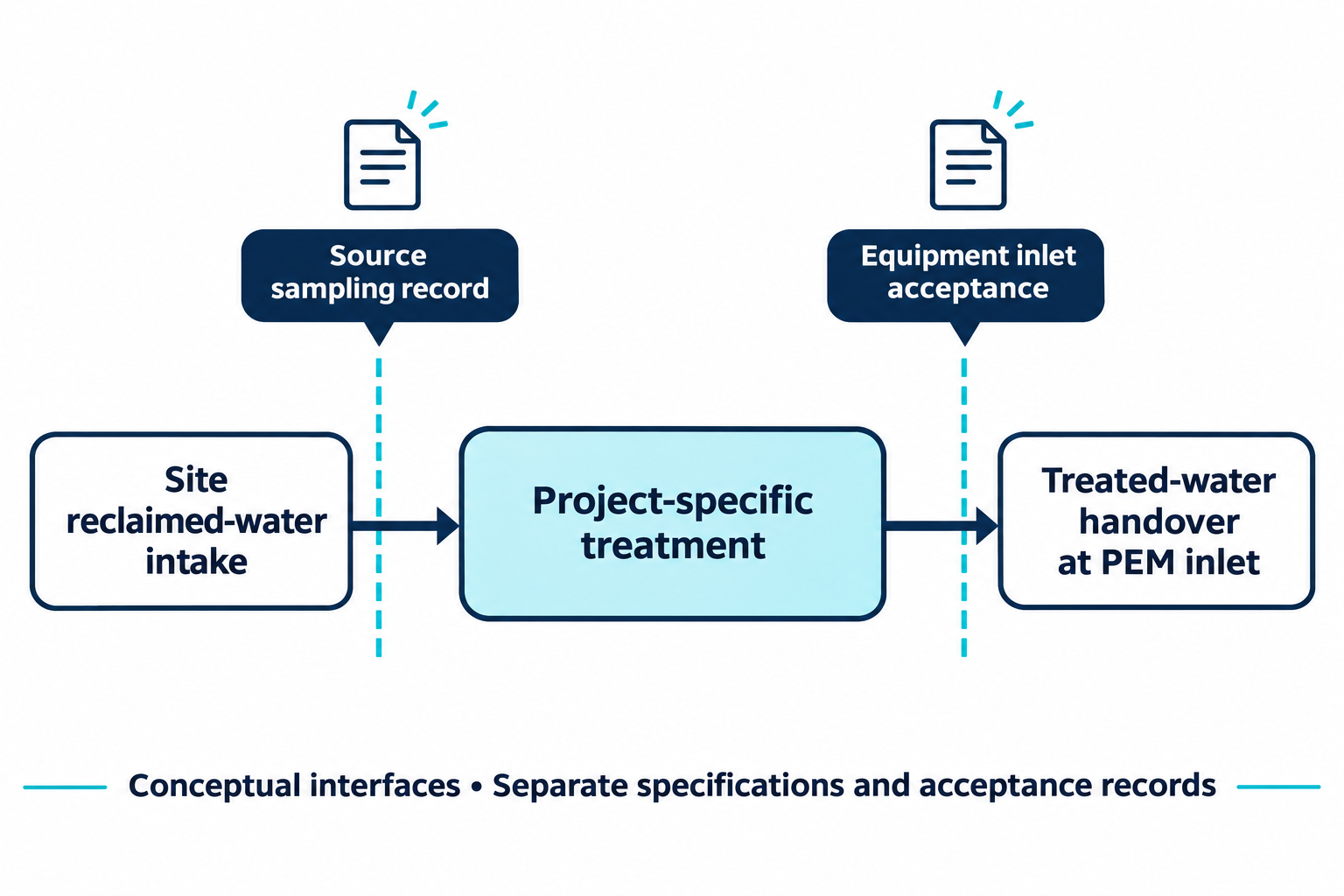
Separate water handover points at the reclaimed-water intake and PEM inlet are linked through project-specific treatment. Conceptual interfaces: the site intake and electrolyzer inlet have separate specifications and acceptance records. Treatment and ancillary streams depend on the project; this is not an actual project design.
Compare net water delivery over the same operating profile
Ask each bidder for a water balance with the same time basis and operating scenarios. Identify the reclaimed water drawn at the site intake, treated water available to the electrolyzer, and water used for auxiliary duties where included. Record the assumptions for recirculation, internal uses and losses. Require the bidder to define what its recovery figure includes and the feed conditions under which it applies. Ask for net delivery in both the normal case and the most demanding case included in the agreed feed range.
Review normal demand alongside peak demand and its duration. For example, a treatment unit sized for average demand might rely on storage to cover a brief peak. The proposal should show how much usable storage is assumed, when it can be replenished, and what occurs during an intake shortfall or treatment outage. Record whether backup water is available, permitted for the project and verified against the same equipment inlet limits.
Ask where each reject, purge or intermittent treatment stream is handed over, what flow and quality basis the receiving party uses, and who arranges any further treatment. The UK Environment Agency guidance discusses water supply and reuse in §3.4 and continuous or periodic wastewater streams in §5.1. Use those categories to check the water balance and consult the project team about the requirements that apply to the site. UK Environment Agency electrolysis guidance, §§3.4 and 5.1
Assign the sampling and release decisions before acceptance
For each handover point, put the sampling method, instrument or laboratory, test interval and witness or release role in the acceptance plan. Set the conditions under which flow and quality will be observed together. If the factory uses a different feed or bypasses site distribution, record that test basis and assign separate site checks for the installed supply and treatment chain.
Agree who acts when the incoming feed exceeds the treatment supplier's agreed range, when the treated water misses the equipment requirements, and when there is too little conforming water to serve the current demand. Specify who decides whether to hold the supply, use an approved backup or authorize a return to normal delivery. Keep the results and disposition linked to the relevant sample and operating period.
For a PEM scope review, provide the available intake analyses, intended operating profile, proposed treatment and distribution responsibilities, and the water verification point at the equipment connection. HELE PEM electrolyzer enquiries
Frequently asked questions
Can reclaimed industrial water feed a PEM stack directly?
Use the water requirements for the selected stack and configuration. Evaluate the measured feed against those limits and agree the treatment and verification needed to deliver conforming water at the specified connection.
Is one source-water analysis enough for a quotation?
It can support a preliminary estimate. Ask which process or seasonal variations are still unknown, how they may affect the treatment offer and what measurements would support a firm guarantee.
Where should treated water be sampled if there is a buffer tank?
Use the location named in the acceptance plan. If the tank or distribution line sits downstream of the treatment outlet, agree what each test demonstrates and verify the equipment inlet where the equipment specification applies.
Can two offers be compared on percentage recovery alone?
Compare the feed range, net conforming flow at the handover and what each offer includes in its recovery calculation. Check how storage, peak demand and any intermittent streams affect usable delivery.
Does a factory acceptance test establish that the site water will be suitable?
A factory test demonstrates performance under its documented feed and supply conditions. Define a site verification for any source, treatment or distribution condition absent from the factory test.
Who is responsible for reject water and off-spec supply?
Name the party that receives each reject stream and the party authorized to hold or release treated water at the equipment interface. Record both responsibilities and the evidence they use in the order.
Prepare a technical enquiry
Share the hydrogen or test duty, operating conditions, interfaces and the equipment scope you need reviewed.
Ask a technical question →References

Project contact