
Which Hydrogen Demonstration Kit Fits Your Teaching Objective?
Compare electrolysis, fuel cell and solar hydrogen teaching kits by student learning objective, observations and supplied equipment.
Table of Contents
Choose the kit that makes the lesson’s main observation measurable. An electrolysis demonstration focuses on electrical input and hydrogen production. A fuel cell demonstration focuses on electrical output under a load with an approved hydrogen supply. A solar-to-hydrogen kit connects the stages so students can explain the conversion sequence and identify which measurements support each conclusion. PEM electrolysis demonstration · Fuel cell demonstration · Solar hydrogen demonstration kit
For a purchase request, write down one observation students should make and one conclusion they should be able to justify. Ask the supplier to show what the specific equipment records. The data needed for a classroom discussion can differ from the data needed to assess a quantitative energy balance.
Choose the lesson objective first
| Teaching objective | Suitable demonstration | Ask to see before ordering |
|---|---|---|
| Follow how electrical input relates to observed gas production | PEM electrolysis | A sample worksheet that identifies the electrical input and any gas measurement the supplied equipment provides |
| Compare fuel cell output at approved loads | Fuel cell and load | The compatible supply and load scope, available electrical displays or data outputs, and a sample observation record |
| Trace conversion across electrical, hydrogen and electrical output stages | Integrated solar-to-hydrogen kit | A diagram of the stages, named measurement points, a list of supplied modules and any separate light-source requirements |
| Teach controlled stack testing and data collection | Laboratory rack or test platform | Device and fixture interfaces, measured channels, controls and export requirements matched to the test plan |
For example, an introductory class can label energy conversion stages and note which variables change under the manufacturer’s demonstration conditions. An advanced group can compare two recorded observations on the same basis. If the lesson promises an efficiency calculation, name both the input and output boundaries, ensure the measured signals and units support the comparison, and identify which energy or loss terms the classroom data leave uncertain.
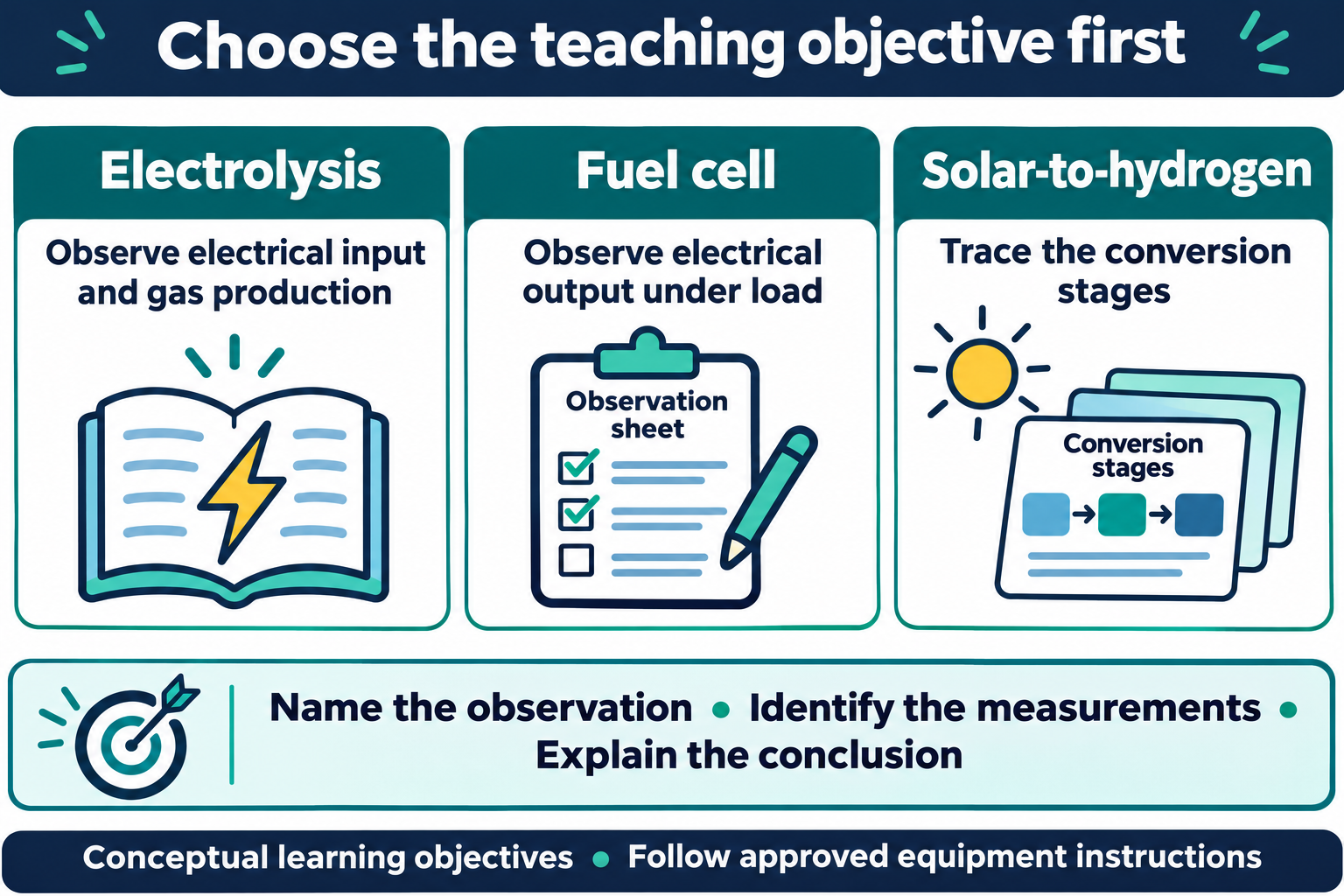
Three conceptual teaching objectives compare electrolysis observations, fuel-cell output and solar-to-hydrogen conversion stages. Conceptual learning objectives only. Match the observation record to the supplied equipment and follow its approved instructions and the institution's laboratory requirements.
Check equipment and instructor requirements together
Ask what is included for the approved demonstration, including the equipment modules, measurement displays, instructor materials and any consumables or separate utilities. Confirm which accessories the school or training lab is responsible for. Record the intended room, available supervision and the approved conditions for using the exact model. Use the supplier’s operating and safety documentation and the institution’s laboratory approval process.
If the vendor supplies an optional sensor, storage module or display, ask how that option changes the worksheet and which observations it makes possible. Confirm how many teams can use the apparatus during the scheduled lesson and whether a demonstration station or a set of student workstations is appropriate.
Ask for a sample lesson record
Give bidders the class level, learning outcome, maximum group size, duration and desired observations. Ask for a short sample instructor worksheet that labels inputs, outputs, conditions and units. At receipt, compare the included kit and documentation with the quote. Before classroom release, have the instructor verify that the equipment produces the intended demonstration under the approved conditions.
Frequently asked questions
Does a fuel cell demonstration make its own hydrogen?
A dedicated fuel cell demonstration uses an approved stored or supplied source. Confirm the scope of the quoted assembly or evaluate an integrated kit when production is part of the lesson.
What can students record in a PEM electrolysis lesson?
Ask the supplier to identify the electrical signals, available gas observations and which values are displayed or saved by the quoted equipment. Match the worksheet to those signals.
Can we use the kit to teach efficiency?
Yes, if the exercise defines what is measured and the expected interpretation. Quantitative efficiency requires justified input and output measurements on a consistent basis.
Do all solar kits include the same light source?
Confirm the offered modules and light-source requirements. Ask what room conditions the approved activity assumes and what the institution must provide.
When is a test rack a better fit?
Evaluate a test rack or platform when the lesson requires the students to define the device under test, control conditions and collect reproducible data over a specified test.
What should go into a request for quotation?
Send the learning objective, class size, room and utilities, desired observations, instructor material and delivery date. State which accessories and evidence should be included.
Prepare a technical enquiry
Share the hydrogen or test duty, operating conditions, interfaces and the equipment scope you need reviewed.
Ask a technical question →References

Project contact