
Titanium Products Buying Guide
Choose the titanium product form that supports the service and the remaining manufacturing work.
Table of Contents
Choose the titanium product form that supports the service and the remaining manufacturing work. A plate, tube, bar, wire, mesh, forging and machined part involve different standards, delivery conditions and verification. Define the assembly or process needs first and compare suppliers on the same scope.
Convert the application into a material and form requirement
Describe exposure, loading, interfaces and the operations the part or stock will undergo. Identify the grade, condition and relevant product specification with the design authority. A material recommendation depends on the medium and service conditions as well as what the supplier must manufacture.
Choose the form that leaves a practical route to the finished item. Sheet and plate can be specified for the forming or machining operation they support. Bar and forgings need a defined stock shape and usable envelope. For tube, specify the product and its mating joints. Wire, mesh and foil need form-specific dimensions, orientation or packaging.
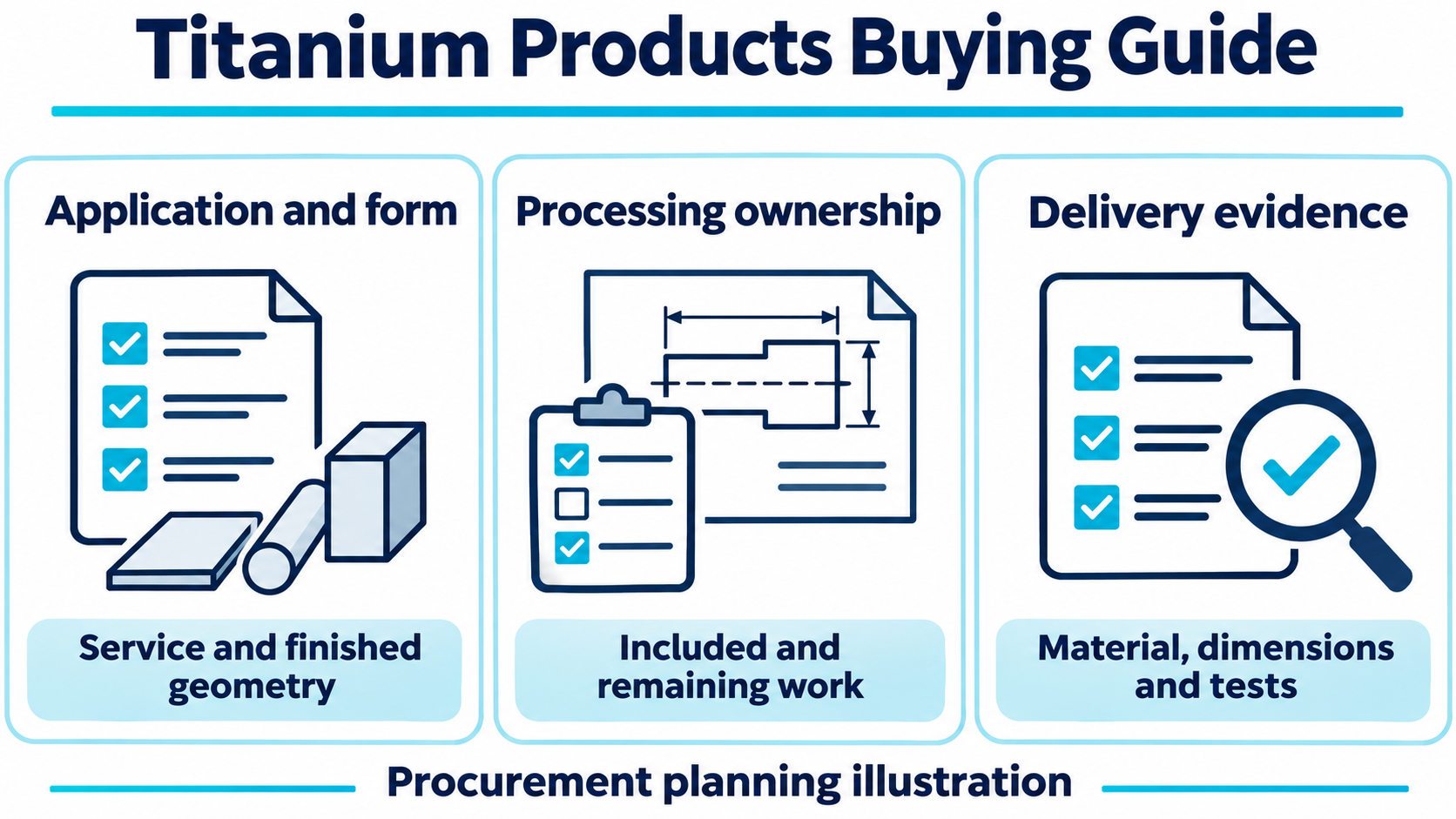
Titanium Products procurement illustration: application and form, processing ownership, delivery evidence. Concept illustration of the article's procurement checks: service and finished geometry; included and remaining work; material, dimensions and tests.
Assign responsibility for material processing and delivery
Decide which steps are included, such as cutting, forming, machining, joining or finishing. Name the condition in which the buyer will accept the item and who qualifies any later process. Ask each supplier to identify its proposed route, deviations and documentation rather than relying on a product category or grade alone.
Use the drawing or schedule to record dimensions, tolerances, critical surfaces and interfaces. For any material or route substitution, require the design owner to review the effect on function, inspection and delivery. Compare cost with remaining work and usable material visible.
Connect batch evidence to actual delivery
Identify what the material record must show and how it links to the item after cutting or processing. Specify dimensional, surface, examination and functional records according to the finished scope. Use the approved drawing and purchase documents to distinguish a material certificate, a conformity statement and a test result. Titanium material certificates and inspection
For an enquiry, send the intended use, proposed form, material and condition, drawing or dimension schedule, quantity, processing and verification requirements. HELE titanium products and fabrication
Frequently asked questions
How do I choose between titanium product forms?
Start from geometry, service and the process used to reach the final part. Compare allowable starting forms and confirm the applicable specification for each.
Does a titanium grade name define all the material requirements?
State the product form, specification and revision, grade and deliverable condition. Add the inspection and documentation required for the order.
When should the material supplier and fabricator be separate?
Assign the processes by the evidence and responsibility the buyer needs. Define how constraints and lot identity are passed between suppliers.
What makes a proposal a like-for-like comparison?
Use the same dimensions and condition, technical requirements, process scope, documents and delivery basis. Identify deviations before price comparison.
Can a material certificate cover a finished assembly?
Use it to verify the material it identifies. Specify assembly dimensions, tests and evidence separately where required.
What should I send if I do not know the product form?
Provide the service and finished geometry, intended downstream work and any fixed design conditions. Ask the supplier which proposal assumptions need review.
Prepare a technical enquiry
Share the product form, grade or standard, dimensions, quantity and inspection requirements.
Ask a technical question →
Project contact