
Titanium Mesh Buying Guide
Specify titanium mesh by its construction and what must pass through, be retained or make contact.
Table of Contents
Specify titanium mesh by its construction and what must pass through, be retained or make contact. The purchase should identify the geometry convention, orientation, material and finished boundary. Compare the complete installed form, including edges and frame, when the mesh serves as part of an assembly.
Choose the construction by installed function
State whether the mesh is intended for filtration, support, an electrode substrate or another defined function. Give the equipment drawing, contacting medium, flow or load and the relevant service conditions. Identify which choice of woven, expanded or perforated construction the design permits.
For woven mesh, ask which wire size and opening or count define the product. For expanded mesh, identify required strand and opening dimensions, including direction. For perforated material, show hole shape, pattern and pitch. State whether a design needs open area and agree how it is determined for the intended use.
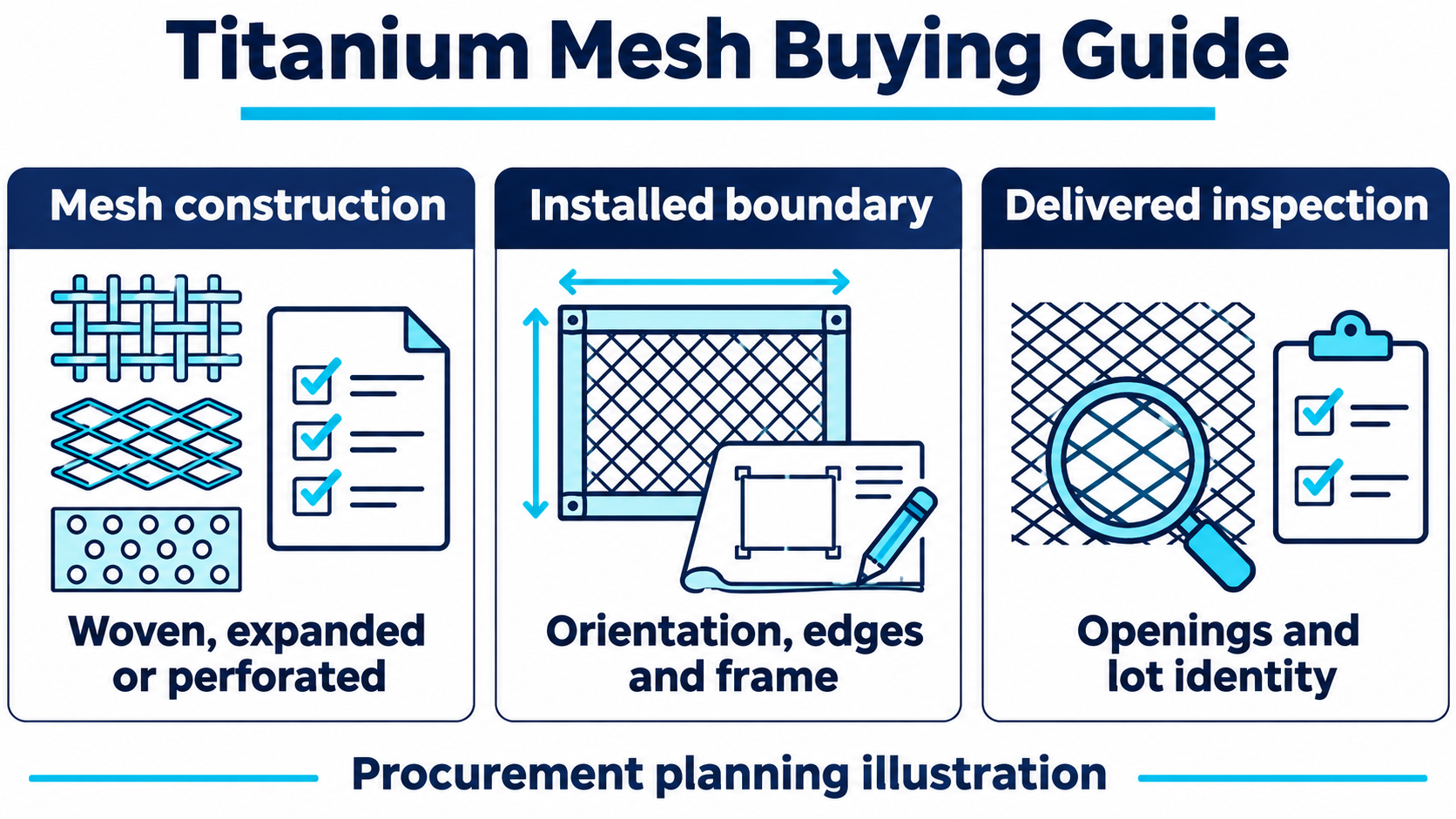
Titanium Mesh procurement illustration: mesh construction, installed boundary, delivered inspection. Concept illustration of the article's procurement checks: woven, expanded or perforated; orientation, edges and frame; openings and lot identity.
Define material, orientation and finished interfaces
Specify the titanium grade, feedstock basis and condition. Identify which orientation, edges, attachment, framing and finished outline are critical. If welding, bending or cutting applies, indicate responsibility and what final checks will be made after processing.
Where mesh is a bare substrate for an electrode, separate the mesh requirement from the coating and electrical scope. If the order includes a finished electrode or another assembly, use the approved drawing to define working zones, connections and the related qualification. For applications requiring special validation, ask the responsible authority to approve the complete use case.
Set inspection evidence for the actual mesh type
Agree opening measurements, orientation, size, flatness or finished fit, and any surface criteria. Where the mesh will be fitted to a frame or installed with a defined edge, request inspection in the delivered condition. Link material and processing records to the product and specify how bundles or parts are identified.
Before requesting a quote, send the form, geometry and orientation, grade and condition, active or flow boundary, final dimensions and inspection plan. HELE titanium mesh
Frequently asked questions
Can the same opening number compare woven and expanded mesh?
Specify what the number measures, the direction and construction. Compare the actual opening and design function on that basis.
Why should orientation be marked?
Orientation may affect the installed opening geometry and mechanical or electrical behaviour. Record it where those characteristics matter to the design.
What distinguishes mesh stock from a framed part?
A framed part includes the supplied shape, edge, joint and fit requirements. Identify who provides the frame and verifies the finished assembly.
Does a mesh quote include coating?
Use the agreed supply list. Specify coating, working area and acceptance separately if the order includes them.
Which documents should follow cut mesh pieces?
Specify material and lot identification, the cut drawing, dimensions and any required inspection records.
What if a flow or retention result is critical?
Agree a test on the actual geometry, or justify a representative sample. State the installation and conditions that the result is intended to cover.
Prepare a technical enquiry
Share the product form, grade or standard, dimensions, quantity and inspection requirements.
Ask a technical question →
Project contact