
Titanium Forgings Buying Guide
Buy a titanium forging against its delivery envelope and the requirements of the final part.
Table of Contents
Buy a titanium forging against its delivery envelope and the requirements of the final part. Specify the material, starting-stock and forging route, condition, machining allowance and evidence for properties, examination and identification. Use the released envelope drawing to compare offers for rough and machined supply.
Define the usable forging envelope
State whether the order covers an as-forged blank, rough machined component or finished part. Provide a released drawing identifying the final part within the forging, its orientation and controlled datums. Mark machining and inspection stock, surfaces requiring cleanup and any protective allowance needed for the next operation.
Ask the design owner to state the approved grade, product specification and delivery condition. If a specific grain-flow or orientation requirement applies, show where it is evaluated and what evidence the buyer needs. Ask for the proposed route and identify which changes to stock, process or heat treatment would require approval.
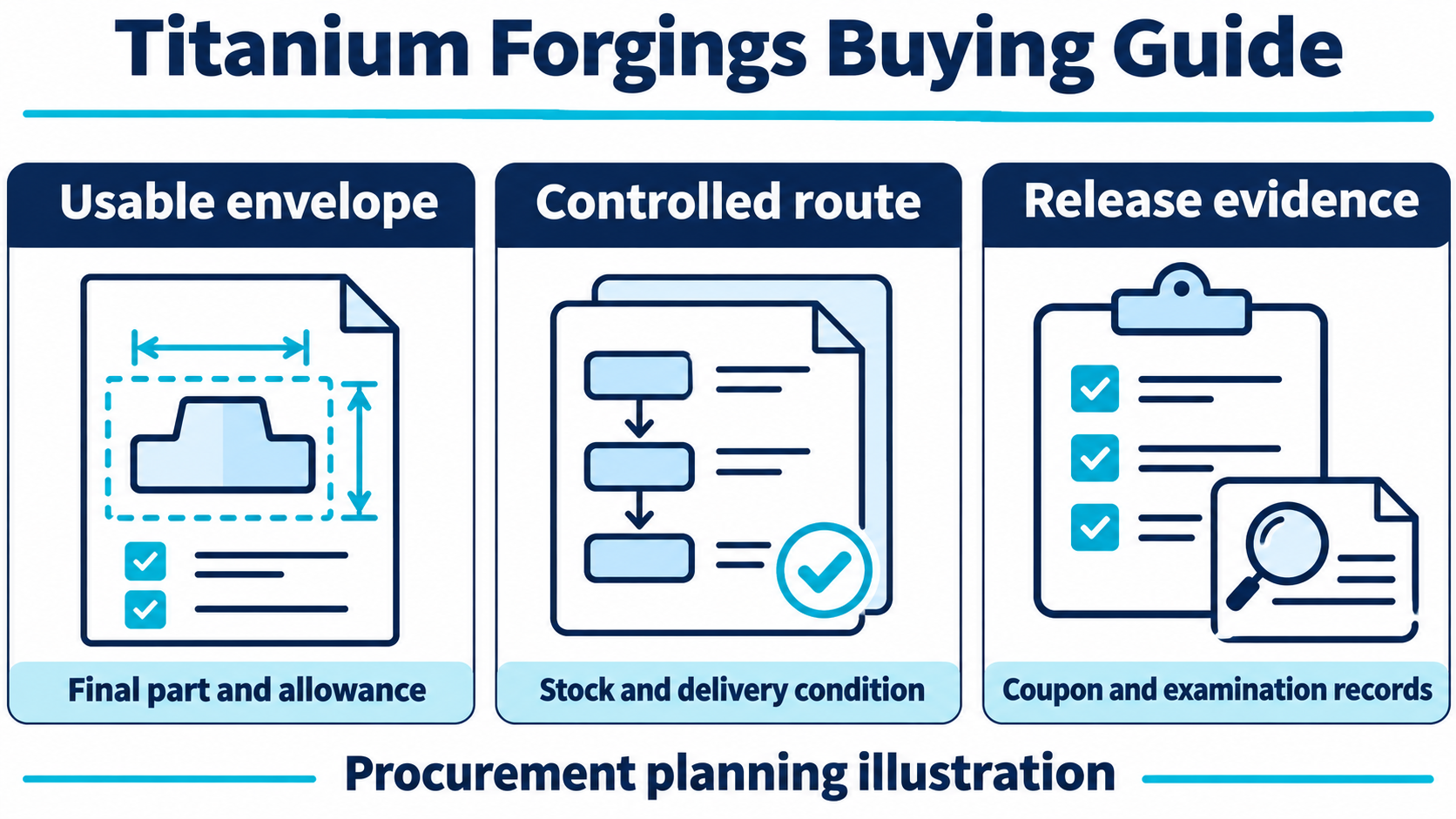
Titanium Forgings procurement illustration: usable envelope, controlled route, release evidence. Concept illustration of the article's procurement checks: final part and allowance; stock and delivery condition; coupon and examination records.
Plan material identification, coupons and examination
Choose how material heat and processing lot are identified from starting stock through forging, heat treatment, examination and cutting. Request evidence that links each delivered item to the actual processing condition. Where properties are verified by a coupon, identify its location, orientation and relationship to the lot and part.
Set the scope of nondestructive examination when specified by the design. Agree the stage, affected areas, method, coverage, acceptance basis and report, including how regions that cannot be inspected are handled. Confirm which dimensional or surface checks apply before the next machining step.
Compare the delivered scope and release sequence
Place rough and finished geometry on a clear inspection basis so price comparisons include the work still required at the buyer's site. Ask each supplier to list process, allowances, testing, any witness points and delivery dates against the approved scope. Record which responsibilities apply to machining after delivery and how part identity will be retained.
For a quotation, send the finish and forging-envelope drawings, grade and condition, approved process constraints, quantity, inspection plan and documents required. HELE titanium forgings
Frequently asked questions
What is a forging-envelope drawing?
It shows the delivered blank relative to the final geometry, including orientation, margins and locations that guide downstream processing or inspection.
Who defines machining allowance?
The parties responsible for design and machining agree it against the actual route and final geometry. Record it on the controlled drawing or instruction.
Does a coupon result apply to every forged location?
Confirm how the coupon relates to the part and lot. Specify orientation, position and the acceptance basis used by the project.
When must an examination take place?
Use the stage identified in the approved inspection plan, taking account of access, surface condition and what subsequent processing may change.
Which changes should require review?
Identify process, material, heat treatment and facility changes that can affect the qualified route or evidence. State the approved review path.
How do I compare a raw forging with a machined offer?
List the finished condition, allowances and remaining work for each. Align test, handling and delivery scope before comparing total cost.
Prepare a technical enquiry
Share the product form, grade or standard, dimensions, quantity and inspection requirements.
Ask a technical question →
Project contact