
Titanium Diaphragm Buying Guide
Specify a titanium diaphragm using its actual role, the formed drawing and the validation required in the final assembly.
Table of Contents
Specify a titanium diaphragm using its actual role, the formed drawing and the validation required in the final assembly. Put material, finished profile and thickness, edge and joining conditions, tooling ownership and evidence for the intended duty on the order.
Confirm which geometry performs the function
Describe whether the component moves, transmits pressure or forms an isolation boundary, and identify the connected equipment and environment. Include the design team's pressure, motion, temperature or cycle requirements where relevant. State who confirms complete-assembly performance and which component data are needed for that evaluation.
List the material standard and condition and use the drawing to define diameter, formed profile, features and edge condition. If thickness is controlled both before and after forming, show the location and required measurement state. Specify cleanliness and surface requirements where they affect the working interface.
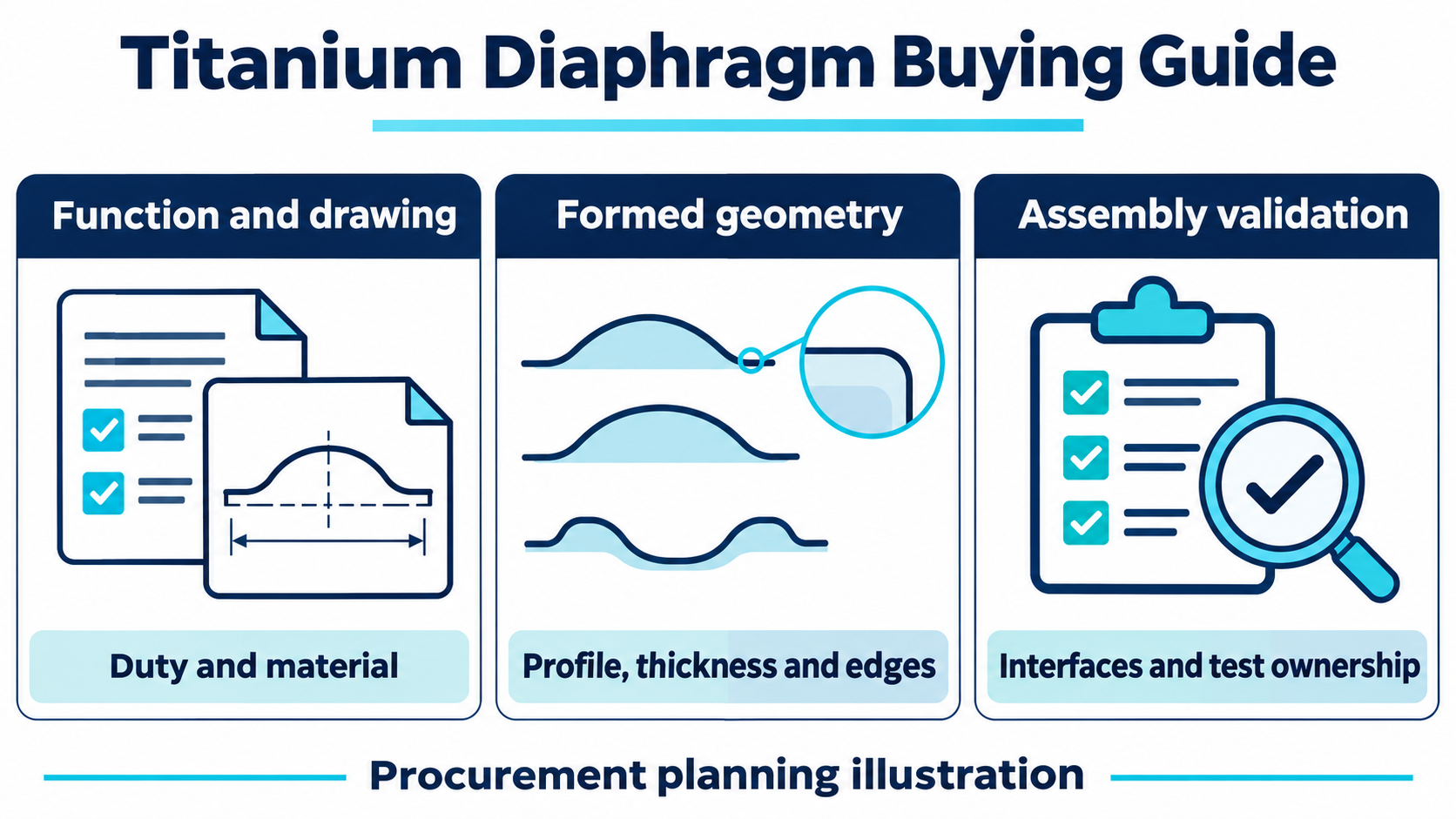
Titanium Diaphragm procurement illustration: function and drawing, formed geometry, assembly validation. Concept illustration of the article's procurement checks: duty and material; profile, thickness and edges; interfaces and test ownership.
Qualify the formed part and the joining interface
Ask the proposed supplier to identify the production route and what tooling or samples represent it. Agree what the prototype should demonstrate about fit, profile and handling. If a reference sample is used, connect it to the drawing revision and state which characteristics can be verified from the sample.
Show the surfaces that locate, seal or join to the next assembly. Assign bonding or joining, where required, and confirm which checks take place before and after those operations. Define support and measurement locations for thin geometry. If a dimensional check can distort the part, ask the design and quality teams to approve the inspection condition in advance.
Protect the diaphragm and preserve evidence
Specify what the release document should identify about material, tooling, production lot, drawing revision and results. If changes to forming, stock or joining can affect the component, state the approval and requalification process. Agree packaging and handling that protect thin features and keep each lot identifiable.
For a quote, provide the service and working function, finished drawing, material, prototype demand, mating interfaces and the planned component and assembly tests. HELE titanium diaphragms
Frequently asked questions
Is blank thickness sufficient?
Identify what thickness condition the design needs at the formed locations. Specify any blank requirement separately.
How should a corrugated profile be purchased?
Use a controlled section or model to identify the functional shape and datums, then agree how the profile will be checked.
Can a prototype approve production?
Agree which aspects the prototype represents. Identify differences in material, tooling or route requiring a production check.
Who qualifies installed pressure or cycle performance?
Assign it to the party responsible for the assembly validation. Define the configuration and conditions that the test will represent.
How should an edge condition be verified?
Identify the protected or joined edge, its limit and the inspection condition. Keep the approved criteria with the drawing revision.
What should the packing specification cover?
Define support, separation, protection and identification so the diaphragm can be handled without losing its verified condition.
Prepare a technical enquiry
Share the product form, grade or standard, dimensions, quantity and inspection requirements.
Ask a technical question →
Project contact