
How to Specify Usable Length and Splice Positions in a Titanium Coil Order
Specify the reference end, splice restrictions and minimum uninterrupted run length when buying titanium coil.
Table of Contents
Approve the minimum uninterrupted feed length before comparing titanium coil offers. Ask for a record for each delivered coil showing the feed direction, the reference end and the stretches that the line may use. Total net weight answers how much material arrived. The segment record answers whether the coil can run the intended job.
Put the line's release unit on the order
A buyer planning a continuous run needs the minimum uninterrupted length for one release. A buyer using a cut-to-length process may accept several shorter runs. Put the applicable rule on the quotation request alongside the coil ID and OD, unit weight, winding orientation, strip dimensions and permitted splice types. For a slit coil, identify the delivered child coil as well as the parent material. Its map must match the unit installed on the line.
Use the approved material specification and its edition for material conformity. ASTM B265 covers titanium and titanium-alloy strip, sheet and plate. Splice positions, exclusions and usable-length reporting belong in the order documents when they matter to the receiving line. ASTM B265 scope
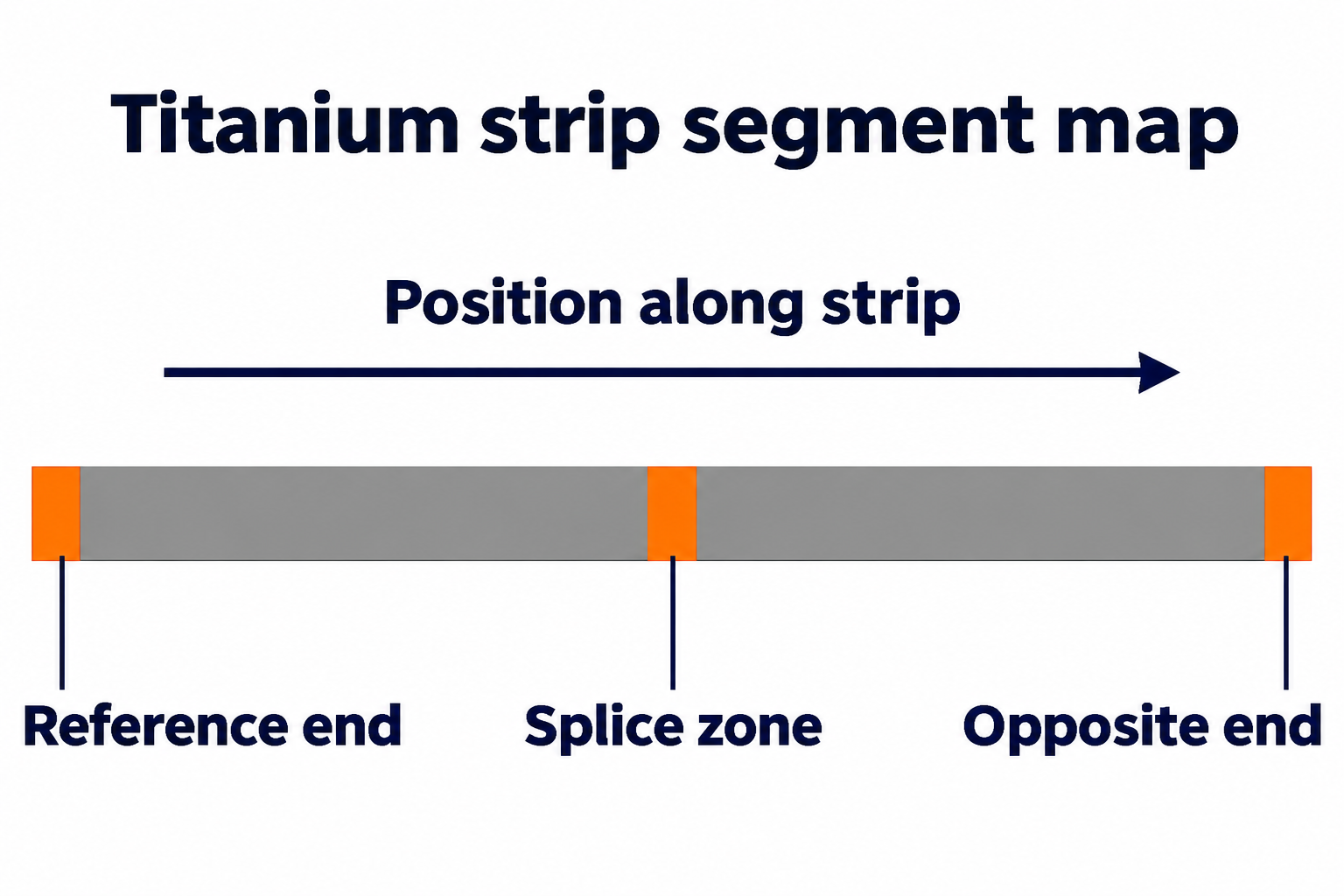
Specify how to draw and read the coil map
Name the leading end for the stated feed direction and record the unit of length. Define the boundary of a marked splice zone, a restricted end, and any other section the buyer has agreed to exclude. Indicate whether a listed splice is allowed through the line, needs to be cut around, or requires review. The map is easier to reconcile when the width, coil identity, winding and label version travel with it.
A position measured from the trailing end needs an agreed conversion before it can be compared with a record measured from the leading end. If a coil is rewound, split or reidentified, ask how the supplier transfers the map and parent traceability to the delivered coil. Let the line owner approve any change in feed orientation or release basis.
Calculate total usable length and longest continuous segment separately
The following example uses hypothetical values in metres to demonstrate the calculation. It assumes the buyer has already approved exclusion intervals. Measure positions from zero at the leading end of a 100 m coil.
| Example interval | Status | Counting rule |
|---|---|---|
| 0 to 3 m | Leading end excluded | Exclude 3 m |
| 40 to 42 m and 41.5 to 44 m | Two exclusions overlap | Combine them as 40 to 44 m and exclude 4 m |
| 97 to 100 m | Trailing end excluded | Exclude 3 m |
| 3 to 40 m and 44 to 97 m | Usable stretches | Record 37 m and 53 m separately |
The total usable length is 90 m across the two stretches. The longest uninterrupted stretch is 53 m. If the planned job needs 60 m without interruption, the total is sufficient on paper and the coil still lacks a qualifying continuous segment. These example lengths are for arithmetic only. Use the approved requirements for the actual line.
Give receiving staff an explicit hold and release record
Ask receiving to match the coil label, packing list and map, then verify the stated reference end and feed direction. If the map conflicts with the label or the expected mark is missing, record the discrepancy against that coil and follow the approved hold procedure. Request an updated, traceable map or a written disposition from the authorized party. On the release record, repeat the map revision, the accepted stretches and any remaining restrictions so the line receives the same information as purchasing.
See the HELE TITANIUM coil buying guide for the wider material, dimensional and handling requirements.
Frequently asked questions
Can a coil with a splice run continuously?
The line owner decides which splice conditions are acceptable for the equipment and process. Record the decision and any required segregation on the order.
From which end should splice positions be measured?
Name the reference end and feed direction on the order and map. Use a common unit and reconcile any map produced in the opposite direction.
How should a slit child coil be identified?
Match its delivered identifier to its own map and the parent identity. Confirm any change after slitting or rewinding before releasing the coil.
How do we count exclusions that overlap?
Combine overlapping intervals on the same coordinate basis and deduct their union once. Report the separate continuous usable stretches as well as the total.
Can net weight replace the length map?
Use net weight for the commercial quantity and the agreed segment record for the run-length decision. A mass conversion cannot show where an excluded section begins.
Who releases a coil when the label and map disagree?
Follow the order’s hold and disposition process. Record the affected coil and request written approval tied to the corrected evidence before the line uses it.
Request a coil order review
Send HELE TITANIUM the alloy and condition, line and winding information, minimum continuous usable length, splice policy and required mapping record. View titanium coil · Submit a coil enquiry
Prepare a technical enquiry
Share the product form, grade or standard, dimensions, quantity and inspection requirements.
Ask a technical question →References

Project contact