
Titanium Balls and Spheres Buying Guide
Specify titanium balls by their function and purchase form.
Table of Contents
Specify titanium balls by their function and purchase form. A solid bearing-related component, a sealing ball and a hollow float each need a different drawing and test basis. Make the approved material, finished geometry, surface and acceptance record visible on the same order.
Define the construction and service
Tell the supplier whether the order covers a solid ball, hollow sphere, hemisphere or drawing-based assembly. Identify where it contacts a seat, race, fluid or other component. Provide the load, medium, temperature and movement the design team used. Ask who validates final assembly performance, especially where the part is used to seal, float or roll.
Specify titanium grade, product specification and condition, then identify what record will link the material to the delivered items. A mill record should trace the feedstock. Request separate finished-part evidence for the required spherical geometry and surface.
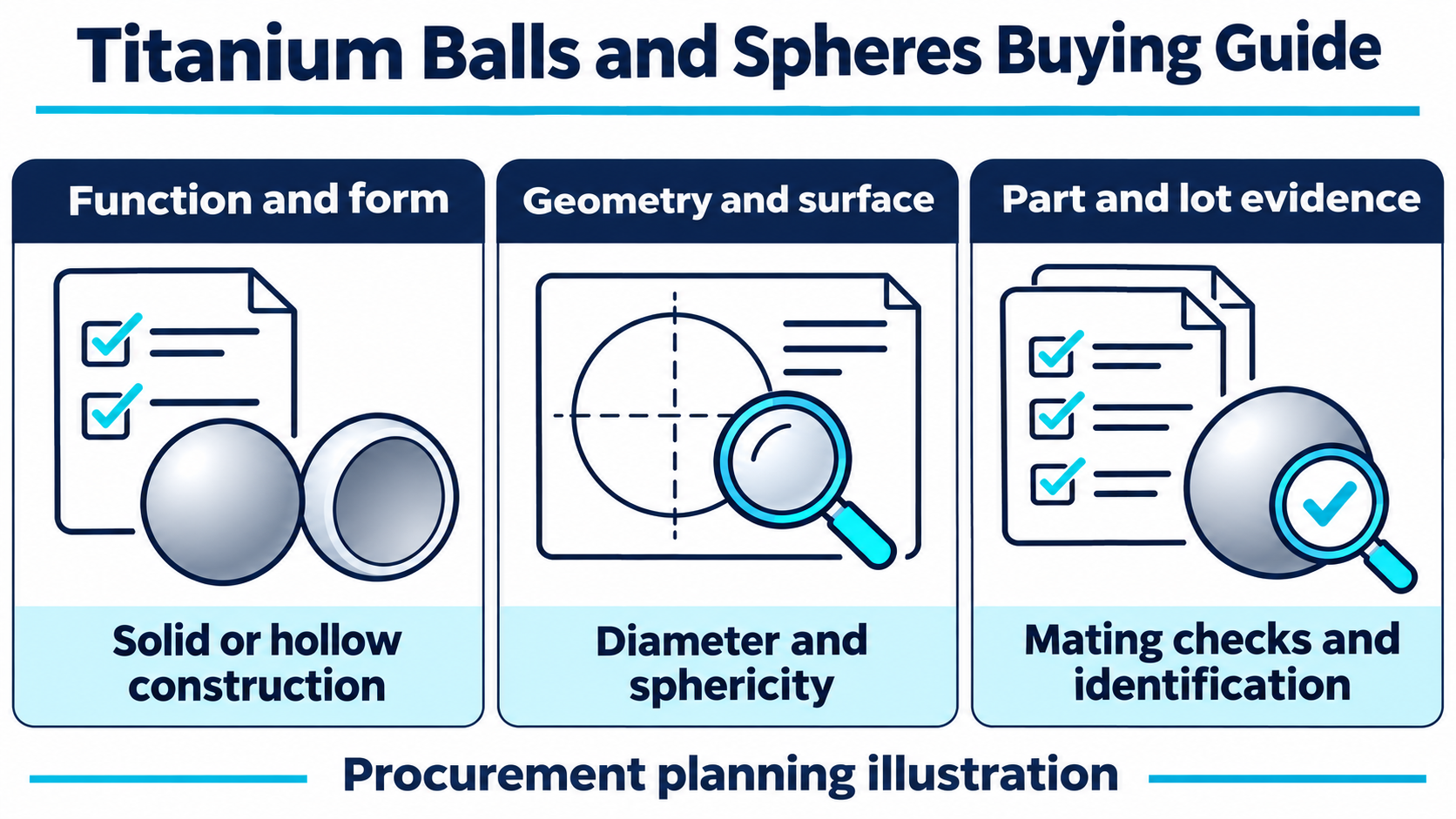
Titanium Balls and Spheres procurement illustration: function and form, geometry and surface, part and lot evidence. Concept illustration of the article's procurement checks: solid or hollow construction; diameter and sphericity; mating checks and identification.
Make shape and surface requirements measurable
List finished diameter and limit, then specify any separate form characteristics such as sphericity and the method used to verify them. If fitted with a seat, identify the contact region and surface finish at that location. State requirements for handling marks, edges, contamination and packaging where those could affect the mating part.
For hollow components, define the envelope, wall requirements if applicable, joint location and any checks for integrity or mass that support the design. For solid precision forms, agree measurement locations, support, instrument resolution and lot sampling. Discuss how a record represents the complete population where the order specifies critical characteristics.
Verify the first article and keep lot identity visible
Set a first-article or representative trial if mating performance depends on tightly controlled geometry. Name the actual mating part or approved gauge, and specify what result the assembly team will record. For production, request the verified dimensions and appearance alongside material, process and lot identifiers. State how the units will be protected during delivery and storage.
For a quote, share the intended function, construction, drawing, lot and surface requirements, and any seat, leak or functional checks the buyer needs. HELE titanium balls and spheres
Frequently asked questions
Is a diameter tolerance enough to define a precision ball?
Identify the form and surface properties that matter to the function and put those requirements and checks on the drawing.
How should a hollow sphere be quoted?
State the size, construction, wall or seam requirements, handling conditions and any mass or integrity checks required.
Does a material certificate establish the finished diameter?
It can support material identity when the records link to the lot. Request a finished-part measurement report for the geometry.
Where should surface condition be evaluated?
Specify the functional contact area and any other surfaces with different limits. Agree inspection access and the evidence to retain.
Who tests sealing or buoyancy?
Assign the named party and define the test article, equipment and acceptance basis in the order. Separate component and assembly release roles.
What packaging information belongs on the RFQ?
Describe how the spheres must be prevented from contacting or marking one another, any cleanliness requirement and the lot identification needed on each pack.
Prepare a technical enquiry
Share the product form, grade or standard, dimensions, quantity and inspection requirements.
Ask a technical question →
Project contact