What to Record When Salt Chlorinator and Independent Test Readings Disagree
Capture both salt readings and the conditions under which they were taken before sending a salt chlorinator for service or requesting a replacement cell.
Table of Contents
Capture both salt readings and the conditions under which they were taken before sending a salt chlorinator for service or requesting a replacement cell. The service team needs to know which controller and cell are paired, which display value was recorded, how the independent sample was tested and what changed before the readings diverged.
Record two measurements that can be compared
Photograph the controller display with the reading, units and any alarm visible. Note the time and identify whether the display shows an average, an instant value or an unspecified reading. Use the terms in the system manual so the service team knows which reading it is comparing.
Record the independent water test with the sample location, time, method, instrument and unit. Include the test instrument's verification status if available. Note any intervening water addition, salt addition or other change that makes the two measurements less comparable. When readings were taken on different days, send both as history and ask the service team whether a fresh comparison is needed.
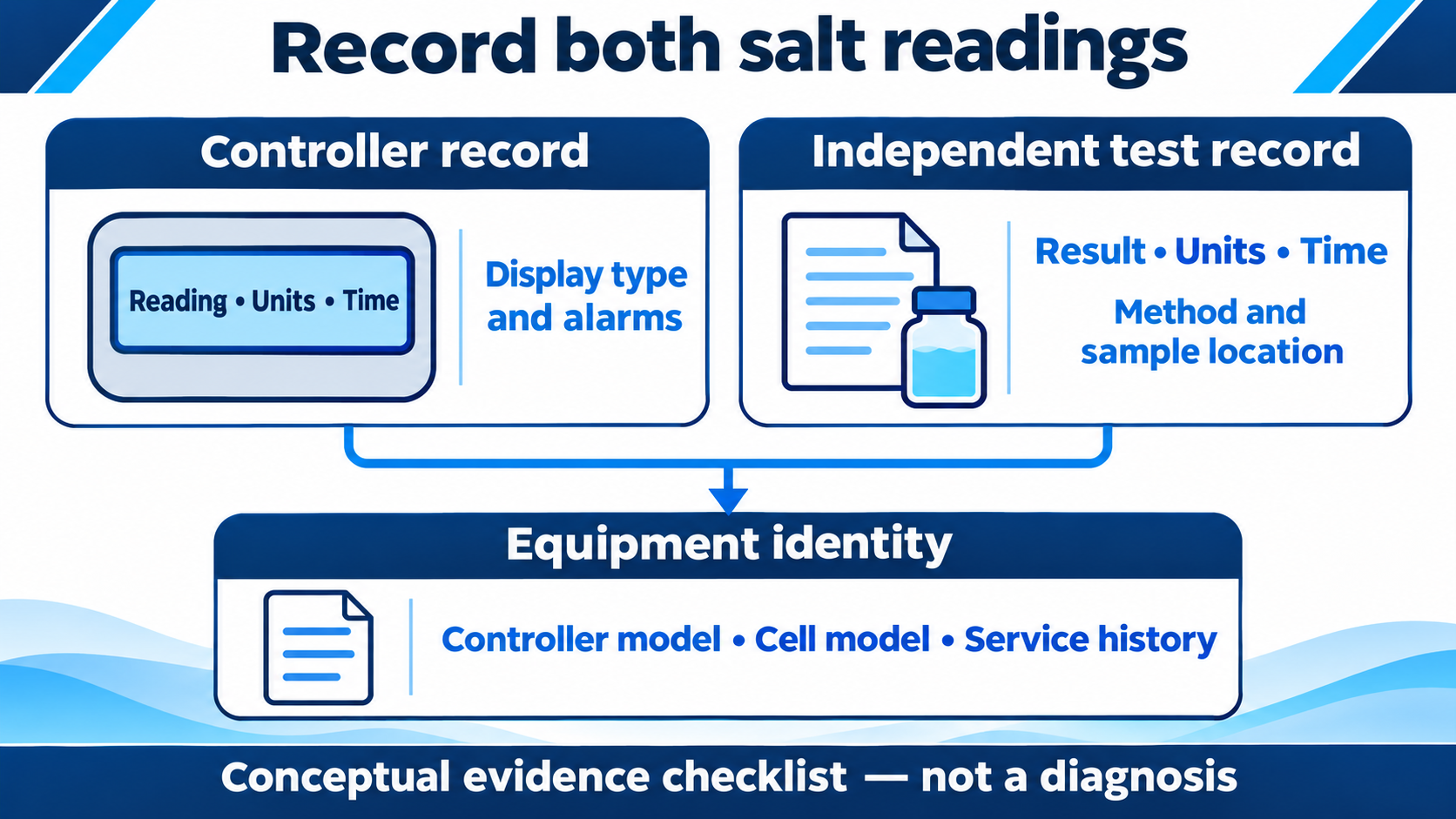
Controller and independent salt-test records are linked to controller model, cell model and service history. Conceptual evidence checklist for a service review. Placeholder labels are not measured readings or a diagnosis.
Link the readings to the installed equipment
Collect the controller and cell model identifiers and any visible revision information from accessible labels or existing service records. Ask an authorized technician to verify whether the recorded controller configuration corresponds to the installed cell. Record whether the mismatch appeared after a cell change or service visit, and attach the service findings if available.
Hayward's AquaRite troubleshooting guide illustrates the approach for systems covered by that guide. It calls for an independent salt check and verification of the cell model programmed in the control centre. Follow documentation for the installed system when interpreting displays, allowable differences and service findings. Hayward AquaRite troubleshooting guide
Decide what the service request should resolve
Send the observations in order and identify whether the request is for a diagnostic review, a warranty decision or a replacement quote. If the cell has already been inspected or replaced, say who performed the work and include the models and before-and-after results. A repeat discrepancy is a reason to reopen the evidence, including the independent test and system pairing.
If service recommends replacement, request written confirmation for the specific cell and controller combination. Ask which fittings and cables are included, who owns the compatibility decision and how any service or warranty terms apply. Retain the written scope so procurement can compare like for like when one offer covers a cell and another covers a complete system.
For a new equipment enquiry, give the intended pool application and specify whether the request concerns a cell, controller or complete assembly. For an installed third-party system, seek model-specific support from the responsible supplier or service team. HELE pool salt chlorinator enquiries
Frequently asked questions
Which units should be recorded?
Copy the units exactly as reported by the controller and test method. Ask the service team to verify the reporting basis before comparing a result labelled salinity with another value derived from conductivity.
What if the controller shows a warning without a numerical salt reading?
Record the exact warning and any other status indicators, along with the equipment identification. The technician can then locate the meaning of the warning in the correct manual and request the missing test information.
Should we include photos if the cell was recently inspected?
Include any authorized inspection photos with the service date and cell identity. Keep the technician's findings alongside the images so the reviewer can distinguish a visible observation from a diagnosis.
What if two independent tests disagree?
Send both results with the different methods and sampling conditions. Ask the service team which comparison method it accepts and whether the difference must be resolved before interpreting the controller reading.
Can two cells with the same housing be assumed to fit the same controller?
Ask the supplier to confirm the specific pairing in writing. Externally similar cells may be offered for different systems, and a physical fit alone leaves supply and controller compatibility unresolved.
What should we retain for a warranty review?
Keep the purchase and installation records, controller and cell identifiers, comparable readings, service dates and written findings. Ask the warrantor which documents its terms require and who will make the decision.
Prepare a technical enquiry
Share the process or protected asset, operating conditions, geometry or drawing, and the scope you need reviewed.
Ask a technical question →References

About the publisher
HELE Titanium
HELE Titanium supports industrial buyers with titanium materials, electrochemical anodes and PEM system project review.