
Ruthenium-Iridium Anode Buying Guide
Specify a ruthenium-iridium (Ru-Ir) coated titanium anode against the intended chlorine-evolution duty and its true chloride chemistry.
Table of Contents
Specify a ruthenium-iridium (Ru-Ir) coated titanium anode against the intended chlorine-evolution duty and its true chloride chemistry. Give suppliers the same process window, active area, requested assembly and performance measurement basis. Specify the coating and electrical connection evidence separately so procurement can identify what has actually been accepted.
Describe the actual chloride service
Provide the feed composition and relevant variation, including chloride concentration, other constituents, temperature range and duty schedule. Identify the desired output and where it will be measured. For an existing cell, state the electrode configuration and the conditions associated with any drop in output. Those records help separate a replacement decision from a review of the wider process.
Ask the supplier which operating points its proposal addresses and what should be evaluated if the feed or duty changes. Compare candidate coatings against the reaction conditions and measurements. Electrochlorination coating selection
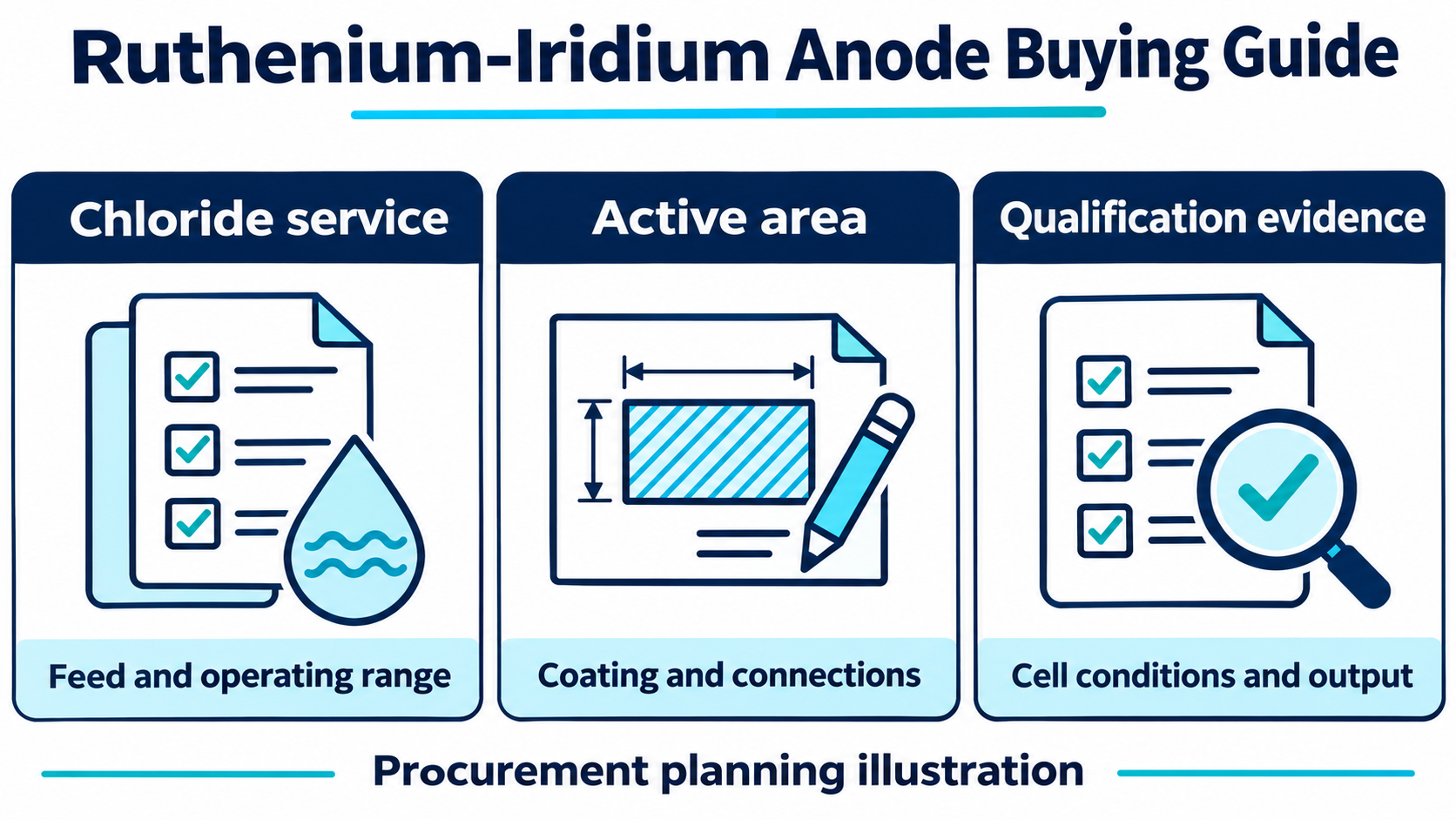
Ruthenium-Iridium Anode procurement illustration: chloride service, active area, qualification evidence. Concept illustration of the article's procurement checks: feed and operating range; coating and connections; cell conditions and output.
State what is coated and how electrical duty is calculated
Use the purchase drawing to identify the titanium grade and form, coated and masked zones, clearance, supports and connection details. Set a consistent active-area convention for the current density and any coating-loading value. Record the quantity to be verified, its units and the agreed measurement method.
If the supplier quotes a cell performance value, identify the cell configuration, electrical inputs, feed and measurement position that produced it. Ask which factors depend on the anode and which belong to the integrated cell. Put connectors, seals and auxiliary items on the supply list when they affect installation or verification.
Compare evidence for qualification, shipment and operation
Define what the supplier must report about material, coverage and dimensions, with lot links and drawing revision. If the buyer asks for a performance demonstration, agree the output basis, feed and duration. Check how results from a trial or prior cell map to the proposed configuration and what needs to be demonstrated at site. Keep any life or warranty condition tied to the duty and agreed limits.
For an enquiry, share the process chemistry, expected output, current profile, active-area convention and relevant drawing. Ask for the quoted construction, supply list and verification plan. HELE Ru-Ir coated titanium anodes
Frequently asked questions
Is chloride concentration sufficient to select a Ru-Ir anode?
Provide the full chemistry and variation that matters to the cell, plus temperature, electrical duty, target reaction and geometry. The proposal should be based on those combined inputs.
Can an existing drawing be reused?
Confirm that the installed cell, active zones, electrical contacts and process conditions still match. Have the design team approve any changes.
Which coating metrics should be compared?
Use like-for-like metrics with stated units, reference area and verification. Compare the performance basis separately.
Does an anode inspection establish output from the whole cell?
It can establish the anode characteristics tested. Define a separate output check for the agreed cell and operating conditions.
What should be recorded when production declines?
Capture the affected period, feed evidence, electrical readings, observed cell condition and maintenance or duty changes. Ask the responsible team which further evidence is needed.
What belongs in a change notice?
Identify each changed material, coating route or feature, why it changed, the affected lots and the evidence required for approval.
Prepare a technical enquiry
Share the process or protected asset, operating conditions, geometry or drawing, and the scope you need reviewed.
Ask a technical question →
Project contact