
Industrial Process Basket Buying Guide
Specify a process basket around the parts, equipment, fluid access, handling and the loaded acceptance test.
Table of Contents
Start with the parts, the equipment and the process the basket must pass through. A cleaning or handling basket has to support and retain the workpieces, fit the machine at every stage and meet the agreed cleaning or handling result. Develop the load pattern and acceptance test before choosing a mesh or specifying titanium.
Define what the basket does in each process step
List each operation from loading to unloading, including any transfers, rinsing, drainage, inspection and storage. One basket may serve several steps if its material and geometry satisfy the restrictions of each. Write down the sizes and forms of the workpieces, the proposed arrangement, and which surfaces must remain accessible. A basket that carries the load can still obstruct rinse flow or mark a machined face if two parts touch in use.
Name the basket's function on the drawing and RFQ. A carrier for parts has a different duty from a plating anode basket, which holds soluble anode material and forms part of a defined electrical path. Keep the electrical function explicit if the process requires it.
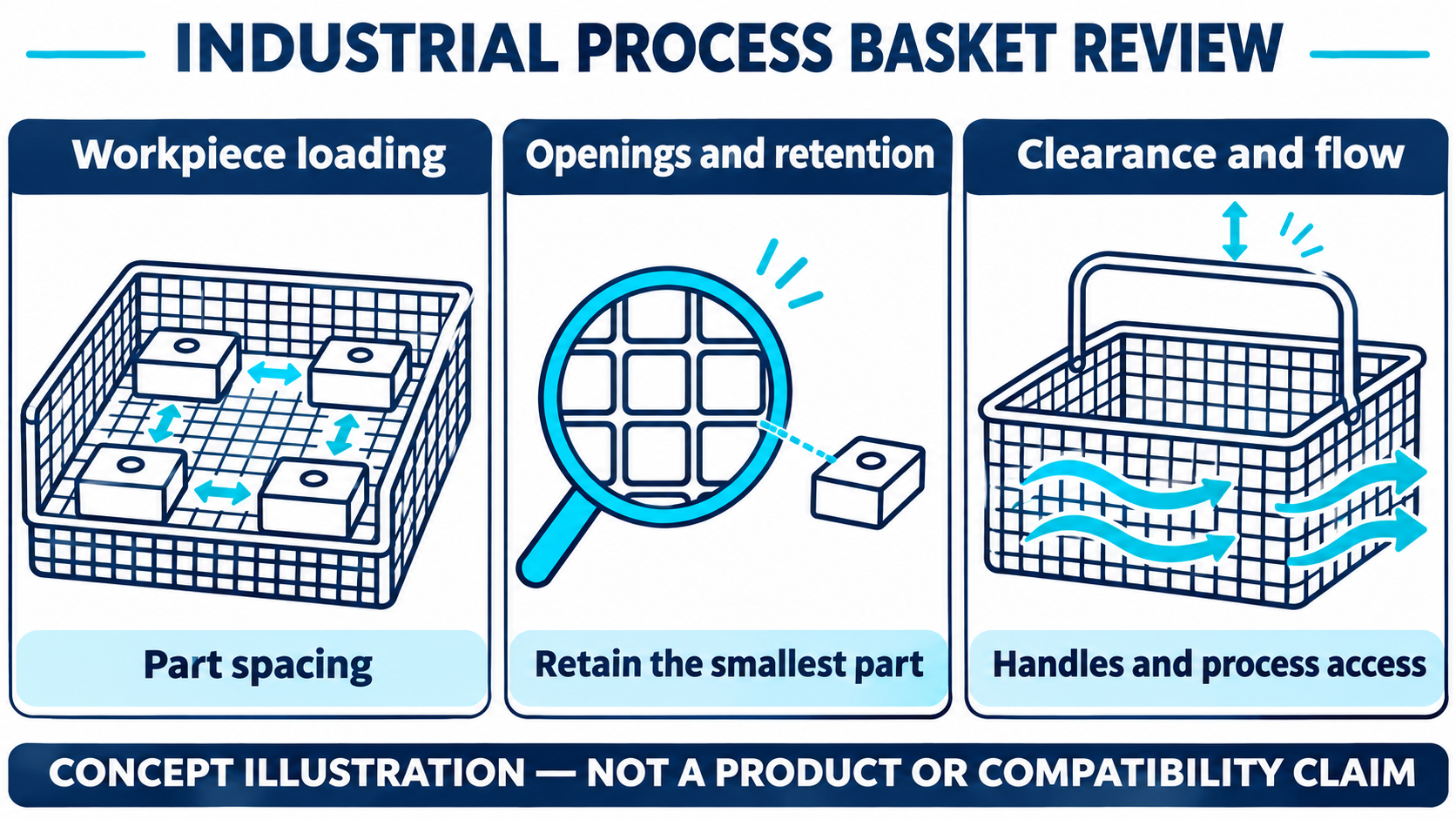
Concept illustration of industrial process basket loading, opening retention, handle clearance and process flow. Concept illustration only, not an existing HELE product or a compatibility claim. Confirm the actual load, retention, handling and process requirements against an approved drawing.
Select the construction and material around the duty
| Where the choice matters | What to specify | What to confirm |
|---|---|---|
| Fine or irregular workpieces | Smallest escape dimension, part orientation, expected movement and any lid or partition | Parts remain retained and can be removed without damage |
| Machined or finished surfaces | Contact areas, permissible marks and loading pattern | Parts do not shift into prohibited contacts during the assigned duty |
| Cleaning or rinsing | Workpiece spacing, support points, basket openness and drainage requirements | The loaded pattern reaches your process result and leaves no unacceptable retained liquid |
| Corrosive or alternating baths | All chemistry, temperature, exposure conditions and process cleaning steps | Material, welds and any other wetted parts are compatible with the complete route |
| Handling or automation | Loaded mass, lifting and gripping interfaces, equipment envelope and transfer path | Basket fits through the route and meets the agreed handling checks |
Open mesh can provide large passages for fluid but fine parts may require openings that retain them at every orientation. A perforated body can give a different support pattern. A rack or internal divider may be preferable if parts need to remain separated. Ask the supplier to show where these options change accessible surfaces, containment or handle clearance. Agree the actual opening, strand or plate dimensions, edges, orientation and tolerances on the drawing.
Specify titanium when the process evidence or approved materials list supports it. Ask the process owner to review the complete wetted assembly, including welds, attached handles or inserted hardware. Compare materials using the same chemistry, temperature, maintenance and part-handling requirements. Use material certificate and inspection guidance to define the documents needed for the chosen material form. Agree what record will tie the finished basket to the ordered material.
Verify fit and performance on the actual equipment
Use the equipment model and an approved interface drawing. Record the usable tank envelope after space is allowed for rails, supports, lids or lifting and handling equipment. Check how the loaded envelope moves through the entire path. A revised width or handle position can resolve a tank fit issue yet still conflict with the transfer fixture or lid.
For an ultrasonic cleaning application, follow the equipment manufacturer's rules on supports, clearances, approved accessories and loading. Elma's Elmasonic Easy R manual gives one example of instructions tied to an equipment family. Use your own machine's documentation for approval. Ask the process owner to define measurable cleaning and part-surface acceptance under representative loading.
Compare quotations on the same scope
Give every supplier the same controlled drawing, part list and load case. Separate the frame and retention geometry, inserts or covers, site fit checks, first-article cost and documentation. Ask which party supplies the approved fixture or sample parts. Where a quote assumes a generic basket envelope, record that assumption and request a revision against the actual interface.
For acceptance, identify tolerances and inspection points on the drawing. Then agree the representative loaded test, which surfaces to inspect after processing, whose equipment the trial uses and who accepts the result. Store the final drawing and first-article record with the order. For a repeat purchase, compare any proposed changes to the accepted material, welds, mesh, tooling or fittings before releasing the revised drawing.
For a technical drawing enquiry, share the workpiece envelope and quantity, duty, loaded mass, environment and equipment interface. Request a feasibility review for the exact configuration. Options and availability depend on the item under review.
Frequently asked questions
Is a larger open area always better for cleaning?
Check how the openings retain the smallest part and how the basket supports the load. Compare the cleaning result on representative parts before accepting a different pattern.
Can the finished basket be specified from tank dimensions alone?
Also record supports, lid and transfer clearance, liquid level where relevant, and the loaded travel path. Use the equipment documentation and drawing to resolve any dimensional conflict.
Can I reuse an electroplating anode basket for washing parts?
Confirm the role, prior exposure, condition and suitability for the equipment. The original design may have been based on holding soluble anode pieces and supplying current.
What if different parts require different cleaning orientations?
Mark the orientations on the drawing or loading sketch. Consider separate compartments or fixtures if one arrangement leaves inaccessible surfaces or lets parts contact each other.
Does a material certificate approve the finished assembly?
It identifies the material within its stated scope. Define separate acceptance for dimensions, workmanship, fit, retention and the checks needed on the loaded basket.
When should I buy a first article?
Consider a first article when the equipment interface is new, parts are easily damaged, or the proposed opening and handling design differ from a proven assembly. Put the intended load and the decision criteria on the trial plan.
Prepare a technical enquiry
Share the bath conditions, basket dimensions and mounting details, plus any drawing or replacement reference.
Ask a technical question →References

Project contact