
Electrolytic Scale Remover Buying Guide
Before requesting an electrolytic scale remover, establish which cooling-water circuit needs attention, what the team wants to improve and how the site will verify it.
Table of Contents
Before requesting an electrolytic scale remover, establish which cooling-water circuit needs attention, what the team wants to improve and how the site will verify it. Compare proposals on the side-stream connection, water variation, solids collection and the service work the operator will have to perform.
Define the cooling circuit and its water baseline
Provide a circuit drawing and identify the makeup supply, recirculation loop, blowdown, treatment programme and proposed inlet and return points. Share dated water analyses with relevant variation, representative operating records and evidence of where deposits or performance problems occur. Identify important changes in process load, chemistry, flow or maintenance during the same period.
Ask who will determine the deposit type and which indicator the site can monitor reliably. The project could evaluate deposition on a defined surface, cleaning frequency, or heat transfer under comparable conditions. Record the baseline and any other interventions so a trial result can be interpreted.
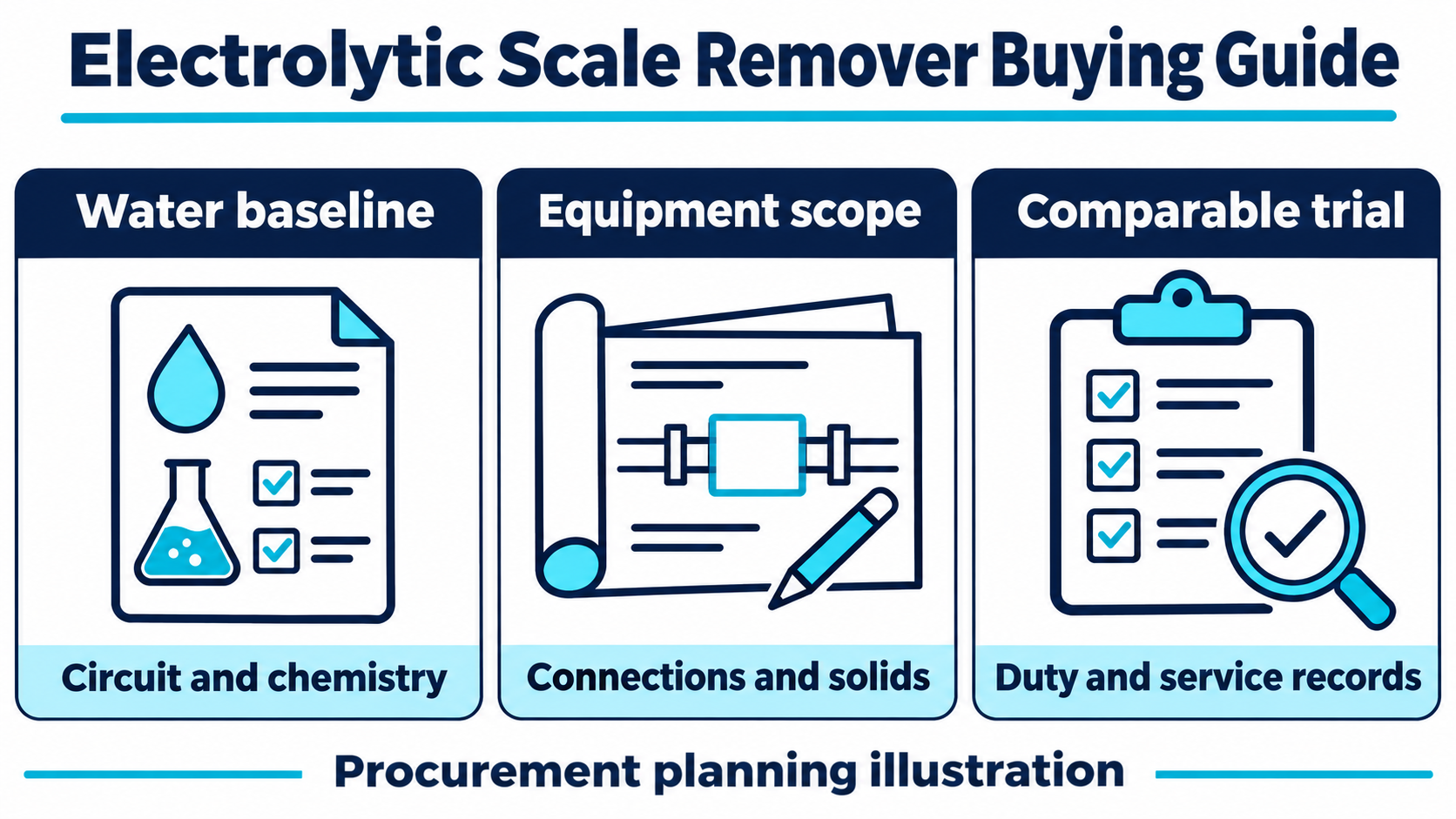
Electrolytic Scale Remover procurement illustration: water baseline, equipment scope, comparable trial. Concept illustration of the article's procurement checks: circuit and chemistry; connections and solids; duty and service records.
Compare the offered equipment and waste-handling scope
Request the treatment unit's supply boundary. Identify the side-stream piping, valves, electrical supply, monitoring, access, drain and solids collection. Ask the bidder to state its proposed flow and available head requirements for the connection, and identify who verifies them on the installed system. Where cooling operation must continue during service, agree how the treatment unit will be isolated within the site's approved design.
Ask the supplier to identify what residues are expected under the proposed conditions, who removes them and which records the facility needs for discharge or disposal review. Keep responsibility for corrosion and microbial control visible in the order. Where the site uses a wider treatment programme, confirm with the responsible engineer how the proposed device fits with it.
Define a trial that the operator can assess
Set the trial period, relevant operating cases, data sources, test locations and personnel. Use a baseline and follow-up under comparable duty. If makeup, load or other treatment changes during the test, record that change so the project team can evaluate its effect. Agree in advance who decides whether the results support continued use or a revised approach.
Request the actual installation and maintenance documents for the quoted configuration. Include access needs, service reminders, measurements the operator must retain and the record required after cleaning. Before quotation, send the circuit diagram, water analysis, load profile, deposit observations, proposed connection and trial success criteria. HELE electrolytic scale remover enquiries
Frequently asked questions
Is a single hardness result enough for sizing?
Use it as preliminary information. Provide the broader chemistry and operating history relevant to deposition and show how the recirculating water changes over the expected range.
Where should the side stream connect?
The project designer should select and approve the inlet and return. The supplier should state the offered connection conditions, and the site should verify them.
Who decides how collected solids are handled?
Assign a facility representative and the supplier's documentation responsibility. Use the measured or agreed waste description and the site's disposal process.
How should a trial compare maintenance effort?
Log the service activity, frequency, duration, collected material and any effect on cooling operation. Compare with the baseline over a similar operating period.
What utility records should the quote include?
Ask for the proposed side-stream flow, pressure loss, electrical boundary and drainage conditions, with the assumptions used.
Does the purchase also cover corrosion and microbial control?
Read the equipment scope alongside the facility's treatment plan. Agree who is responsible for each control objective and how the site will verify it.
Prepare a technical enquiry
Share the process or protected asset, operating conditions, geometry or drawing, and the scope you need reviewed.
Ask a technical question →
Project contact