
Electrochlorination Cell vs. Complete System: What Should the Quote Include?
Compare electrode assemblies, housed cells and complete electrochlorination systems using a shared quote and acceptance checklist.
Table of Contents
Ask every bidder to draw the same boundary around the equipment listed in its quote. An electrode assembly, a housed electrochlorination cell and a complete on-site generation package answer three different purchasing needs. Put the feed, electrical input, product outlet, gas handling and controls on one marked-up process drawing, then assign an owner and acceptance check to each connection.
This is especially useful when an EPC firm compares a cell retrofit with a packaged system. Both bids may mention the same generation duty. They can still leave the owner with different work at the plant, and different evidence for accepting it. Titanium electrolytic cells for electrochlorination · De Nora seawater electrochlorination systems
Start with the part of the plant you intend to buy
Electrode assembly. A replacement set fits inside an existing cell. Confirm the approved drawing, electrode geometry, terminal and insulation arrangement, coating duty, existing flow conditions and applicable inspection evidence. Identify service parts supplied with the assembly.
Housed cell. The cell includes a wetted housing and the electrochemical assembly within an agreed mechanical and electrical boundary. Ask for the inlet and outlet connections, terminals, seal arrangement, limits, maintenance access and the list of supplied instruments or fittings. A cell quote needs a defined interface to the plant’s feed, rectifier and controls.
Complete generation package. Define the package by explicitly listing the feed-conditioning, power conversion, generation, gas handling, measurement and controls that it includes. The discharge handover might be the generator outlet, a storage interface or a dosing connection. Treat buildings, utilities, site piping and downstream monitoring as explicit bid items even if they sit outside the package. On-site sodium hypochlorite generation systems
Compare quotes at the same connections
| Interface | Electrode or cell enquiry | Complete package enquiry | Evidence to agree |
|---|---|---|---|
| Feed | Confirm the electrolyte, operating envelope and connection or cell compatibility | Identify the incoming water or brine basis and the conditioning included | Water analysis, design feed conditions and marked-up process drawing |
| Electrical | Confirm existing DC requirements, terminals, mounting and insulation | Identify the AC handover, rectifier, power measurement boundary and interfaces | Electrical drawing, list of loads and agreed test method |
| Product and outlet | Agree the outlet connection and what cell-level testing can demonstrate | Specify output, concentration basis, sampling point and any storage or dosing included | Duty sheet, analysis method, measurement location and acceptance conditions |
| Gas handling | Identify what the existing plant provides and where the cell hands off | Identify included separation or vent interfaces, monitoring and responsible site parties | Approved safety design documents and an agreed function-test list |
| Controls | List signals and local instruments used with the existing system | List the control panel, instruments, communications, alarms and site tie-ins | I/O schedule, cause-and-effect responsibilities and witnessed checks |
| Documents and service | Confirm drawings, inspection scope and replacement parts | Confirm drawings, manuals, training and commissioning scope | Document register, scope exceptions and acceptance checklist |
Name the parties in the final responsibility column of your bid sheet. “By others” leaves room for a missing contract. Assign the EPC, owner, cell supplier, package supplier or nominated installer, and identify who verifies completion. Get signed resolution for any exception that changes scope or acceptance.
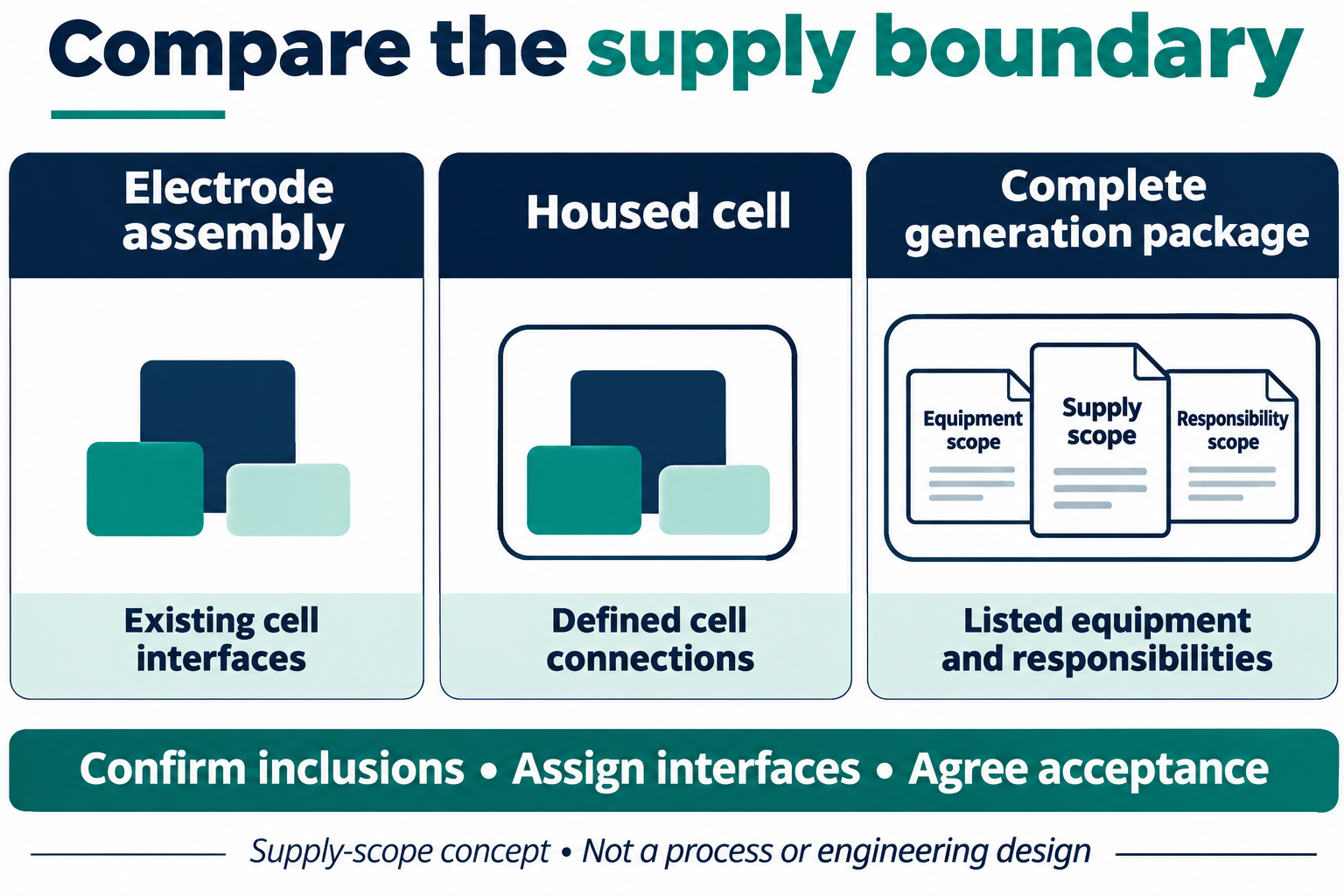
Abstract comparison of electrode assembly, housed cell and complete generation package procurement scopes. Supply-scope concept only, not a process or engineering design. Confirm the actual inclusions, interfaces and acceptance responsibilities in each quotation.
Specify the output where it will be measured
Write the required available-chlorine production on a stated basis and pair it with the concentration, feed conditions and operating point. Mark the sample on the drawing. If bidders use different concentration units or chemical bases, have them restate their guarantees on the agreed basis before comparing them.
A measurement at the generator outlet verifies the generator’s output under defined conditions. An outcome at the end of a treatment process also depends on dosing, water demand and the downstream system. Assign the sample locations and responsibilities separately, particularly if the bid stops upstream of storage or dosing. Generator output and downstream residual verification
Decide what is verified in the factory and at the site
Ask which tests can be run on the exact equipment being supplied. For a replacement assembly, inspection may center on drawings, identification and interface dimensions. For a housed cell, add the agreed assembly inspection and any pressure-boundary, electrical or functional tests in the contract. For a package, agree which controls, sample points and performance measures can be witnessed at the factory, and document the test feed and load.
Site checks cover installed utilities, connections and any performance or safety functions that depend on the installed equipment and actual feed conditions. If a factory test uses a different feed, name the conditions and record which performance checks remain open until site acceptance. Put a method, owner and release criterion next to each outstanding check.
Prepare one scope for all bidders
Send your process duty, water analysis, existing equipment drawings if applicable and the sample point where you need to verify output. Mark the boundaries for the supply and test responsibilities. With those inputs, HELE can review the equipment scope and identify which interfaces still need confirmation. Request a cell or package scope review
Frequently asked questions
Is a titanium electrode set the same as an electrolytic cell?
An electrode set is the electrochemical assembly. A housed cell adds the assembly’s mechanical and wetted interfaces. Ask the bidder to identify each supplied part on a drawing.
Is a rectifier normally part of a cell quote?
It depends on the bid boundary. For a retrofit, provide the existing rectifier data and ask the cell vendor to confirm the required operating window and protection interfaces. Add the rectifier explicitly when it belongs in the new supply.
Can I compare seawater and prepared-brine bids by rated output alone?
Compare them at an agreed output and measurement basis, then review the feed conditions, included conditioning, utilities and site interfaces. Each route may carry a different scope of work.
Should the supplier guarantee residual at the treatment outlet?
Only if the contract assigns the necessary downstream variables and verification to that supplier. For a generator-only package, define the generator outlet performance separately and assign residual verification to the responsible treatment team.
Who owns the gas-handling interface?
Assign it in the project documents. The package supplier can show its handover point and supplied functions, and the project’s responsible design team can confirm the installed arrangements and acceptance checks.
What should I send if I only want to replace the electrodes?
Send the cell drawing and revision, existing fittings and terminals, electrolyte and operating conditions, and any relevant inspection history. Ask which tolerances and records the quote will cover before approving manufacture.
Prepare a technical enquiry
Share the process or protected asset, operating conditions, geometry or drawing, and the scope you need reviewed.
Ask a technical question →References

Project contact