
BDD Electrode Buying Guide
Buy a boron-doped diamond (BDD) electrode against a defined electrochemical task and a representative test.
Table of Contents
Buy a boron-doped diamond (BDD) electrode against a defined electrochemical task and a representative test. The order should name the substrate and coating construction, the exposed working area, the electrical and liquid interfaces, and the evidence that allows the electrode or assembled cell to be accepted.
Establish what the trial must prove
Describe the target reaction, the actual feed and the required result. For an oxidation project, give a representative composition range and identify which treated-stream measurements, including any relevant by-products, the process owner will review. Supply the operating profile, treatment objective and existing reactor data. Ask the bidder to state what feed and conditions its evidence represents and which variations need further evaluation.
Review a BDD proposal alongside the other technologies the process owner considers. Compare measured outcomes at the same treatment boundary, then account for energy, maintenance and replacement assumptions. A laboratory result on a model solution can help design a trial. A project decision requires evidence on the actual or justified representative matrix.
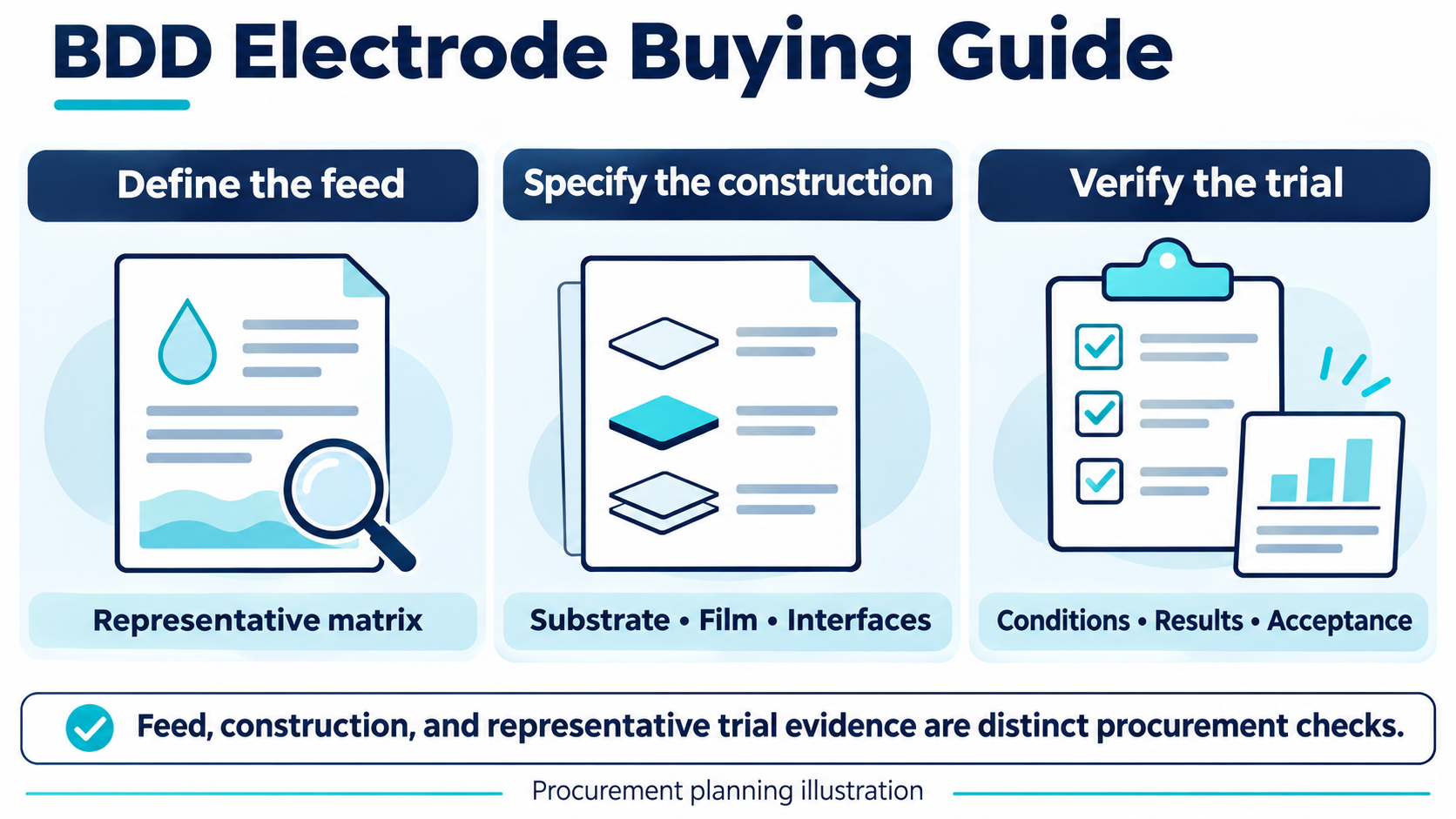
BDD electrode procurement illustration covering representative feed, substrate and film construction, and trial acceptance evidence. Concept illustration: define the representative feed, offered construction and trial acceptance basis before comparing BDD electrode proposals.
Approve the diamond-film construction and electrode interfaces
Ask the bidder to identify the substrate, film construction, available geometry and areas of exposed substrate. Mark the active faces, masked zones, edges and electrical connection on the approved drawing. Establish how the area is calculated if the purchase specification compares current density. For a module or cell, document who supplies headers, supports, seals, electrical distribution and monitoring.
Ask what verifies each film characteristic. For example, a spectral report and a thickness measurement answer different questions. Agree how the inspected region or sample relates to the supplied geometry and lot. Carry any proposed change in substrate, film route, geometry or connection through the approved review process.
Qualify the offered configuration before scale-up
Set the pilot boundary with project engineering. Identify the flow or batch condition, defined operating period, input and output measurements, relevant utility and maintenance records, and the end condition used to evaluate each run. If a production design will use a different area, flow distribution or support arrangement, have the supplier identify what must be verified at that scale.
For receiving, request the approved drawing, identification and agreed film or dimensional records. Assign who accepts the electrode, who verifies installation and who reviews treatment results. Keep replacement and cleaning responsibilities in the operating plan for the specific cell. HELE BDD electrode enquiries
Frequently asked questions
Can a successful laboratory run qualify an industrial cell?
Use it to support the trial design. Identify differences in feed, area, flow and operating duty, and assign verification at the intended scale before approval.
What counts as the electrode's working area?
Identify the faces and zones exposed to the process, then document the area convention on the drawing. Use that same convention whenever current density is reported.
What should be stated about the substrate?
Ask for the material, delivered form, interfaces and any design restrictions affecting exposed areas. Record how the substrate is identified in lot documents.
Does a spectral result establish film thickness?
It documents the property determined by the agreed spectral method. If the order also specifies thickness, name a suitable thickness method, location and acceptance rule.
How can a buyer compare electrode life claims?
Compare the configuration, feed, duty, failure criterion and evidence. Ask which part of the result is applicable under the proposed service.
What goes in the first enquiry?
Send the feed analysis, target result, intended operating schedule, reactor boundary or interface drawing and the measurements your team needs for trial acceptance.
Prepare a technical enquiry
Share the process or protected asset, operating conditions, geometry or drawing, and the scope you need reviewed.
Ask a technical question →
Project contact